
The Challenge: Building a Platform That Shouldn't Have Been Possible
The SRKMB (Sri Ramakrishna Mission Boys’ Home) Old Students’ Association is a non-profit alumni organisation dedicated to expanding educational opportunity for students preparing for Indian government competitive examinations, particularly those from rural and semi-urban communities who lack access to quality coaching resources.
Their vision was ambitious: a custom adaptive learning platform called Udbodhanam (Sanskrit for “awakening”), built not just as an exam tool but as a comprehensive career-guidance ecosystem. The platform needed to:
- Guide students from self-assessment to job eligibility through a career pathfinding engine that maps individual profiles to government job opportunities.
- Develop 46 measurable competencies aligned with NSQF (National Skills Qualifications Framework) standards, India’s benchmark for workforce skill certification.
- Deliver content in three languages — Kannada, Hindi, and English — from day one, serving students across linguistic regions.
- Help students understand not just what the right answer is, but why wrong answers seem convincing, through an analytical feature called Viveka Deep (named after the Sanskrit concept of discriminative intelligence), which deconstructs the reasoning traps embedded in exam questions.
- Comply fully with India’s DPDP Act (Digital Personal Data Protection Act), including AES-256 field-level encryption, data residency controls, and guardian-consent workflows for minor students.
A conventional technology assessment put the build timeline at eight months and recommended adopting an off-the-shelf LMS (Learning Management System) like Moodle or WordPress-based solutions instead. But off-the-shelf platforms would have delivered only a fraction of the required functionality: no Pathfinder engine, no Viveka Deep trap analysis, no DPDP-compliant architecture, and no multilingual scaffolding built for scale.
The real challenge: Deliver a first-of-its-kind, compliance-grade, multilingual learning platform with a team of 3 developers and 1 architect, and do it in a fraction of the expected time.
Why AI Coding Tools Alone Weren't the Answer?
The team had access to powerful AI coding assistants tools like Claude Code and GitHub Copilot that can generate production-ready code at remarkable speed. But speed alone wasn’t the bottleneck.
Across a 3-month development cycle spanning 265+ commits, multiple branches, and parallel workstreams across 4+ epics, the real risk was loss of context, not execution speed.
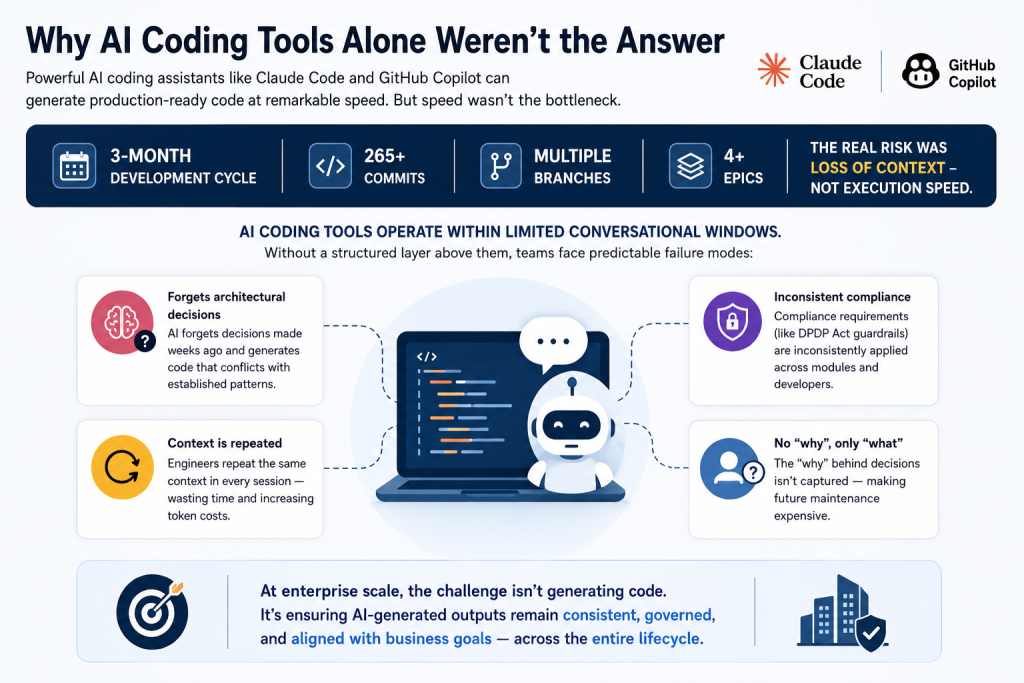
AI coding tools operate within limited conversational windows. Without a structured layer sitting above them, teams encounter predictable failure modes:
- The AI forgets architectural decisions made two weeks ago and generates code that conflicts with established patterns.
- Engineers repeat the same context in every session, wasting time and increasing token costs.
- Compliance requirements (like DPDP Act guardrails) are inconsistently applied across different modules built by different developers.
- No one captures the “why” behind decisions — only the “what” — making future maintenance expensive.
At enterprise scale, the challenge isn’t generating code. It’s ensuring that AI-generated outputs remain consistent, governed, and aligned with business goals across the entire lifecycle.
The Solution: BMAD + Aykan Orchestration Layer
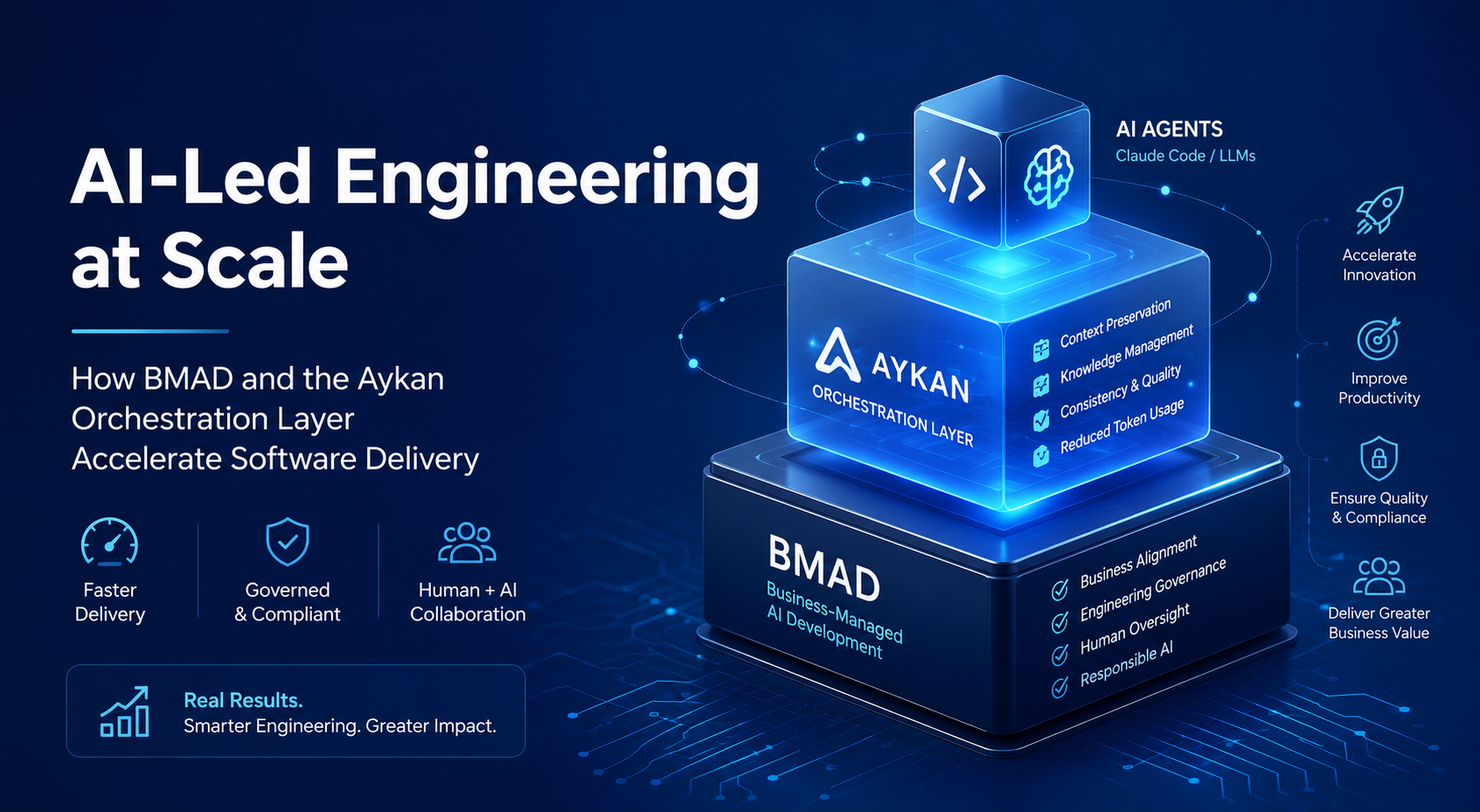
Udbodhanam was delivered using two complementary frameworks that Aykan deploys together for complex AI-driven engineering engagements.
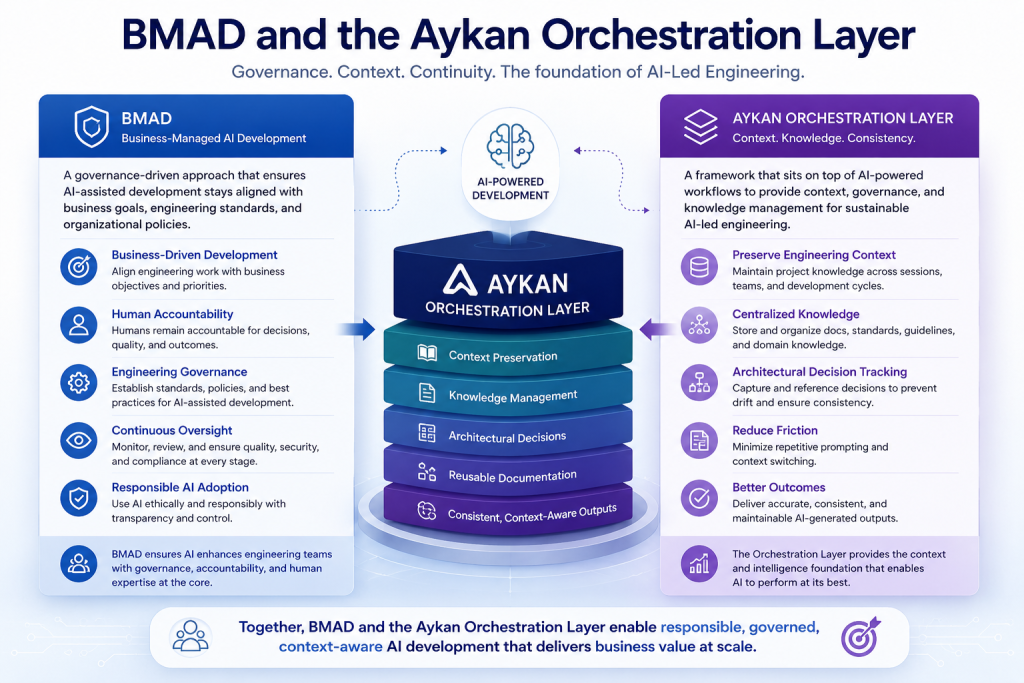
BMAD — Breakthrough Method for Agile AI-Driven Development
BMAD is a governance methodology that keeps AI-assisted development anchored to business intent. It ensures that every engineering decision connects back to a product requirement, that humans remain accountable for quality and compliance, and that development is structured around well-defined epics, user stories, and acceptance criteria, not improvised around what the AI can generate.
For Udbodhanam, BMAD provided:
- A structured PRD (Product Requirements Document) and system architecture derived from the raw product vision.
- Epic and user-story breakdown across Pathfinder, adaptive diagnostics, multilingual delivery, and DPDP compliance modules.
- Clear acceptance criteria that AI agents used as the definition of “done” — enforced during development, not audited after.
The Aykan Orchestration Layer
The Orchestration Layer is the technical execution engine that sits on top of BMAD and coordinates AI agents across the delivery lifecycle. It has three categories of agents working in concert:
Planning Agents
Converted the product vision into detailed specifications, PRDs, system architecture documents, epics, and user stories with explicit acceptance criteria. Development always started from precise intent, not assumptions.
Development Agents
Implemented each user story end-to-end, generating production-ready NestJS backend code, Prisma database migrations, React frontend components, API layers, i18n (internationalisation) structures for multilingual delivery, and DPDP-compliant data handling modules.
Review & Validation Agents
Continuously evaluated outputs for correctness, compliance, and alignment with requirements. DPDP guardrails, workflow integrity, and architectural consistency were enforced in real time, not in a post-release audit.
The Differentiator: Aykan's Coding-Agent Memory System
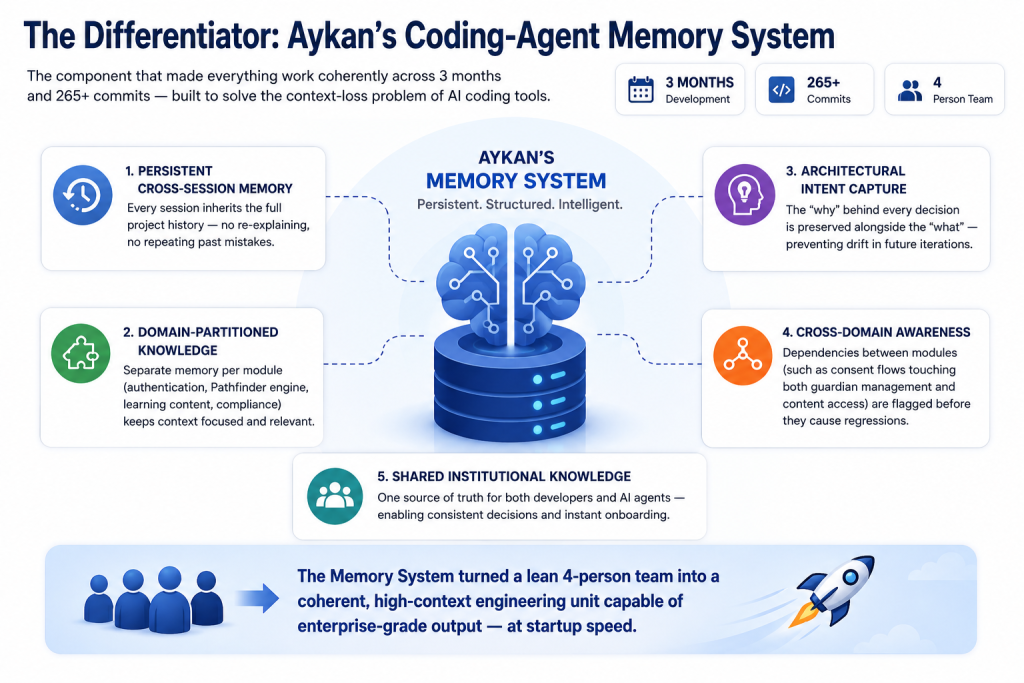
The component that made everything work coherently across 3 months and 265+ commits was Aykan’s Memory System, a persistent, structured knowledge layer built specifically to address the context-loss problem of AI coding tools.
The Memory System provided:
- Persistent cross-session memory: Every session inherited the full project history no re-explaining, no repeating past mistakes.
- Domain-partitioned knowledge: Separate memory per module (authentication, Pathfinder engine, learning content, compliance) kept context focused and relevant.
- Architectural intent capture: The “why” behind every decision was preserved alongside the “what” — preventing drift in future iterations.
- Cross-domain awareness: Dependencies between modules (such as consent flows touching both guardian management and content access) were flagged before they caused regressions.
- Shared institutional knowledge: One source of truth for both developers and AI agents enabling consistent decisions and instant onboarding.
Recommended Blog: Building a Scalable Cloud & DevOps Foundation for a Digital Platform
In short: The Memory System turned a lean 4-person team into a coherent, high-context engineering unit capable of enterprise-grade output at startup speed.
The Results
Using the Aykan Orchestration Layer and BMAD, the team successfully delivered a fully custom, enterprise-grade platform in approximately three months.
Key outcomes included:
| Area | Result |
|---|---|
| Delivery Timeline | 3 months (vs. 8-month conventional estimate — a 63% reduction) |
| Team Size | 3 developers + 1 architect |
| Platform Complexity | 30+ user stories across 4+ epics, 265+ commits |
| Cost Efficiency | Enterprise-grade platform delivered at small-team cost |
| Compliance | DPDP Act-compliant from day one — encryption, data residency, guardian consent |
| Student Access | Multilingual platform (Kannada, Hindi, English) expanding access to rural and semi-urban aspirants |
Beyond the metrics, the platform’s real impact is in what it enables: students from rural districts who previously had limited access to quality government exam preparation can now engage with a multilingual, adaptive, career-mapped learning experience, one that was built specifically for them, compliant with India’s data protection regulations, and designed to scale.
What Does This Mean for ISVs and Enterprise Engineering Teams?
The Udbodhanam project is not an isolated case study. It is a demonstration of a repeatable model.
For ISVs and enterprise software teams facing pressure to deliver faster without sacrificing quality, the lesson is clear: AI coding tools are not the ceiling, they are the floor. The teams that pull ahead are the ones that layer governance, context management, and structured orchestration on top of AI generation.
The combination of BMAD and the Aykan Orchestration Layer makes that possible without requiring a large team, an extended timeline, or a wholesale reengineering of how your development organisation works.
The future of AI-led engineering: It is not about generating more code. It is about generating the right code consistently, sustainably, and aligned with what your business actually needs to deliver.
Conclusion
AI-powered development tools can significantly accelerate software delivery, but long-term success requires governance, context preservation, and human oversight. The Udbodhanam project demonstrates how BMAD and the Aykan Orchestration Layer enabled a lean team of three developers and one architect to deliver a complex, enterprise-grade platform in just three months.
For ISVs and enterprise teams, the future of AI-led engineering is not simply faster coding, it is combining AI, governance, and institutional knowledge to deliver high-quality software at scale.
FAQ's
1. What is AI-led engineering?
AI-led engineering is the practice of integrating AI tools and intelligent agents into the software development lifecycle to assist with activities such as coding, testing, documentation, architecture reviews, and knowledge management. It helps teams improve productivity while maintaining engineering quality.
2. How is AI-led engineering different from using AI coding tools?
AI coding tools focus primarily on generating code, whereas AI-led engineering combines AI with governance, context management, architectural oversight, and structured delivery processes to ensure sustainable and maintainable software development.
3. What is BMAD?
BMAD(Breakthrough Method for Agile AI-Driven Development) is a governance-driven approach that ensures AI-assisted development remains aligned with business objectives, engineering standards, compliance requirements, and organizational policies. It keeps human accountability and oversight at the center of software delivery.
4. What is the Aykan Orchestration Layer?
The Aykan Orchestration Layer is an internal framework that sits on top of AI-powered development workflows. It preserves project context, architectural decisions, documentation, and engineering knowledge, enabling AI systems to generate more consistent, accurate, and context-aware outputs.
5. Is this approach available for our organization?
Yes. Aykan deploys the BMAD + Orchestration Layer combination for ISV and enterprise clients with complex software delivery requirements. If you are navigating a build that feels too large for your team’s timeline, we would be glad to explore how this model applies to your context.