

Introduction
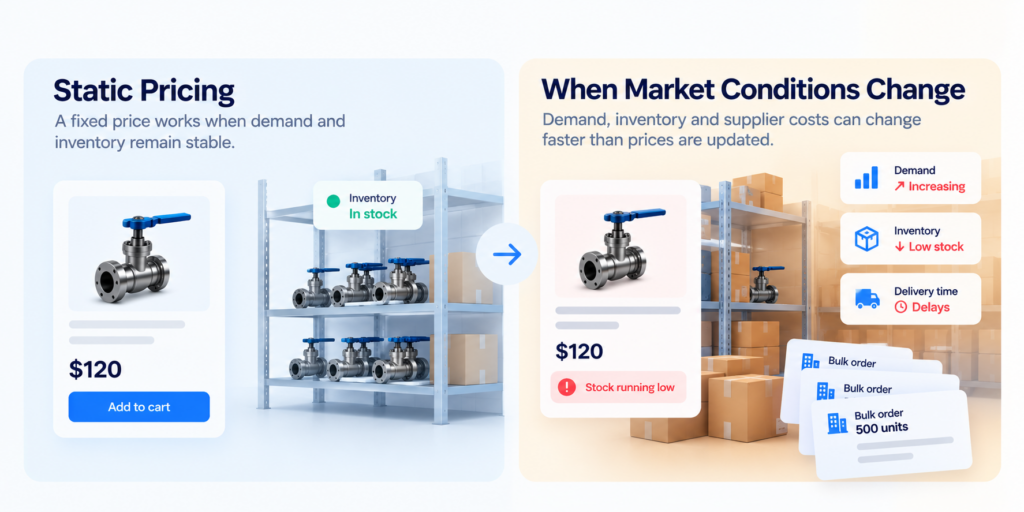
Imagine a buyer looking to purchase 500 units of a specialised industrial component. The product is listed at a competitive price, but a few days later, demand increases, supplier inventory drops, and delivery timelines change. The listed price, however, remains the same.
This is where static pricing can become a challenge for niche B2B marketplaces. Fixed prices and manual updates may work when demand is predictable, but they become harder to manage as inventory, supplier costs, and order volumes fluctuate.
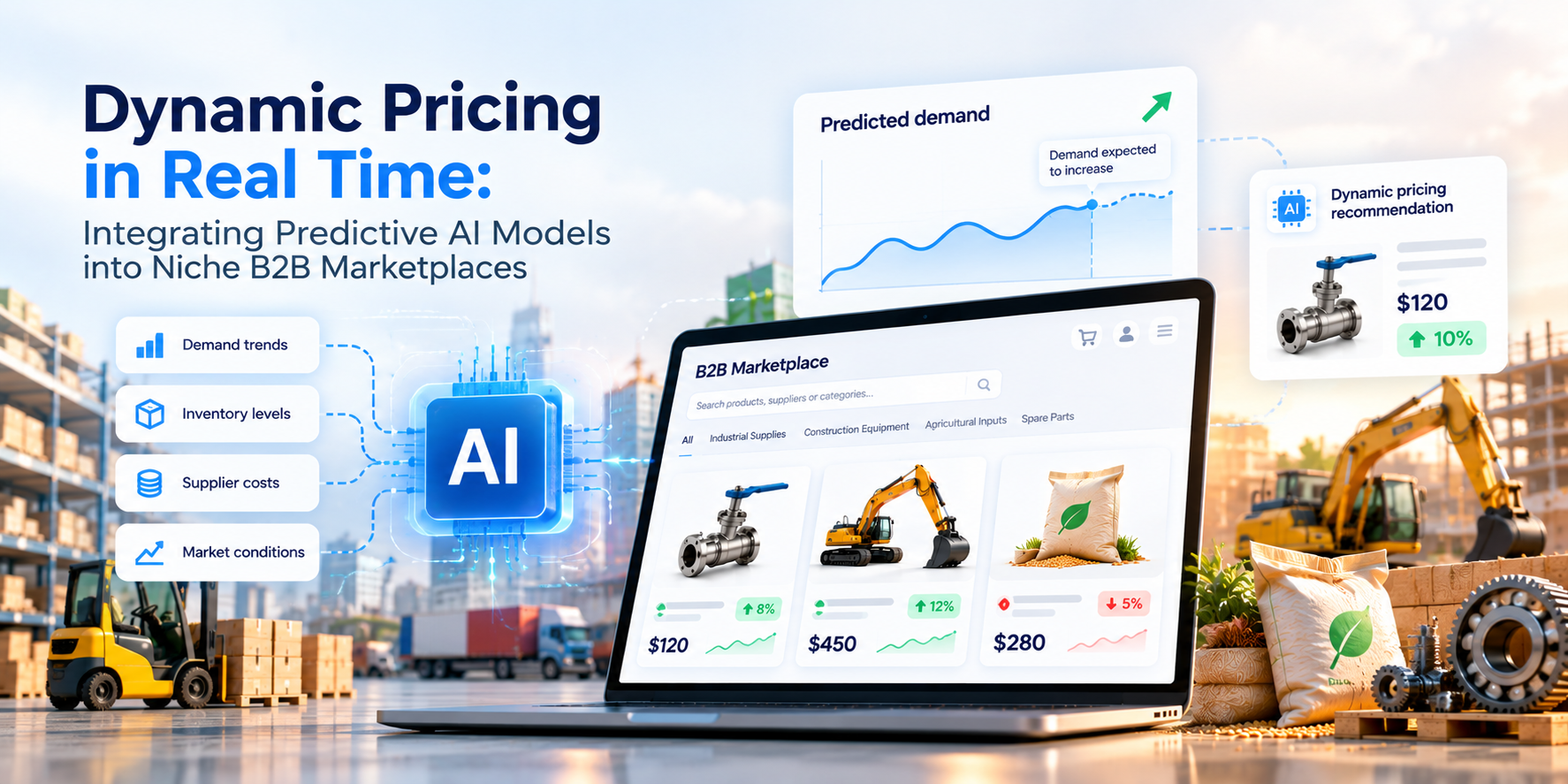
Predictive AI can help marketplaces anticipate these changes and make more informed pricing decisions. By combining demand forecasts with inventory data and predefined business rules, marketplaces can respond to changing conditions without relying entirely on manual price adjustments.
In this article, we explore how predictive AI works with dynamic pricing, what businesses need to consider when implementing it, and how B2B marketplaces can introduce it in a practical way.
The Limits of Static Pricing
Static pricing is not necessarily a problem. If product costs remain stable and demand is predictable, a fixed price may be all a marketplace needs.
The challenge begins when market conditions change faster than the catalog can be updated.
Consider a marketplace connecting manufacturers with suppliers of specialised machine parts. One supplier has plenty of stock, while another is running low on the same product. At the same time, several buyers are placing larger-than-usual orders.
If the marketplace relies entirely on fixed prices, it may struggle to respond to these changes. Suppliers may miss opportunities to sell available inventory, buyers may face stock shortages, and administrators may spend considerable time coordinating price updates.
The same challenge appears in other niche markets:
Equipment rentals: Demand varies depending on location, project schedules, and equipment availability.
Agricultural supplies: Seasonal demand can affect product availability and procurement costs.
Industrial materials: Supplier prices, order quantities, and delivery costs can change over short periods.
Wholesale marketplaces: Bulk orders and negotiated discounts make it difficult to apply one price to every buyer.
In these situations, pricing is connected to much more than the product itself. It depends on what is available, who is buying, how much they need, and when they need it.
Predictive AI and Dynamic Pricing
Dynamic pricing adjusts prices according to changing conditions. Predictive AI adds the ability to anticipate those conditions rather than simply react after they occur.
For example, a marketplace may use historical orders, current inventory, supplier lead times, and seasonal patterns to estimate which products are likely to experience higher demand.
The system can then use these predictions to recommend pricing adjustments or trigger approved changes through predefined business rules.
It helps to separate two important functions:
Predictive AI forecasts demand. It identifies patterns, estimates future purchasing activity, and highlights potential inventory constraints.
The pricing engine applies business rules. It considers supplier costs, minimum margins, contract terms, order quantities, and other restrictions before recommending or applying a price change.
This distinction matters. A forecast showing increased demand should not automatically result in a higher price. The marketplace must also consider supplier costs, available alternatives, customer agreements, and the commercial impact of the decision.
The goal is to make pricing decisions more informed, not simply more frequent.
How Real-Time AI Pricing Works
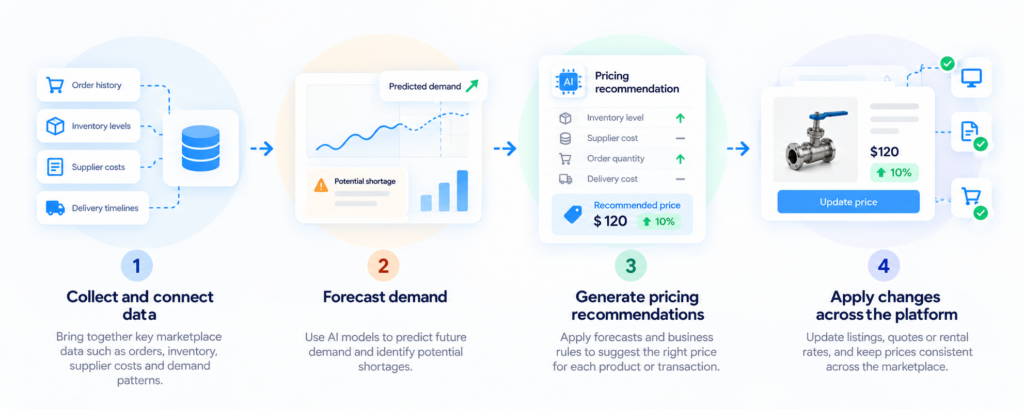
A real-time pricing system connects marketplace data, demand forecasting, commercial rules, and transaction workflows. The process can be broken into four stages.
Step 1: Collect and connect marketplace data
The system first needs reliable information about the factors that influence pricing.
Depending on the business model, this may include:
-
Historical orders and quote requests.
-
Current inventory and supplier lead times.
-
Supplier costs and delivery expenses.
-
Order quantities and repeat purchasing patterns.
-
Seasonal demand and product availability.
Example: A distributor notices that a particular replacement component is frequently ordered in bulk near the end of each quarter. If the marketplace has complete order and inventory records, the model can use this pattern to help forecast future demand.
Data quality is critical. If one supplier’s inventory updates every few minutes while another’s updates only once a day, the system may make recommendations using inconsistent information. Product records that use different identifiers for the same component can create similar problems.
Before introducing predictive pricing, marketplace operators should establish reliable product data, inventory updates, and transaction records.
Step 2: Forecast demand and identify potential shortages
Once the relevant data is available, predictive models can estimate future demand and identify patterns that may not be obvious from current sales alone.
Example: A construction materials marketplace sees an increase in quote requests for a particular grade of steel. Historical orders suggest that similar increases have preceded periods of limited availability.
Rather than waiting for stock levels to fall, the platform can alert suppliers, highlight products that may become difficult to source, and prepare pricing recommendations for review.
Forecasts are estimates, not guarantees. Unexpected projects, cancelled orders, transport delays, and supply disruptions can change the outcome.
Marketplace operators should therefore compare forecasts with actual demand and monitor forecast accuracy over time.
Step 3: Generate pricing recommendations
The pricing engine uses demand forecasts alongside commercial rules to determine whether a price adjustment makes sense.
It may consider supplier costs, minimum margins, stock levels, order quantities, delivery expenses, and negotiated customer prices.
Example: A supplier has 800 units of a component in stock but expects demand for only 300 units over the next month. The supplier may choose to offer a volume discount to encourage larger orders.
Another supplier has only 100 units available and faces a long replenishment period. That supplier may prefer to maintain the current price and restrict the quantity available for immediate purchase.
The system should support both strategies rather than applying the same adjustment to every listing.
Pricing rules can also set minimum margins, maximum permitted changes, and approval requirements. These controls help ensure that a demand forecast does not override the supplier’s commercial strategy.
Step 4: Apply approved changes across the marketplace
Once a recommendation has been evaluated, the resulting price needs to reach the appropriate part of the platform.
This may involve updating a product listing, generating a revised quote, recalculating a rental rate, or displaying a price during checkout.
Integrations can connect the pricing engine with supplier catalogs, inventory systems, and transaction workflows. The platform should maintain consistency between the price shown to a buyer and the amount charged at checkout.
B2B transactions require additional care. If a buyer has received a quote valid for seven days, for example, the platform should respect that commitment instead of unexpectedly changing the agreed price midway through the process.
Real-time pricing does not mean prices must change every second. It means the marketplace can respond to relevant changes at a pace appropriate to its business model.
Where Predictive Pricing Helps
The usefulness of predictive pricing depends on the marketplace’s products, purchasing patterns, and existing pricing model.
Industrial supplies and spare parts
Predictive models can help identify products likely to experience increased demand and highlight potential shortages before they affect purchasing decisions. Combined with supplier-approved pricing rules, these insights can support volume discounts, inventory planning, and the identification of alternative suppliers.
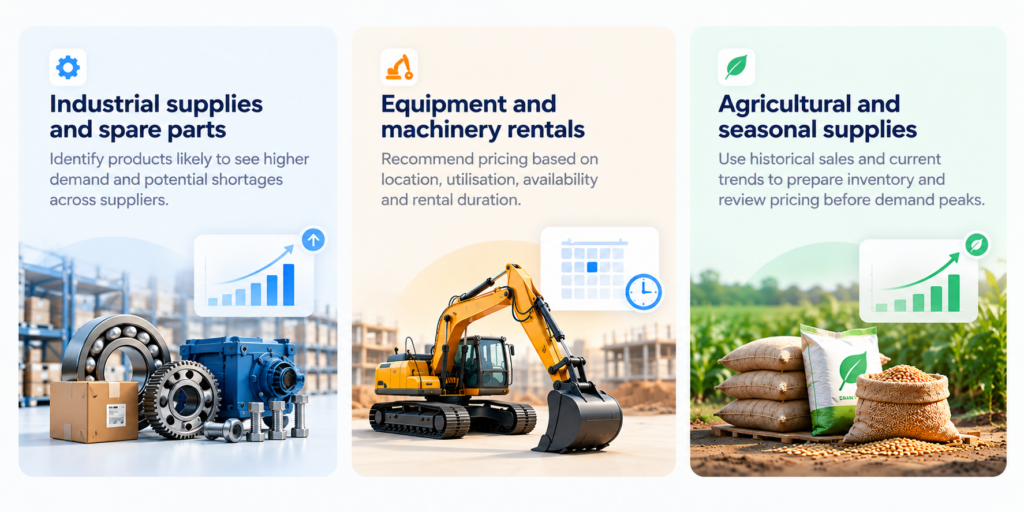
Equipment and machinery rentals
For rental marketplaces, availability depends on both time and location.
Equipment may be in high demand at one location while sitting unused at another. Demand forecasting can help operators assess expected utilisation and make more informed decisions about rental rates, rental duration, and equipment allocation.
Agricultural and seasonal supplies
Agricultural inputs and other seasonal products often follow recurring demand patterns.
By analysing historical sales and current purchasing activity, predictive models can help suppliers prepare inventory ahead of expected demand peaks. Better forecasting may also reduce last-minute procurement and help businesses maintain product availability.
In each case, the benefit comes from connecting demand insights to actual business decisions, not from increasing or decreasing prices automatically whenever a forecast changes.
Key Considerations for AI Pricing
Predictive pricing requires more than an AI model. The system must account for commercial relationships, operational constraints, and the expectations of buyers and suppliers.
Protect existing agreements
B2B buyers frequently negotiate prices based on order volumes, long-term relationships, or annual contracts. Automated pricing must recognise these arrangements and prevent agreed prices from being unintentionally overwritten.
Example: A buyer has negotiated a fixed rate for the next six months. A general marketplace pricing update should not silently replace that rate with a demand-based price.
Keep pricing transparent
Buyers need to plan procurement budgets, obtain internal approvals, and understand the terms of a purchase.
Marketplaces should clearly communicate applicable discounts, quote validity, delivery charges, and purchasing conditions. If a price changes before an order is confirmed, buyers should be able to understand why.
Give suppliers appropriate control
Not every supplier will want the same level of automation.
Some may prefer to review every recommendation, while others may approve automatic changes within predefined limits.
A supplier selling standard consumables may accept small adjustments within an agreed range. A supplier providing specialised equipment under negotiated contracts may require manual approval for every change.
The platform should support the level of control appropriate to each supplier and transaction type.
Monitor performance and retain oversight
A model that performs well under one set of market conditions may become less reliable as demand patterns change.
Marketplace operators should monitor a combination of commercial and operational measures:
- Gross and contribution margins: Are pricing decisions supporting profitability after relevant costs?
- Purchase conversion rate: Are more buyers completing purchases after pricing changes?
- Inventory turnover and stockout frequency: Is stock moving more efficiently, and are shortages becoming less frequent?
- Forecast accuracy: How closely do predictions match actual demand?
- Supplier participation: Are suppliers continuing to list products and accept orders?
- Buyer retention and complaints: Are pricing changes affecting trust or repeat purchasing?
These measures should be compared against a baseline established before the pilot. A rise in revenue alone does not prove that a pricing system is performing well if margins are falling or suppliers are leaving the marketplace.
Automation should reduce repetitive work and improve decision-making without removing accountability.
Getting Started with AI Pricing
Moving directly to a fully automated pricing system is rarely the best first step.
A more practical approach is to begin with one product category, supplier group, or region.
Start by identifying a clear objective. Perhaps suppliers spend too much time updating prices manually, inventory frequently becomes unavailable, or the marketplace struggles to respond to changes in demand.
Next, review the available data and establish a baseline against which results can be measured. A pilot can then generate pricing recommendations for review before the marketplace begins applying changes automatically.
Useful measures include:
-
Gross and contribution margins.
-
Purchase conversion rates.
-
Inventory turnover and stockout frequency.
-
Supplier participation and satisfaction.
-
Demand forecast accuracy.
-
Buyer retention and pricing-related complaints.
This gives businesses a way to test the commercial value of predictive pricing before committing to a more extensive implementation.
Building More Adaptive Marketplaces
For niche B2B marketplaces, pricing is closely connected to inventory availability, supplier relationships, order volumes, and purchasing commitments. Managing these factors through fixed prices and manual updates can become increasingly difficult as the marketplace grows.
Predictive AI can help operators anticipate changes in demand and make better-informed pricing decisions. But the value of the technology depends on how well forecasts are connected to business rules, existing agreements, and everyday transaction workflows.
The most effective approach is not necessarily the most automated one. It is the one that helps buyers and suppliers make informed decisions while keeping pricing consistent, transparent, and commercially practical.
As marketplace technology evolves, the challenge will be to make pricing more responsive without making the purchasing experience more complicated.