


Introduction
Most booking platforms are designed around the assumption that people book trips a few weeks or months before they travel. That works well for hotels, holiday rentals, and short city breaks, where reservations are typically made close to the travel date. Motorhome travel, however, follows a very different pattern. Families often book summer road trips during the winter, festival-goers reserve vehicles months before the event, and extended adventures across Europe are frequently planned a year or even two years in advance. For a marketplace like GoGallivanting, supporting this type of customer behaviour wasn’t just a nice-to-have, it was essential.
GoGallivanting is built on Sharetribe with Stripe handling marketplace payments, a combination that provides a solid foundation for peer-to-peer rentals. However, like many marketplace platforms, it comes with a practical limitation: bookings are typically capped at around 90 days in advance. While that restriction works for most marketplaces, it creates a significant challenge for motorhome rentals, where long-term planning is the norm.
This article explores why that limit exists, why simply increasing it isn’t an option, and how redesigning the payment flow enabled bookings up to two years in advance while keeping the payment process secure, compliant, and seamless for both guests and hosts.
Understanding the Real Problem
When we first encountered Sharetribe’s 90-day booking limit, it looked like a straightforward platform restriction. The obvious assumption was that the booking window simply needed to be extended.
However, after investigating how Sharetribe and Stripe handle marketplace transactions, we discovered that the limitation wasn’t actually about bookings, calendars, or availability.
The real challenge was the payment lifecycle behind every booking.
| What We Initially Thought | What We Discovered | Why It Matters |
|---|---|---|
| The 90-day limit was a booking setting issue. | It was linked to the payment flow, not the calendar. | Increasing the booking window required a payment solution, not a configuration change. |
| The calendar couldn't support future bookings. | Availability was not the problem, the payment lifecycle was. | The challenge was handling payments responsibly for long-term bookings. |
| We just needed to extend Sharetribe's booking period. | We needed to redesign how payments moved between guests, the platform, and hosts. | Long-term bookings required a different financial workflow. |
| Sharetribe was the limitation. | The restriction came from how Stripe marketplace payments and payouts work. | Customer funds cannot remain tied to undelivered services for long periods. |
| We had a booking problem. | We had a payment architecture problem. | The solution needed to focus on payment handling, not booking availability. |
Why This Was a Business Problem, Not Just a Technical One?
A 90-day booking limit might seem reasonable from a technical perspective, but for a motorhome rental marketplace, it directly impacts how customers plan their trips. Motorhome holidays are often organised months or even years in advance. Families book summer trips during the winter, travellers reserve vehicles for festivals well ahead of time, and long-distance road trips are carefully planned around availability.
Without the ability to make advance bookings, customers may delay their plans or choose another platform that allows them to reserve vehicles earlier. Hosts are affected too, as many rely on early bookings to predict future income, manage vehicle availability, and prepare for busy travel periods.
The limitation was therefore more than a platform constraint; it was preventing the marketplace from supporting real customer behaviour and limiting potential business growth.
The First Attempt: Solving the Wrong Problem
Our first approach focused on the most obvious issue: calendar availability. The idea was simple, if customers couldn’t officially book a motorhome far into the future, we could reserve those dates on the calendar to prevent double bookings and protect future availability.
Technically, it worked. Future dates were successfully blocked, but the actual booking problem remained. Customers still couldn’t complete long-term reservations because the payment flow had not changed. The platform was still designed around hosts receiving payment shortly after a booking was confirmed, which works well for short-term bookings but not for reservations made 12 or 24 months in advance.
We had solved the availability problem, but not the payment problem. This helped us identify the real limitation: the booking calendar was never the blocker—the payment architecture was.
Rethinking the Payment Flow
Once we understood the real constraint, we changed our approach. Instead of asking, “How do we extend the booking window?”, we asked, “Does the host need to receive the payment immediately?”
The answer was no. The host only needs payment when the rental actually begins.
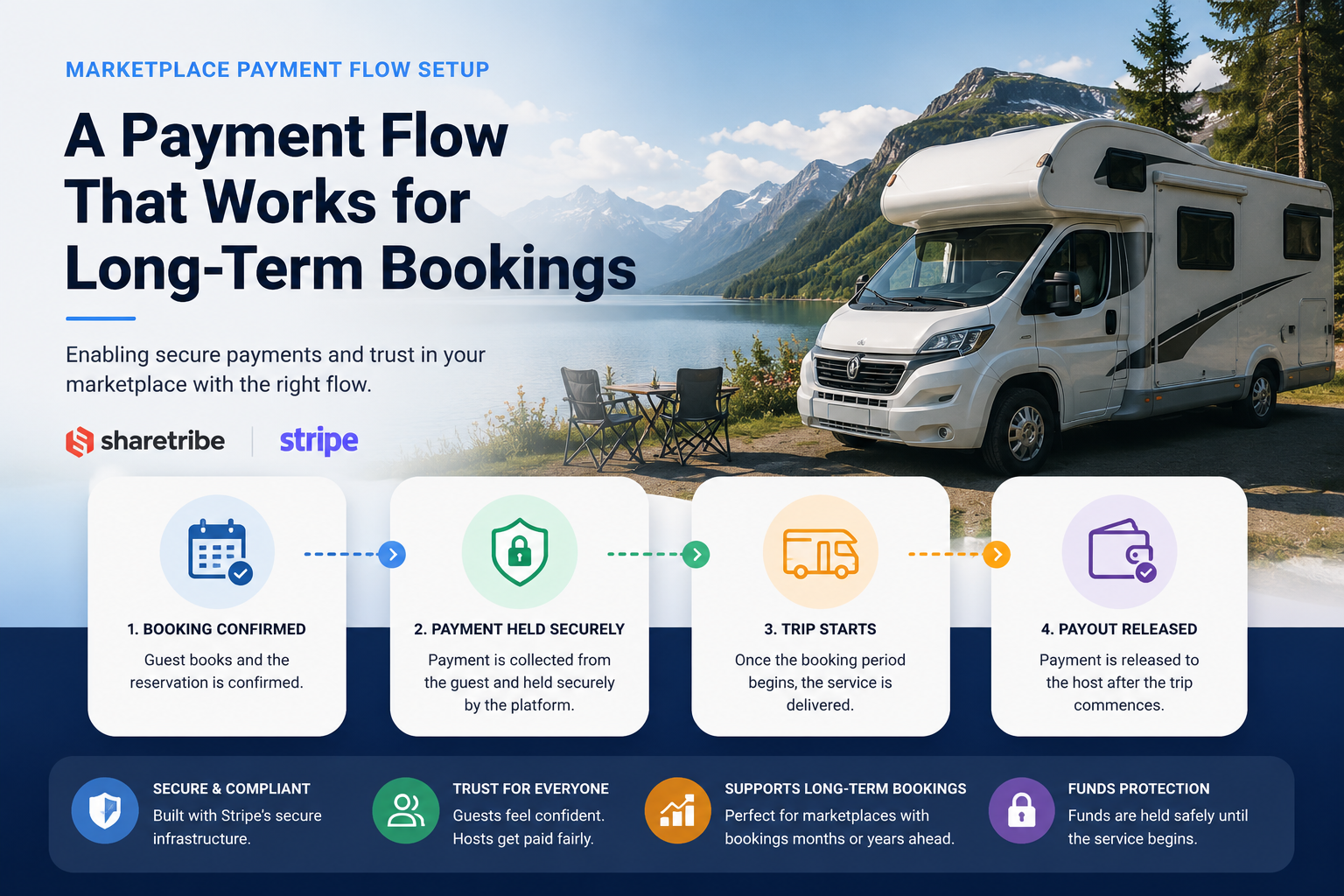
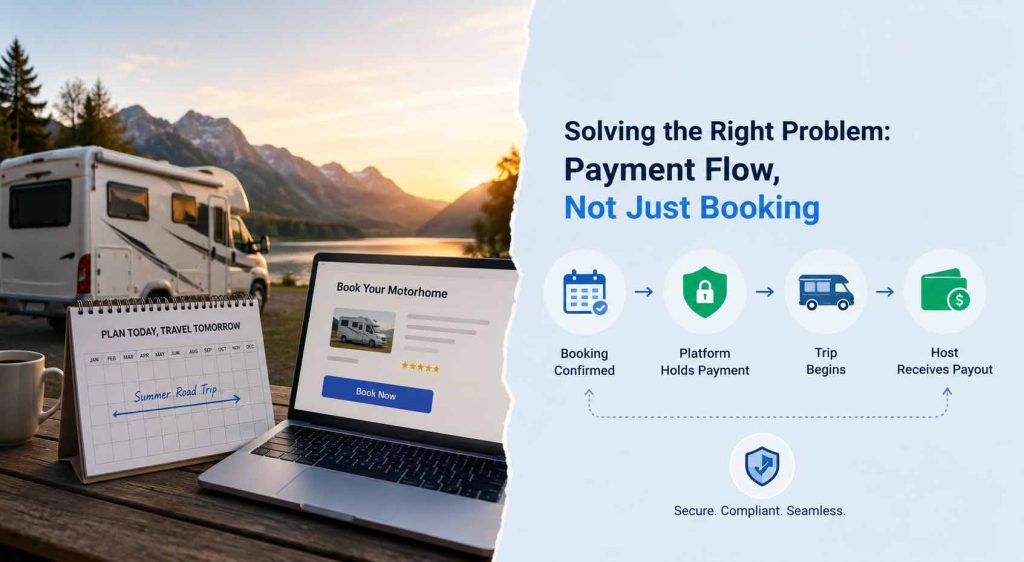
So, we redesigned the long-term booking flow. Instead of sending payment directly to the host at the time of booking, the platform would securely hold the funds until the trip started.
This aligned the payment timeline with the service timeline:
Booking confirmed → Platform holds payment → Trip begins → Host receives payout
The solution wasn’t about changing the booking limit—it was about creating a payment flow that made long-term bookings possible.
The Solution: Introducing a Dedicated Long-Booking Workflow
Rather than trying to modify the existing booking process, we introduced a separate workflow specifically designed for long-term reservations.
Keeping this flow independent from standard bookings helped us avoid adding unnecessary complexity to the existing system. Regular bookings continue to follow the standard Sharetribe and Stripe flow, while long-term bookings follow their own payment lifecycle designed to handle reservations made months or even years in advance.
The goal was simple: keep the customer experience familiar while changing the way payments are handled behind the scenes.
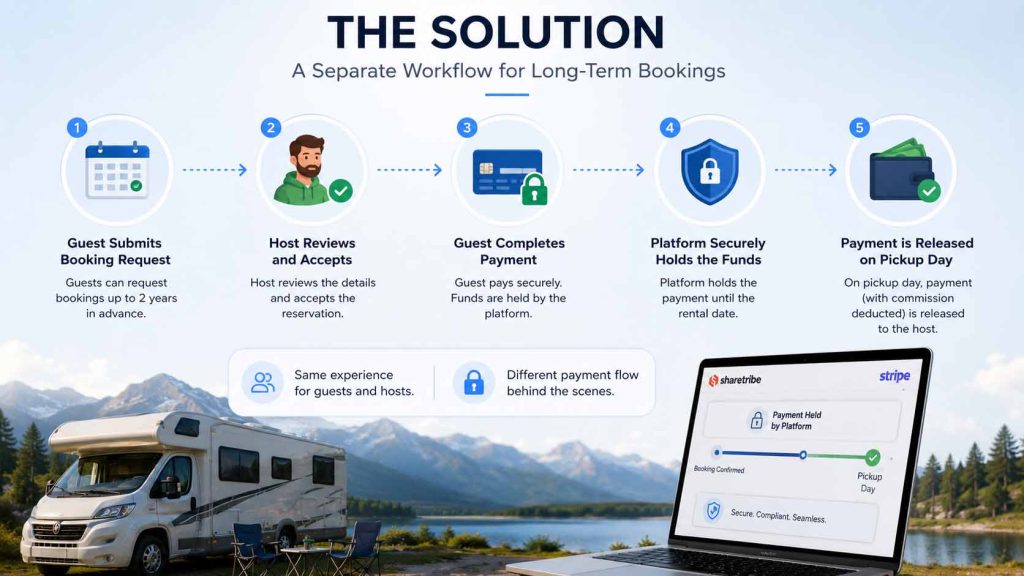
Step 1 – Guest submits a booking request
Guests can now request bookings up to two years in advance, instead of being restricted by the traditional 90-day booking window.
From the guest’s perspective, the experience remains almost identical to a normal booking. They select their preferred dates, submit their request, and wait for the host’s approval.
No additional steps or complicated processes are introduced, the extended booking capability works seamlessly within the existing marketplace experience.
Step 2 – Host reviews and accepts
The host receives the booking request and reviews the details, including the travel dates and rental information, before accepting the reservation.
This step works exactly like a standard booking.
The host does not need to manage payments differently or take any additional action because of the extended booking period. The complexity is handled entirely within the platform’s payment workflow.
Step 3 – Guest completes payment
Once the host accepts the booking, the guest completes the payment as usual.
The key difference happens behind the scenes.
Instead of immediately transferring the funds to the host, the payment is securely retained by the platform. This ensures that the booking is confirmed while avoiding a situation where the host receives payment long before the rental actually takes place.
The guest gets the confidence of having their booking secured, while the platform manages the payment timeline appropriately.
Step 4 – Platform securely holds the funds
For long-term bookings, the platform holds the payment until the rental date arrives. Depending on when the booking was made, this could be several months or even up to two years.
During this period, the reservation remains active and confirmed. The platform tracks the payment status and ensures that the funds are properly managed until they become payable to the host.
Although this process is invisible to the guest and host, it required careful consideration behind the scenes, including payment tracking, reconciliation, and handling potential changes or cancellations during the waiting period.
Step 5 – Payment is released on pickup day
When the guest arrives to collect the motorhome, the platform releases the host’s payment after deducting the platform commission.
At this point, the booking continues through the normal rental lifecycle. The guest completes their trip, the vehicle is returned, and the usual processes such as reviews, communication, and support continue exactly as they do for standard bookings.
The only major difference is when the payment moves.
By changing the timing and ownership of the payment flow, the platform was able to support bookings up to two years in advance without changing the overall experience for guests or hosts.
Visualising the New Booking Flow:
The new workflow keeps the booking experience simple for guests and hosts while changing what happens behind the scenes with payments.
Guest requests booking (up to 2 years ahead)
│
▼
Host reviews availability & accepts booking
│
▼
Guest completes secure payment
│
▼
Platform holds funds in escrow (risk protection)
│
▼
Booking is confirmed (notifications sent)
│
▼
Pre-trip coordination (chat, details, support)
│
▼
Vehicle pickup day arrives
│
▼
Platform releases payment to host (as per policy)
│
▼
Trip proceeds with ongoing support
│
▼
Trip completion & optional reviews/ratings
Recommended Blog: Shipping: The Missing Piece in Building a Scalable Marketplace
Why This Wasn't Just a Clever Workaround?
At first glance, the solution might look like a simple way to bypass a booking limitation. However, it was much more than that.
By holding customer payments until the trip begins, the platform takes on additional responsibility. Managing funds for potentially months—or even up to two years—requires a robust process to ensure payments are handled safely and accurately throughout the booking lifecycle.
This includes:
- Maintaining accurate records of all held payments.
- Tracking the status of every long-term booking.
- Ensuring host payouts are released at the correct time.
- Managing cancellations, refunds, and changes appropriately.
- Reconciling held funds with completed bookings.
The platform effectively becomes a trusted intermediary between guests and hosts. This role requires careful financial management, reliable systems, and clear operational processes.
Choosing this approach was therefore not just a technical workaround—it was a deliberate architectural and business decision. The goal was not simply to remove a booking restriction, but to create a payment flow that could support long-term bookings responsibly.
Business Impact
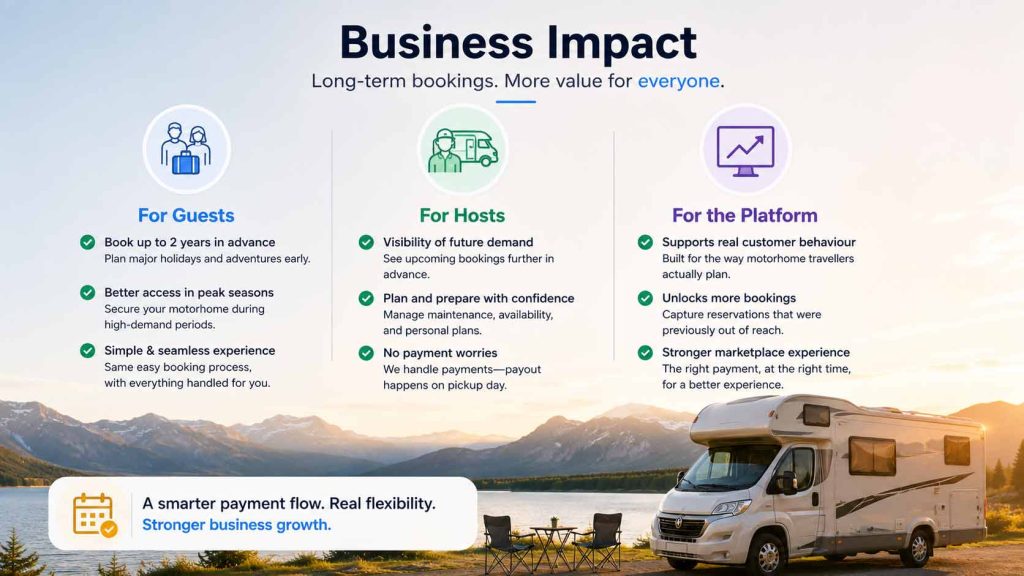
The new long-booking workflow created value for guests, hosts, and the platform by aligning the booking experience with how motorhome travellers actually plan their journeys.
For Guests
Book further in advance
Guests can now reserve motorhomes up to two years ahead, giving them the flexibility and confidence to plan major holidays, family trips, and long-distance adventures well in advance. This is especially valuable for travellers who prefer to secure their vehicle early rather than wait until closer to the departure date.
Better access during peak travel periods
With the ability to book earlier, customers have a better chance of securing vehicles during high-demand periods such as summer holidays, festivals, school breaks, and popular travel seasons. This reduces the risk of limited availability when customers are ready to finalise their plans.
A familiar and seamless booking experience
From the guest’s perspective, the booking process remains simple and unchanged. They can search, request, and confirm a booking in the same way as any standard reservation, while the complexity of managing long-term payments is handled behind the scenes by the platform.
For Hosts
Improved visibility of future demand
Hosts can now see upcoming reservations further in advance, giving them a clearer picture of future demand and vehicle availability. This helps them make better decisions about when their motorhome will be available and how they want to manage their rental schedule.
Better planning and preparation
Advance bookings allow hosts to plan ahead for important tasks such as vehicle maintenance, personal commitments, and preparing their motorhome for upcoming trips. Having more visibility into future rentals makes it easier to manage availability throughout the year.
More confidence in long-term bookings
Hosts can accept bookings months or years in advance without needing to manage customer payments during the waiting period. The platform handles the payment process, while hosts receive their payout when the rental actually begins.
For the Platform
Supports real customer behaviour
The platform now reflects how motorhome travellers naturally plan their journeys. Instead of forcing customers to work within a short booking window, the technology has been adapted to support longer planning cycles.
Unlocks new booking opportunities
Removing the 90-day restriction allows the platform to capture bookings that would previously have been impossible. Customers can secure vehicles earlier, helping increase booking opportunities during high-demand periods.
Creates a stronger marketplace experience
By aligning payment timing with service delivery, the platform provides a more reliable experience for both guests and hosts. Customers get the confidence of advance reservations, while hosts receive payments at the appropriate point in the rental journey.
Ultimately, the biggest impact was not simply extending the booking window, it was building a marketplace that supports real-world travel behaviour instead of forcing users to adapt to technical limitations.
Conclusion
Enabling two-year advance bookings was not about simply increasing a booking limit, it required understanding the payment challenges behind that restriction and redesigning the workflow around them.
By introducing a dedicated long-booking flow, GoGallivanting now supports how customers actually plan motorhome trips. Guests can book earlier, hosts receive payment when the rental begins, and the platform manages the payment lifecycle in a secure and controlled way.
This project highlights an important engineering lesson: the best solutions often come from identifying the real problem behind a limitation and designing the system around real user needs.
FAQ's
1. Why do Sharetribe and Stripe limit advance bookings to around 90 days?
The limitation is not related to the booking calendar itself. It exists because of how marketplace payments are handled. In a standard Sharetribe and Stripe flow, payments are typically connected to the host after a booking is confirmed. Holding customer funds for many months before a service is delivered creates additional financial, refund, and compliance considerations, which is why platforms often limit how far ahead bookings can be made.
2. How did GoGallivanting enable bookings up to two years in advance?
Instead of using the standard payment flow for long-term bookings, GoGallivanting introduced a dedicated long-booking workflow. For these bookings, the platform securely holds the guest’s payment until the rental begins. Once the guest picks up the motorhome, the payment is released to the host.
3. Does the long-booking process change the experience for guests or hosts?
No. The booking experience remains almost identical for both guests and hosts. Guests request and pay for bookings as usual, and hosts accept requests in the same way. The main difference happens behind the scenes, where the platform manages the payment timing differently for long-term reservations.
4. Why not simply increase the booking limit in Sharetribe?
Increasing the booking window alone would not solve the underlying issue. The challenge was not allowing customers to select future dates the challenge was managing payments for bookings that might happen many months later. A longer booking window required a redesigned payment workflow rather than a simple configuration change.
5. What are the benefits of supporting long-term bookings for a motorhome marketplace?
Long-term bookings better match how customers plan motorhome trips. Guests can secure vehicles earlier for holidays, festivals, and extended road trips, while hosts gain better visibility into future demand and can plan availability, maintenance, and income more effectively. For the platform, it creates more booking opportunities and a better experience for the entire marketplace.