

Introduction
For most EV drivers, charging should feel effortless like pulling up, plugging in, and continuing the journey without a second thought. But in reality, the experience often begins with friction: downloading an app, creating an account, and entering payment details before a single charge can start. These extra steps slow users down at the very moment they expect speed and convenience.
We set out to rethink this experience in collaboration with a US-based EV charging provider. The goal was simple but ambitious: remove barriers without removing capability. The result is a mobile app built around a frictionless, guest-first journey where drivers can scan a QR code, start charging instantly, pay, and receive a receipt within seconds. At the same time, the platform supports a seamless transition to a full-featured experience, allowing users to save preferences, manage vehicles, and engage more deeply when they choose.
Behind this simplicity lies a structured, AI-led engineering approach that enabled the team to move quickly from idea to production without compromising on quality, scalability, or real-world usability.
The Challenge: Turning an Idea into Something Teams Can Actually Build
Designing a frictionless EV charging experience may sound straightforward—but translating that vision into a scalable, production-ready product introduces a range of real-world challenges. The goal wasn’t just to simplify the user journey, but to do so without compromising on functionality, reliability, or performance.
1. Remove Friction Without Limiting Capability
At the heart of the product was a bold requirement: enable instant charging without requiring users to create an account. This meant eliminating one of the biggest barriers in existing charging apps—mandatory sign-ups.
However, simplicity alone wasn’t enough. The platform still needed to support advanced capabilities such as:
- Saved payment methods
- Vehicle profiles
- Notifications and session history
The real challenge was architectural as much as it was experiential: how do you keep the core journey minimal while seamlessly layering advanced features on top? The solution had to ensure that first-time users experience zero friction, while returning users can access deeper functionality without disruption.
2. Design for Real Charging Behavior
EV usage is far from linear. Users don’t always operate in single-session, single-vehicle scenarios. Instead, they often interact with charging systems in more complex, real-world contexts.
To reflect this, the app needed to support:
- Multiple vehicles under a single user
- Concurrent charging sessions across different stations
- Real-time visibility into energy consumption, cost, and progress
This required designing a system that goes beyond basic usability—one that can handle dynamic, real-world usage patterns at scale, without sacrificing clarity or performance.
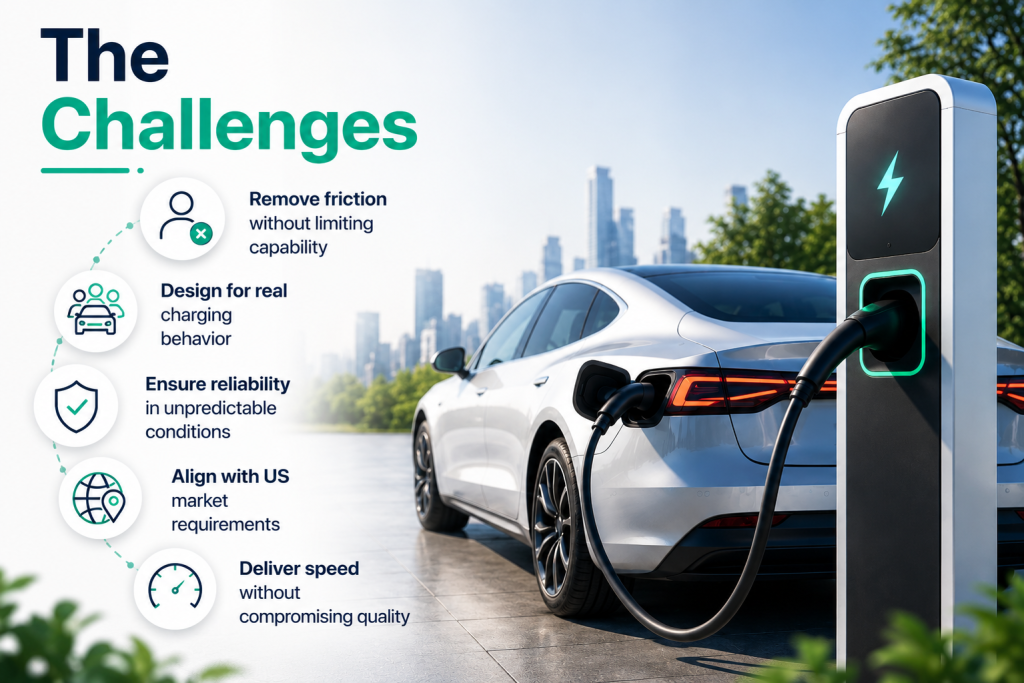
3. Ensure Reliability in Unpredictable Conditions
Charging doesn’t always happen under perfect conditions. Network interruptions, app closures, or device issues can disrupt an active session.
Without proper safeguards, these disruptions could lead to:
- Lost session data
- Incomplete transactions
- Frustrating user experiences
To address this, the system needed to be inherently resilient supporting session recovery and state continuity. The goal was simple: even if something goes wrong technically, the user experience should remain smooth and uninterrupted.
4. Align with US Market Requirements
Building for the US market introduced its own set of considerations that extended beyond core functionality.
The app needed to align with:
- USD-based pricing and transactions
- SMS/OTP-based authentication flows
- Distribution through both the App Store and Google Play
- Privacy expectations and regulatory compliance
Each of these factors influenced both product design and technical implementation, adding another layer of complexity to the development process.
5. Deliver Speed Without Compromising Quality
Perhaps the most critical challenge was execution.
The team needed to answer a fundamental question:
How do you move from idea to production quickly without sacrificing structure, scalability, or code quality?
Traditional development approaches often force a trade-off between speed and rigor. Moving fast can lead to technical debt, while focusing on quality can slow down delivery. Overcoming this trade-off was essential to building a product that is both fast to launch and built to last.
The Solution: An AI-Driven Product Discovery Process
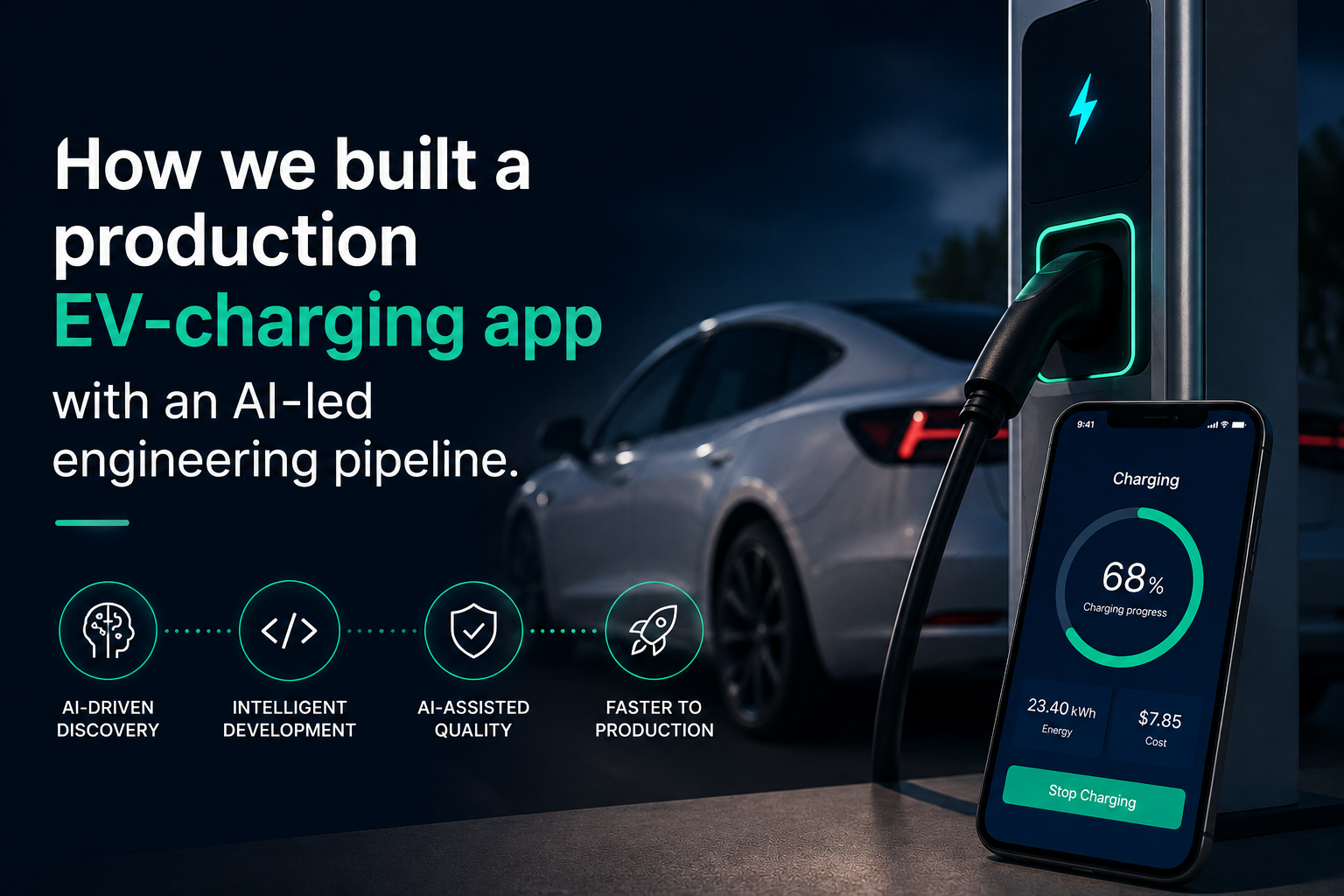
To address these challenges, the product was built using an AI-led, agentic engineering pipeline that structured the entire development lifecycle. This approach ensured that every stage from initial idea to final deployment was aligned, efficient, and driven by clarity rather than guesswork. Instead of relying on disconnected processes, the team followed a unified system where AI played a central role in guiding decisions, reducing delays, and maintaining consistency throughout.
1. Structured, AI-Led Development Lifecycle
The development process was organized into a clearly defined sequence of stages: Analyst → Product Manager → Architect → Scrum Master → Developer → QA. Each stage was supported by AI, enabling smooth transitions and eliminating gaps between teams. This structure ensured that requirements were clearly documented, responsibilities were well defined, and every stakeholder operated with the same understanding of the product. As a result, teams were able to collaborate more effectively, reduce miscommunication, and make faster, more confident decisions while maintaining alignment from start to finish.
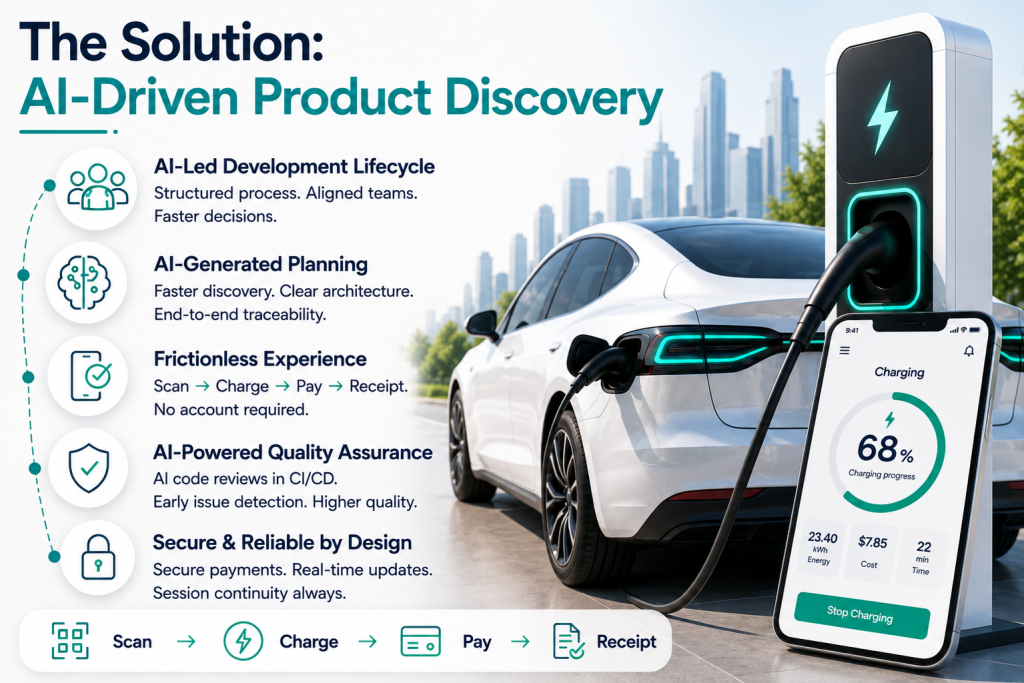
2. AI-Generated Planning and Architecture
A significant advantage of this approach was the use of AI to generate core planning and architectural components. Product requirements, epics, and technical architecture were created through structured AI workflows, replacing traditional manual and time-consuming processes. This not only accelerated the discovery phase but also provided end-to-end traceability, ensuring that every feature could be mapped back to its original requirement. By reducing ambiguity and improving clarity, the team was able to move into development with a strong foundation, minimizing rework and ensuring a smoother execution process.
3. Frictionless Product Experience (Core Solution)
At the center of the solution is a frictionless, guest-first charging experience designed for speed and simplicity. Users can follow a seamless flow—Scan → Charge → Pay → Receipt—without needing to create an account. This allows first-time users to start charging instantly, removing one of the biggest barriers in traditional EV charging apps. At the same time, the platform includes an optional account layer for users who want a more personalized experience, such as saving payment methods, managing vehicles, and receiving notifications. Combined with real-time session visibility and support for multiple vehicles and concurrent sessions, the app delivers both simplicity for new users and depth for returning ones.
4. Integrated Quality Assurance with AI
Quality assurance was embedded directly into the development pipeline rather than being treated as a separate, final step. AI-assisted code reviews were integrated into the CI/CD process, ensuring that every code change was automatically evaluated against defined standards. This proactive approach helped identify issues early, maintain consistency across the codebase, and reduce the likelihood of defects reaching production. By continuously validating code quality throughout development, the team was able to maintain high standards without slowing down delivery.
5. Secure and Reliable System Design
Security and reliability were built into the system from the ground up. Payments are handled using secure tokenization, ensuring that sensitive card information is never stored. The platform is powered by a scalable, real-time architecture that supports live updates on charging sessions, including energy usage, cost, and progress. Additionally, the system includes fallback mechanisms and session recovery capabilities, allowing it to maintain continuity even in cases of network disruptions or unexpected interruptions. This ensures that users experience a smooth, secure, and dependable charging process under real-world conditions.
Business Impact: Why This Approach Matters
This approach delivers meaningful value across both user experience and product delivery, demonstrating how thoughtful design and AI-driven engineering can work together to create scalable, high-quality solutions.
1. Faster, Simpler User Experience
One of the most immediate impacts is a significantly improved user experience. By removing the need for mandatory sign-ups, the app enables users to start charging instantly, eliminating one of the biggest friction points in traditional EV charging platforms. This streamlined onboarding process not only saves time but also reduces user hesitation. Combined with clear, real-time visibility into charging progress, cost, and energy usage, the experience becomes more transparent and intuitive—helping build trust from the very first interaction.
2. Higher Engagement Without Forced Conversion
Instead of forcing users into registration, the platform adopts a more flexible approach by allowing them to start as guests and upgrade when they are ready. This creates a more natural user journey, where engagement grows organically rather than being driven by mandatory steps. The system effectively supports both one-time users who need quick access and repeat users who benefit from saved preferences and personalized features. This balance encourages higher adoption while maintaining a user-first experience.
3. Built for Modern Usage Scenarios
The platform is designed to reflect how EV users actually interact with charging systems in real life. It supports multiple vehicles under a single account, making it suitable for families and small fleets. Additionally, users can manage concurrent charging sessions and monitor them in real time, providing greater control and flexibility. This adaptability ensures that the product is not limited to basic use cases but can scale to meet more complex, real-world needs.
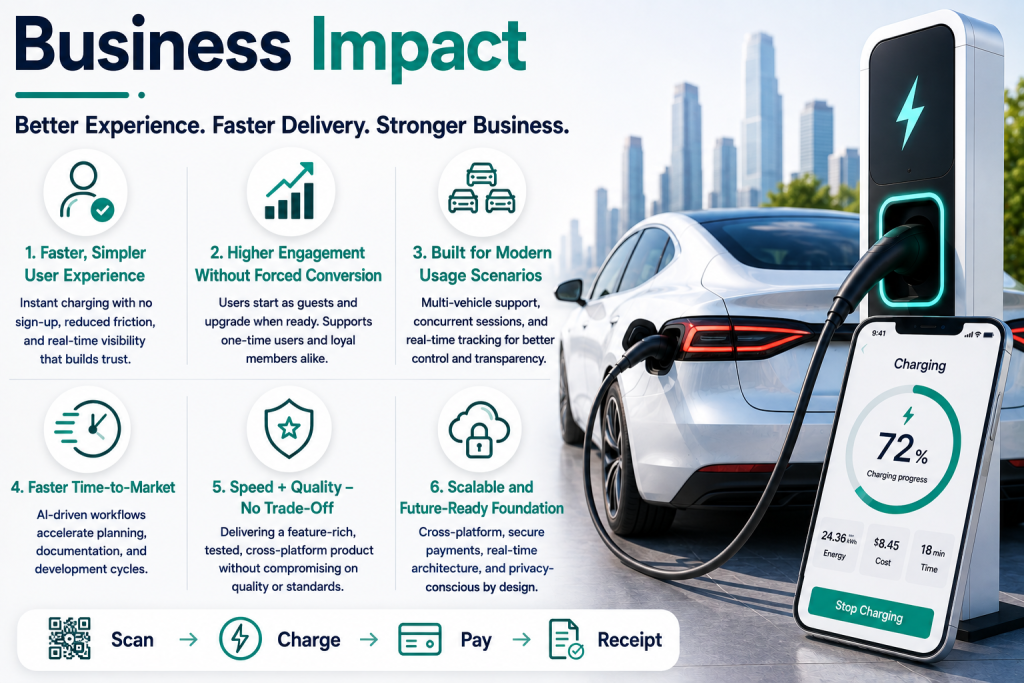
4. Faster Time-to-Market
By leveraging AI-driven workflows, the team was able to significantly accelerate the development process. Tasks such as requirement gathering, planning, and documentation were streamlined, reducing the time typically spent in early project phases. This efficiency enabled a faster transition from concept to production, allowing the product to reach the market more quickly without unnecessary delays. For businesses, this translates into a stronger competitive advantage and quicker realization of value.
5. Speed + Quality — No Trade-Off
A key outcome of this approach is the ability to achieve both speed and quality simultaneously something that traditional development methods often struggle to balance. By integrating AI into planning, development, and quality assurance, the team eliminated the usual trade-offs between rapid delivery and robust engineering. Even with a lean team, it was possible to deliver a feature-rich, well-tested, cross-platform product without compromising on standards, demonstrating the effectiveness of this modern development approach.
6. Scalable and Future-Ready Foundation
Beyond immediate benefits, the solution is built with long-term scalability in mind. The cross-platform architecture supports both iOS and Android from a single codebase, making it easier to maintain and expand. Secure, tokenized payment systems ensure data protection, while the real-time infrastructure enables live updates and responsive interactions. Additionally, the platform is designed with privacy considerations aligned to US standards, ensuring compliance and trust as the product grows. This foundation positions the app for future enhancements and sustained scalability.
Conclusion
EV charging should be simple, fast, and reliable. This solution proves that by combining a frictionless user experience with an AI-led engineering approach, it’s possible to deliver both speed and quality without compromise.
More than just an app, it sets a benchmark for building scalable, user-centric products, where simplicity for users and efficiency for teams go hand in hand.
FAQ's
1. Do users need to create an account to start charging?
No. The app supports a complete guest flow where users can scan a QR code, start charging, make a payment, and receive a receipt—without creating an account.
2. What additional features are available for registered users?
Registered users can access advanced features such as saved payment methods, vehicle profiles, notifications, and session history, while still benefiting from the same seamless experience.
3. How does the app handle real-time charging updates?
The app provides live updates during an active session, including energy consumption (kWh), cost, and charging progress, ensuring full transparency for users.
4. Can the app support multiple vehicles or sessions?
Yes. The platform is designed to support multiple vehicles per user and allows concurrent charging sessions, making it suitable for families and small fleets.
5. How is reliability maintained during interruptions?
The system includes session recovery and continuity features, ensuring that charging sessions can resume smoothly even in case of network or device disruptions.
6. What makes the development approach unique?
The app was built using an AI-led engineering pipeline that structured the entire lifecycle from requirements to QA enabling faster delivery, better alignment, and high-quality output without compromising scalability.