

Introduction
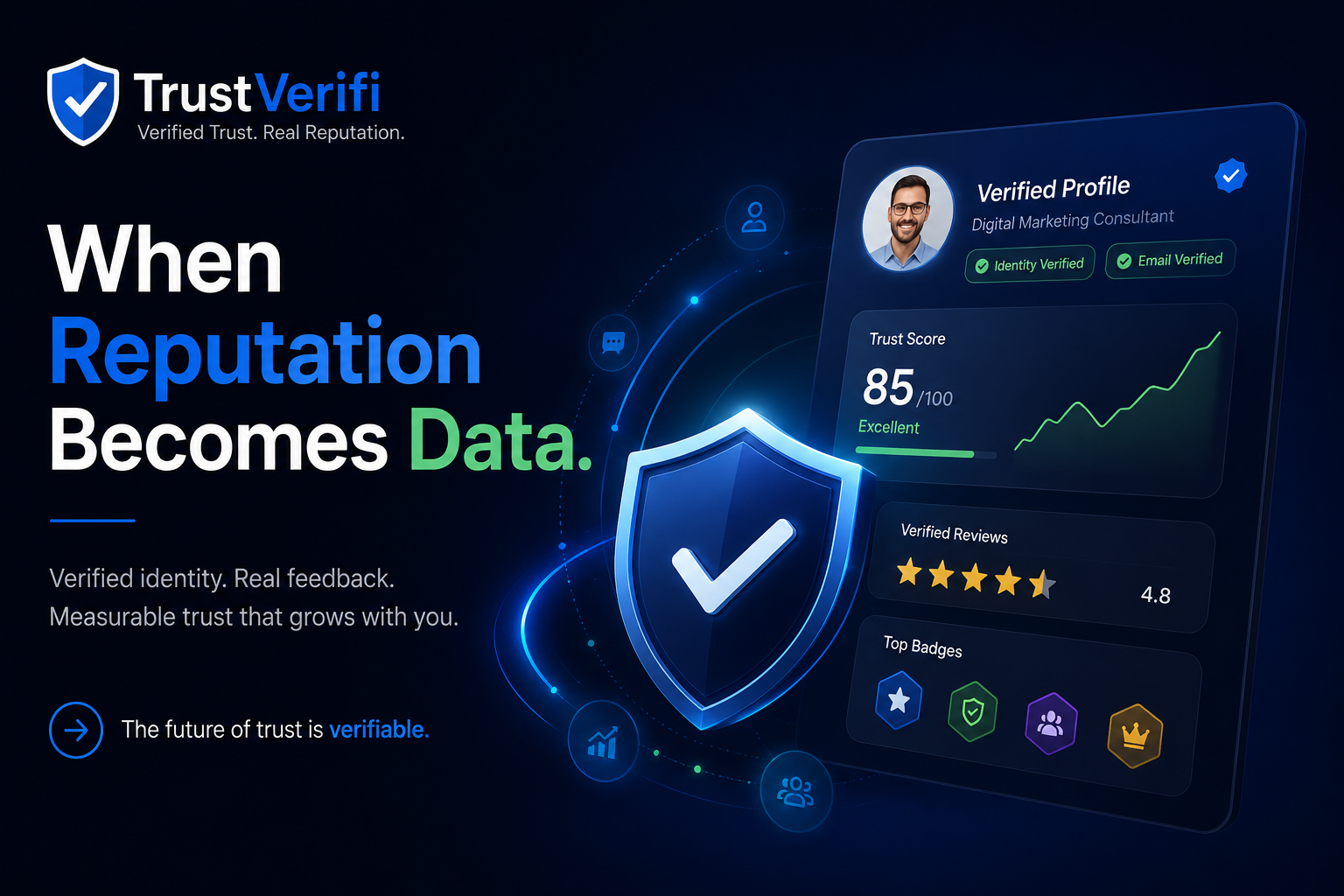
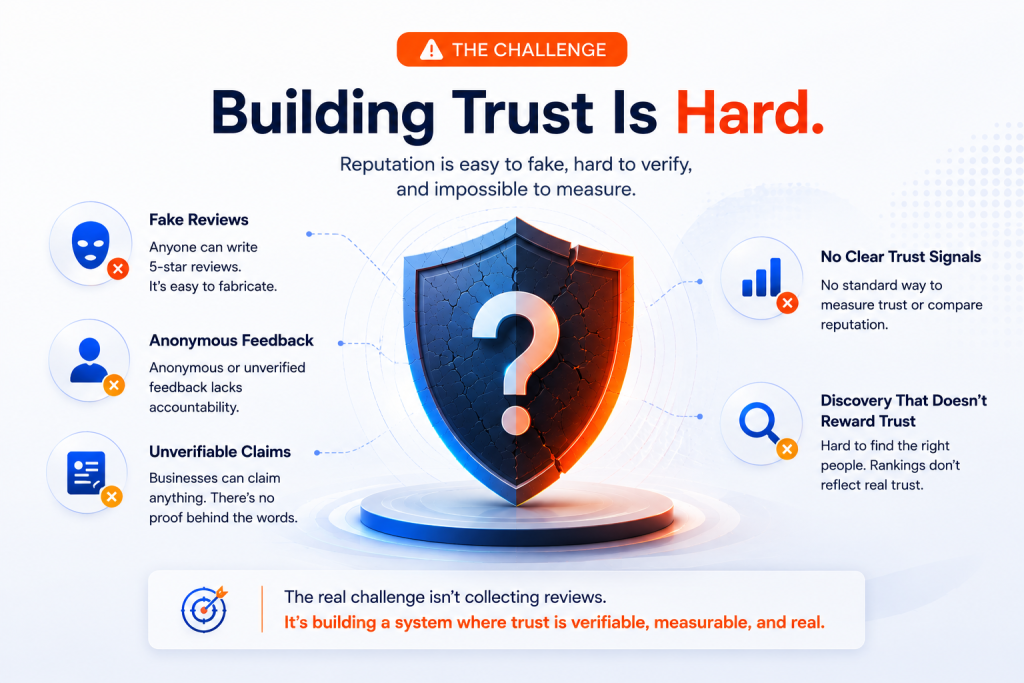
Online reputation runs on an honor system that doesn’t hold up to scrutiny. Star ratings can be gamed, testimonials can be written by the business itself, and a glowing recommendation takes thirty seconds to fabricate. For professionals and businesses trying to prove they’re worth hiring, that gap between earned trust and provable trust is a real growth bottleneck.
TrustVerifi set out to close it: a platform where identity, work history, and client feedback come together into one verified profile that anyone can independently check not just people already in your network.
We were brought in to take that vision from a detailed content and navigation blueprint to a production SaaS platform. The brief covered a full sitemap: public marketing pages, a logged-in dashboard, and a wide feature set spanning identity verification, testimonials, live trust scoring, dynamic badges, sub-profiles, team permissions, dispute handling, and a searchable public directory. Here’s how we approached building it.
The Challenge: Turning a Feature-Rich Spec Into a Coherent Product
1. A Wide Feature Set, One Coherent Experience
The requirements didn’t describe a single feature, they described a complete system made up of multiple moving parts such as identity verification, testimonials, trust scoring, badges, sub-profiles, and discovery. Each of these components behaves differently at a technical level, but from a user’s perspective, they must feel like one unified and seamless experience. The core challenge was to architect the system in a way that keeps backend logic modular (for scalability and maintainability) while ensuring the front-end experience remains simple and cohesive.
For example, when a user visits a business profile, they see a single Trust Score, verified badges alongside testimonials, and clearly organized sub-profiles. However, behind the scenes, verification is handled by a separate workflow, testimonials are filtered through verified identities, and the Trust Score is dynamically calculated using multiple parameters. Despite this complexity, the user experiences it as one smooth, unified interface.
2. Trust Signals That Can’t Be Gamed
The credibility of a trust platform depends entirely on the authenticity of its signals. This means identity and business verification cannot be treated as a simple checkbox—they must act as a strong gate to ensure that testimonials and reviews come from real, verified users. At the same time, overly complex verification processes can discourage genuine users, making it critical to balance strict validation with a smooth onboarding experience.
For example, instead of allowing open or anonymous reviews, users must first complete a verification process such as confirming their email, phone number, or identity documents before submitting testimonials. To prevent drop-offs, this process can be broken into smaller, progressive steps, allowing users to explore the platform before completing full verification. This ensures that reviews remain trustworthy while keeping the user experience accessible and frictionless.
3. A Scoring System That Has to Evolve
TrustVerifi’s Trust Score — a live 0–100 rating based on verified reviews, sentiment, recency, and response time couldn’t be hard-coded to a single launch-day formula. Reputation signals shift as usage data comes in, and a scoring model that made sense on day one would almost certainly need retuning by month six. The system needed to support that evolution without a rebuild every time the weighting changed.
For example, at launch, the system might assign weights such as 50% to reviews, 30% to recency, and 20% to response time. Over time, if data shows that response time has a greater impact on user trust, these weights can be adjusted without requiring a full system rebuild. Additionally, new factors like dispute resolution rates or engagement metrics can be introduced later. This ensures the scoring system evolves with real-world usage and remains relevant.
4. Reputation at Team Scale
The platform is designed not only for individuals but also for businesses that operate across multiple services, products, or locations. Each of these units requires its own reputation layer, while still contributing to an overall business profile. This introduces complexity in both data modeling and access control, requiring a system that supports hierarchical relationships and role-based permissions.
For example, a rental company might have separate sub-profiles for car rentals, bike rentals, and equipment rentals. Each sub-profile maintains its own Trust Score, reviews, and badges, while the parent company profile displays an aggregated score. At the same time, different team members may have different levels of access—admins manage everything, managers handle specific sub-profiles, contributors add content, and viewers have read-only access. This structure allows businesses to scale their reputation management without losing clarity or control.
5. Discovery That Rewards Verification
A well-designed trust system must ensure that users can easily discover the most relevant and credible profiles. Search and ranking mechanisms should reinforce the platform’s core principle that verified and trustworthy profiles are more valuable than those simply optimized for visibility or recency.
For example, when a user searches for “Event Planners in Bangalore,” the results can be filtered based on category, location, verification status, badges, and Trust Score. Profiles with higher verified Trust Scores and consistent positive sentiment are ranked higher, while unverified or low-quality profiles are deprioritized. Paid placements, if included, should be clearly distinguished to maintain transparency. This approach ensures that users find genuinely trustworthy options and encourages businesses to maintain high standards of verification and service quality.
The Solution: A Modular, Azure-Native Trust Platform
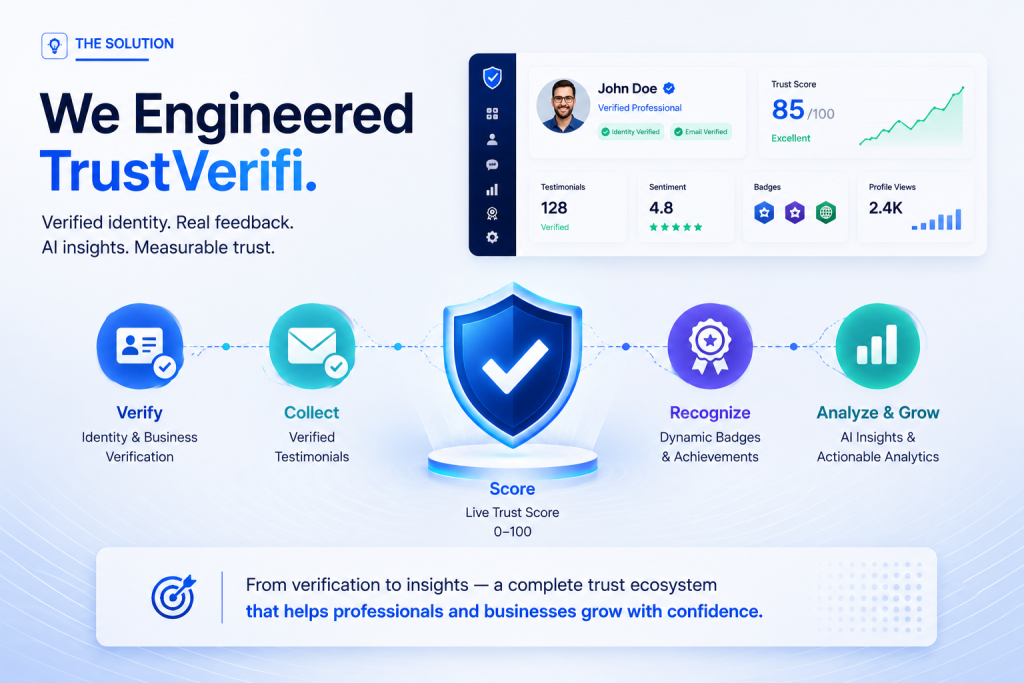
1. Unified Experience, Modular Architecture
We built the product experience, profiles, testimonials, badges, discovery as one coherent product on React with Sharetribe as the marketplace foundation for profile and discovery flows, while keeping verification and workflow logic in separate .NET services. That separation meant the team could iterate on scoring logic or add a new verification provider without touching the front-of-house experience users interact with every day.
2. Verification Workflows Built as First-Class Citizens
Identity checks, business registration verification, and evidence-backed testimonial journeys were engineered as dedicated workflows rather than bolted-on forms. Testimonials require the reviewer to verify their own identity before their feedback counts, so what lands on a profile is confirmation from a real person, not an anonymous handle.
3. A Configurable Trust-Scoring Engine
Instead of hard-coding a scoring formula, we built configurable inputs for how scores, ranks, and badges get calculated. That gives TrustVerifi room to retune what “trustworthy” means as real usage data comes in, without requiring an engineering rebuild every time the weighting shifts.
4. Multi-Tenant Reputation for Teams
Sub-profiles for products, services, and locations sit underneath a business’s main profile, each carrying its own Trust Score, badges, and analytics supported by role-based access so a team can manage reputation across an organization without losing granularity on what’s actually working where.
5. AI-Powered Reputation Intelligence
Testimonials aren’t just displayed they’re analyzed. Sentiment scoring and testimonial insight run on Azure OpenAI, giving profile owners a clearer read on what their reviews actually say, not just how many stars they add up to.
6. Trust-Based Discovery and a Governed Delivery Pipeline
The public directory is built around search, filtering, and reputation-led ranking rather than a flat list. And the platform itself runs on Azure App Service with Application Insights for real-time monitoring, shipping through Azure DevOps with governed CI/CD so releases stay repeatable and issues surface before users do.
Business Impact: Why This Approach Matters
1. Credibility That Holds Up to Scrutiny
Because verification is a real gate rather than a formality, every testimonial and badge on a TrustVerifi profile carries weight a generic review platform can’t offer. That’s the difference between telling a prospect you’re reliable and letting them confirm it independently in under a minute.
2. A Scoring Model That Can Mature With the Product
Configurable scoring inputs mean TrustVerifi isn’t locked into its launch-day trust formula. As real usage patterns emerge, the team can retune what drives the score without a re-architecture which matters far more once the platform has thousands of live profiles than it does on day one.
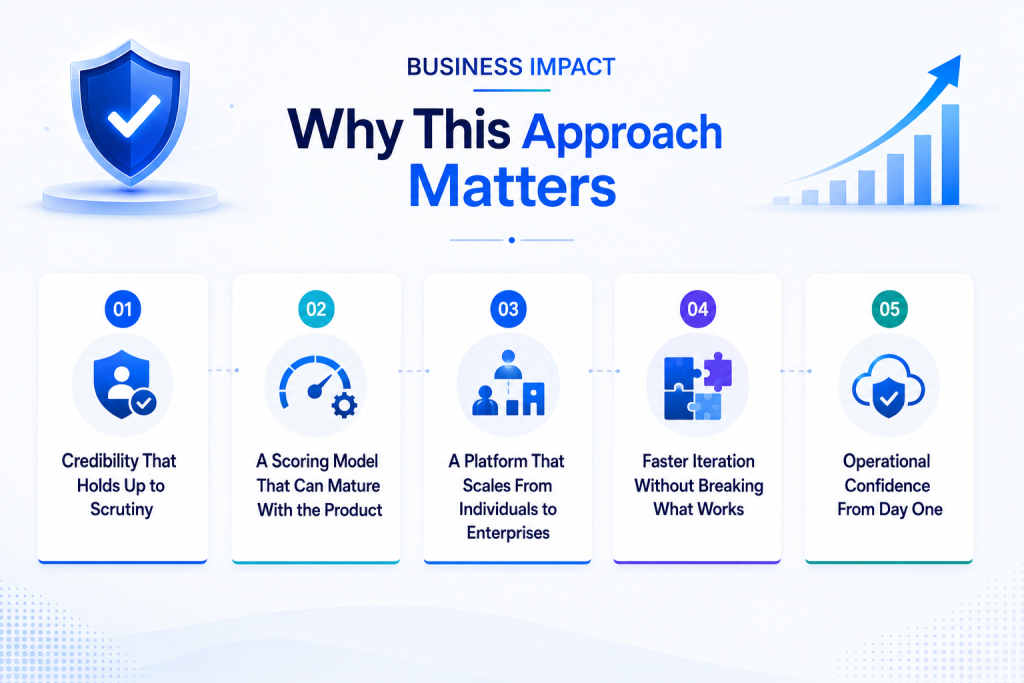
3. A Platform That Scales From Individuals to Enterprises
The same core system supports a solo freelancer’s single profile and a business managing dozens of sub-profiles across products and locations without needing separate products for each. That’s a meaningfully wider addressable market from one architecture.
4. Faster Iteration Without Breaking What Works
Because verification, scoring, and the core experience are cleanly separated, TrustVerifi’s team can ship new integrations or adjust workflows in one part of the system without destabilizing the rest a foundation that matters more with every feature added after launch.
5. Operational Confidence From Day One
Application Insights and a governed Azure DevOps pipeline went in alongside the product work, not after it. For a platform whose entire premise is that users can trust what they see, the infrastructure behind it needed to be dependable from the first release, not “stable enough for now.”
Conclusion
TrustVerifi set out to prove that reputation shouldn’t be something you claim it should be something you can show. Building that meant treating a feature-rich spec as a system to architect, not a checklist to clear: verification, scoring, discovery, and team reputation all needed their own engineering discipline while still feeling like one seamless profile to the people using it.
The result is a trust platform with room to grow configurable scoring, AI-driven reputation intelligence, multi-tenant support, and a delivery pipeline built for confidence, not just launch day.
FAQ's
1. What makes TrustVerifi’s verification different from a typical review platform?
Identity and business verification happen before testimonials can be submitted, and reviewers verify their own identity as part of the process — so feedback comes from confirmed people, not anonymous accounts.
2. How is the Trust Score calculated?
It’s a live 0–100 score based on verified reviews, sentiment, recency, and response time, built on a configurable scoring engine so the weighting can evolve as real usage data comes in.
3. Can businesses manage more than one profile?
Yes. Businesses can create sub-profiles for individual products, services, or locations — each with its own Trust Score, badges, and analytics — under role-based team permissions.
4. What technology powers the platform?
The experience layer runs on React with Sharetribe for profiles and discovery, verification and workflow logic runs on .NET services, sentiment analysis runs on Azure OpenAI, and the platform is hosted on Azure App Service with Azure DevOps-managed CI/CD.
5. How does discovery work?
The public directory supports search and filtering by category, location, badges, and Trust Score, with ranking built around verified reputation signals rather than recency alone.