

Introduction: A Gap in the AI Market
Walk through the AI aisle today and you’ll find two kinds of products.
On one side are enterprise AI platforms: powerful, but priced and built for large retailers with big teams. On the other are single-store tools, such as e-commerce plugins, which assume one seller with one catalogue.
If you run a marketplace, neither fits. You’re not a big retailer, and you’re not a single store. You’re a two-sided business connecting buyers with many sellers or providers, and your problems look nothing like either of those tools’ assumptions.
That’s the gap. SMB marketplaces fall right into it, and this blog explains why, and what AI built for the marketplace model looks like.
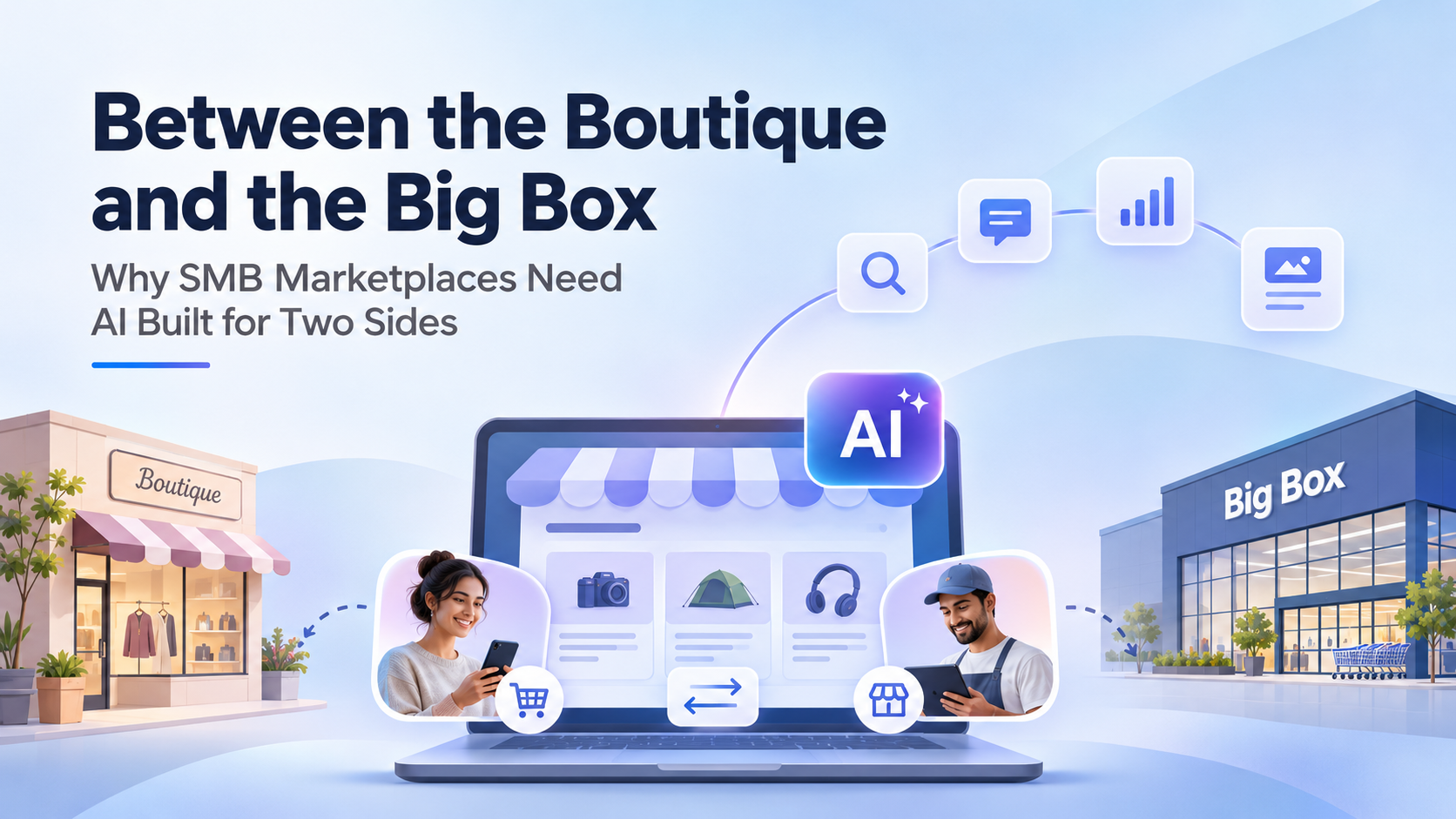
Think of the difference between a boutique and a bazaar. A boutique has one shopkeeper who controls everything on the shelves. A marketplace has many stallholders, many shoppers, and a platform in the middle keeping it all running. The AI that suits the first is not the AI that suits the second.
In a marketplace, buyers and providers want different things. Sellers create listings of very different quality. Helping a buyer find the right provider matters more than pushing one catalogue. Questions about bookings, payments and disputes come from both sides, and success is measured by supply and demand balance, search-to-booking conversion, repeat purchases, seller activation and seller churn, not just store sales.
Platforms like Sharetribe give SMB operators a fast and practical start, but their built-in AI and analytics are limited. That leaves many operators with a real question: where does the intelligence come from? Enterprise platforms are too heavy, and single-store tools are too narrow.
What Makes a Marketplace Different
A boutique has one shopkeeper who controls everything on the shelves. A marketplace is closer to a busy bazaar: many stallholders, many shoppers, and a platform in the middle keeping it all working. Five things set it apart.
Two sides to serve. Buyers and providers (or sellers) have different journeys, goals and frustrations. Good AI has to serve both, not just the shopper.
Many sellers create the listings. Quality, descriptions and photos vary widely from one seller to the next. The platform’s experience is only as consistent as its messiest listing.
Matching is the product. In a marketplace, helping a buyer find the right provider matters more than pushing a single catalogue. Discovery and matching are the core value, not an add-on.
Trust and support run both ways. Questions about bookings, providers, payments and disputes come from buyers and providers, often at all hours.
The metrics are different. Marketplaces track:
- Supply and demand balance
- Search-to-booking conversion
- Repeat purchases
- Seller activation
- Seller churn
These aren’t the same as “store sales,” and a tool that only reports store sales will miss most of what’s happening.
Platforms like Sharetribe give SMB operators a fast start, which is a real advantage. But built-in AI and analytics are limited, so operators still need a way to add intelligence on top.
A Day in the Life: Three People, Three Different Needs
It’s easiest to see the gap by following the three people who touch a marketplace every day. The scenarios below are illustrative, not client stories.
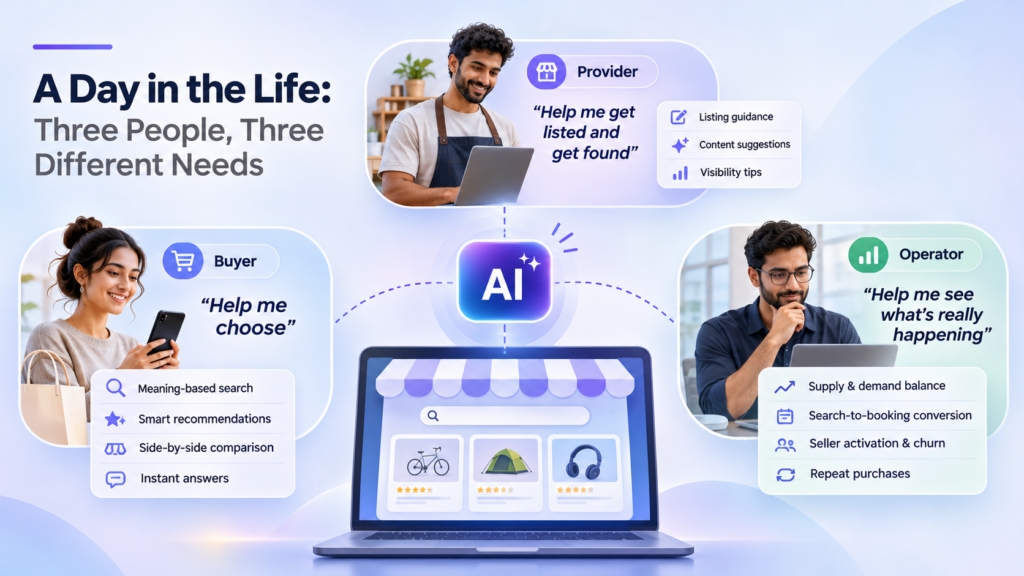
The buyer: “Help me choose”
Imagine a buyer who arrives with a need, not a product name. They might type a loose description of what they want, with dates, preferences and a rough budget in mind. Keyword matching only works if the seller happened to use the same words. Meaning-based search, recommendations and side-by-side comparison are what turn a loose description into a confident choice. And when a question comes up about a booking or a policy, an assistant that answers right away keeps the buyer from leaving.
The provider: “Help me get listed and get found”
Now imagine a provider joining for the first time. They know their craft, but not necessarily how to write a strong listing. A blank form is intimidating, and a rushed listing hurts both their visibility and the buyer’s trust. They need guidance while creating the listing, quick answers about how the platform works, and a sense that effort on their side leads to being found.
The operator: “Help me see what’s really happening”
Finally, the operator watches both sides at once. They need to know whether supply and demand are in balance, whether searches lead to bookings, whether buyers come back, whether new sellers become active and whether existing sellers are leaving. A store-sales report can’t answer any of these questions, because it was never built to look at two sides.
What this tells us
Three people, three journeys, one platform. AI that serves only one of them, or that assumes they’re all the same person, leaves the other two underserved. That’s the core reason dedicated marketplace AI exists.
Why Enterprise AI Doesn't Fit
The Challenge
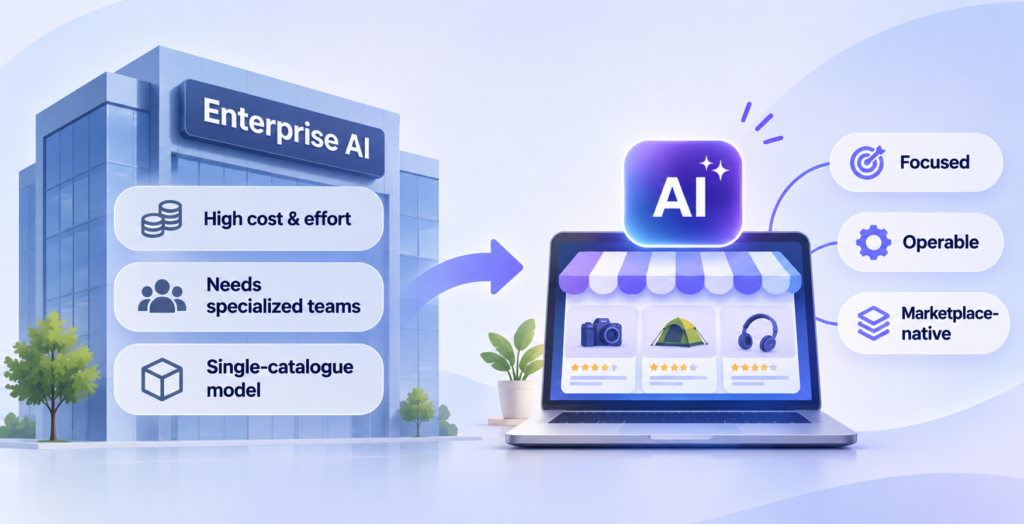
Enterprise AI platforms are impressive, but they’re designed for a different kind of buyer:
• Cost and implementation effort sized for large retailers. The budget and timeline assume a big organization.
• Dedicated data and engineering teams required. Running them well takes people most SMB marketplaces don’t have.
• Built around a single retailer’s catalogue. Multi-seller listings, where many different people create the content, aren’t what they’re designed around.
Each of these points matters more to a marketplace than it might first appear.
Cost and effort. An SMB marketplace usually runs lean. When the budget and timeline are planned around a large organization, the money and attention spent on implementation are money and attention not spent on growing supply and demand.
The team requirement. AI isn’t a switch you flip. Someone has to run it, monitor it and tune it. When that depends on dedicated data and engineering teams, the tool only really works for businesses that already have those teams.
The catalogue assumption. This is the deepest mismatch. A platform that expects one retailer to maintain one tidy catalogue has no natural way to handle many sellers writing listings in many different styles, with no single person responsible for consistency.
The result is a familiar pattern: a capable platform that is hard to adopt, slow to show value, and only partly relevant once it is running.
The Solution
SMB marketplaces need AI that’s right-sized: capabilities you can add where they matter most, without a large team to operate them, and designed for multi-seller listings from the start.
In practice, right-sized AI has three qualities:
• Focused. You choose the capability that addresses your biggest friction point, whether that’s search, support, listings or analytics, rather than adopting a whole platform at once.
• Operable. It doesn’t depend on a dedicated data or engineering team to keep it running, so a lean marketplace team can actually use it.
• Marketplace-native. It’s designed from the start for listings written by many different sellers, rather than adapted from a single-catalogue assumption.
Business Impact
Right-sized AI means you can improve search, support and analytics without taking on cost and complexity built for someone else.
That means budget and attention go to the parts of the marketplace that buyers and providers actually touch: how they search, what answers they get, how well listings are written and what the operator can see. It also lowers the risk of getting started. You can begin with one capability, see how it behaves on your own marketplace, and extend from there.
Why Single-Store Tools Don't Fit Either
The Challenge
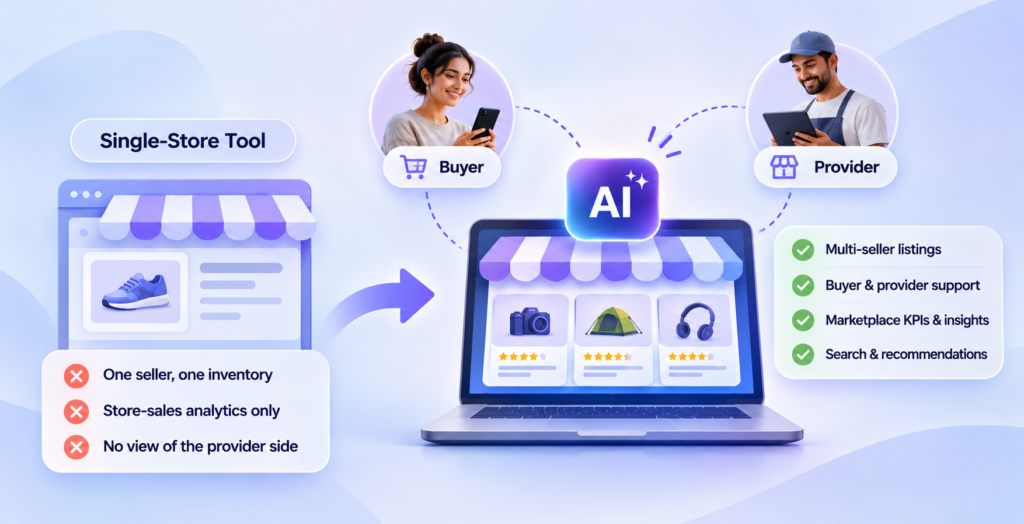
If enterprise tools are too big, single-store tools are too narrow:
• They assume one seller and one inventory. Marketplaces have many sellers, each with their own listings.
• Their analytics are built around store sales, not the health of a two-sided marketplace.
• They have no view of the provider side at all. Half of your business is invisible to them.
All three limits trace back to the same root: a single-store tool is built around one party.
One seller, one inventory. There’s no concept of competing sellers, or of matching a buyer to the right provider among many. Yet in a marketplace, that matching is the product.
Store-sales analytics. Knowing how much was sold doesn’t tell you whether supply and demand are in balance, whether searches turn into bookings, whether buyers come back, or whether new sellers become active and existing ones leave. Those are the questions marketplace operators need answered.
No view of the provider side. If nothing in the tool understands providers, nothing in it can help them create listings, answer their questions or show how they’re doing. Half of the marketplace’s users are effectively unsupported.
A simple test: could the tool tell you why a seller left, or where buyers drop off between searching and booking? If not, it’s measuring a store, not a marketplace.
The Solution
Use AI that treats the marketplace itself as the thing being optimized, with both buyers and providers in view, and metrics that reflect how marketplaces actually succeed.
Treating the marketplace as the thing being optimized has concrete consequences:
• Search and recommendations work across every seller’s listings, not one inventory.
• Assistants answer questions for buyers and for providers.
• Listing help supports the sellers who create the content that the whole platform depends on.
• Analytics report on marketplace KPIs: supply and demand balance, search-to-booking conversion, repeat purchases, seller activation and seller churn.
Business Impact
You get insight and automation that matches your business model, instead of adapting your marketplace to fit a store-shaped tool.
The practical benefit is that you stop translating. Instead of reading store-shaped reports and guessing what they mean for a two-sided business, or working around features that assume a single seller, you get tools whose logic matches how your marketplace actually works.
Side by Side: Three Kinds of AI, One Marketplace
Put together, the differences are easy to see. Only dedicated marketplace AI is designed around a two-sided business.
| What matters to a marketplace | Enterprise AI platforms | Single-store tools | Dedicated marketplace AI |
| Built for | Large retailers with big teams | One seller with one catalogue | Two-sided marketplaces |
| Cost and effort | Sized for large retailers | Light, but narrow | Right-sized for SMB operators |
| Team needed to run it | Dedicated data and engineering teams | Minimal | Added on top of your existing platform |
| Handles many sellers' listings | Built around a single retailer's catalogue | Assumes one inventory | Designed for multi-seller listings |
| Sees the provider side | Depends on custom work | No view at all | Yes, both buyers and providers |
| Analytics focus | Retail reporting | Store sales | Marketplace KPIs: supply and demand balance, search-to-booking conversion, repeat purchases, seller activation, seller churn |
| Support assistants | Generic | Store-focused | Cover bookings, policies and listing help for both sides |
Who it’s built for, and what it costs. Enterprise platforms are sized for large retailers, in cost and in implementation effort. Single-store tools are light, but narrow. Dedicated marketplace AI is right-sized for SMB operators, so you can start small and grow.
What it takes to run. Enterprise platforms need dedicated data and engineering teams. Single-store tools need little, but give little back for a marketplace. Dedicated marketplace AI is added on top of your existing platform, so your team keeps working in the setup it already knows.
How it handles listings. This row is where the gap shows most clearly. Enterprise platforms are built around one retailer’s catalogue, and single-store tools assume one inventory. Only marketplace AI is designed for listings that many different sellers write.
Whether it sees both sides. A tool that has no view of the provider side can only ever serve half your users. Marketplace AI covers buyers and providers, which is also why its assistants handle bookings, policies and listing help for both.
What it measures. Success for a marketplace is supply and demand balance, search-to-booking conversion, repeat purchases, seller activation and seller churn. A tool focused on store sales will always leave these questions unanswered.
The point isn’t that enterprise or single-store tools are bad. They’re excellent at what they were built for. The point is that a marketplace is a different problem, and it deserves a tool built for it.
What Dedicated Marketplace AI Looks Like
This is the thinking behind Aykan’s AI-Powered Marketplace suite, a set of capabilities designed around how marketplaces work. Here’s what’s in it.
AI Search and Discovery
Understands what buyers mean, not just the keywords they type, across listings written by many different sellers. When every seller describes things differently, meaning-based search is what keeps results useful.
Intelligent Recommendations
Matches buyers to relevant listings and providers based on their behaviour, so discovery feels guided rather than random.
24/7 AI Chat Assistants
Support for both buyers and providers, covering bookings, policies and listing help, so common questions get answered at any hour.
AI-Assisted Listing Creation
Helps sellers write consistent, complete, high-quality listings. This also streamlines seller onboarding, since new sellers get guidance instead of a blank form. And because each listing improves, the quality of the whole marketplace rises, which benefits every seller and every buyer.
AI Comparison Tools
Help buyers compare providers and options side by side, which makes the decision easier at the moment it matters most.
AI Analytics and BI Dashboards
Marketplace-specific insights for operators, built around the metrics that matter: supply and demand balance, search-to-booking conversion, repeat purchases, seller activation and seller churn.
Importantly, these capabilities sit on top of an operator’s existing platform, so there’s no re-platforming. You keep what you’ve built and add intelligence to it.
How the Capabilities Work Together
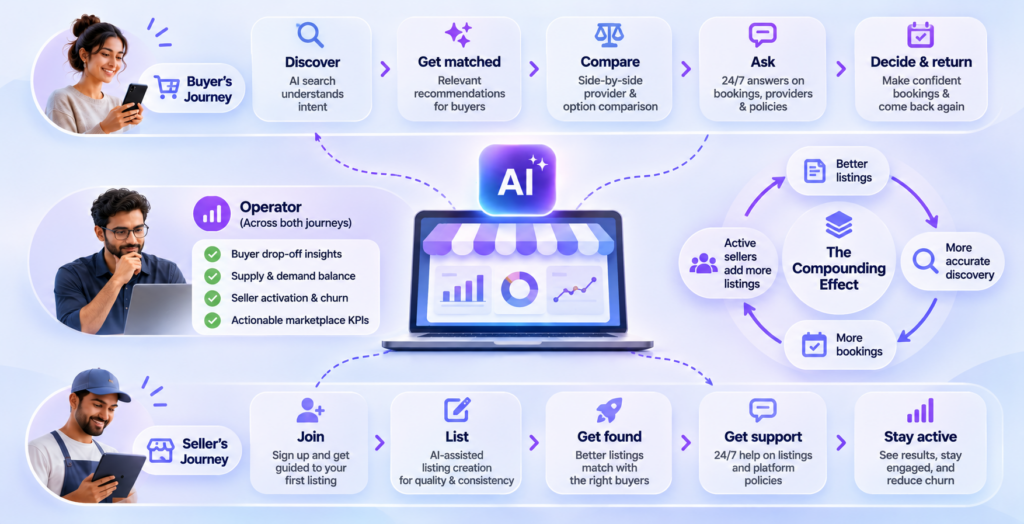
Each capability is useful alone, but the real value comes from how they connect. Here is how they line up along a buyer’s journey and a seller’s journey.
A buyer’s journey
1. Discover. AI search understands what the buyer means, even when listings are written in many different styles.
2. Get matched. Intelligent recommendations surface relevant listings and providers based on behaviour.
3. Compare. AI comparison tools put providers and options side by side.
4. Ask. A 24/7 chat assistant answers questions about bookings, providers and policies.
5. Decide and return. Confident choices lead to bookings and, ideally, repeat purchases, which is one of the KPIs operators track.
A seller’s journey
1. Join. A new seller signs up and is guided into creating a first listing.
2. List. AI-assisted listing creation helps them write a consistent, complete, high-quality listing.
3. Get found. Better listings are easier for AI search and recommendations to match to the right buyers.
4. Get support. The chat assistant helps with listing questions and platform policies at any hour.
5. Stay active. Seeing results keeps sellers engaged, which supports seller activation and reduces seller churn.
Where the operator comes in
AI analytics and BI dashboards sit across both journeys. They show where buyers drop off between search and booking, how well supply and demand are balanced, and where sellers stall or leave. The operator can then act on real signals instead of guesses.
The compounding effect
Better listings make search and recommendations more accurate. More accurate discovery leads to more bookings. More bookings keep sellers active, and active sellers add more listings. Dedicated marketplace AI strengthens that loop on both sides at once, which is something a tool built for one seller cannot do.
Conclusion: Build for the Bazaar
SMB marketplaces don’t need to borrow AI that was designed for someone else. Enterprise platforms are built for large retailers, and single-store tools assume one seller. Neither was made for a two-sided business where matching, trust and seller quality decide success.
Dedicated marketplace AI closes that gap, with search that understands intent, recommendations that match, assistants that support both sides, listings that raise overall quality, and analytics that measure what matters, all added to the platform you already have.
FAQ's
1. Why do SMB marketplaces fall into an AI gap? Enterprise AI is priced and built for large retailers with big teams, and single-store tools assume one seller with one catalogue. Marketplaces are two-sided and need AI built for that model.
2. Why don’t enterprise AI platforms suit marketplaces? They carry cost and implementation effort sized for large retailers, need dedicated data and engineering teams, and are built around a single retailer’s catalogue rather than multi-seller listings.
3. Why don’t single-store tools work for marketplaces? They assume one seller and one inventory, measure success by store sales rather than marketplace health, and have no view of the provider side.
4. What does dedicated marketplace AI include? Aykan’s suite covers AI search and discovery, intelligent recommendations, 24/7 chat assistants, AI-assisted listing creation, comparison tools, and analytics and BI dashboards.
5. Do I need to re-platform to add AI? No. Aykan’s marketplace AI capabilities sit on top of your existing platform.
6. Does this work with Sharetribe? Yes. Sharetribe is the default for our marketplace analytics platform, and adapters let marketplaces on other platforms plug in as well.
7. What metrics does marketplace analytics focus on? Supply and demand balance, search-to-booking conversion, repeat purchases, seller activation and seller churn.
8. What makes a marketplace different from an online store? A marketplace serves two sides, buyers and providers, with different journeys. Many sellers create the listings, matching is the product, support questions come from both sides, and success is measured with marketplace-specific metrics.
9. Why does listing quality matter so much in a marketplace? Because many different sellers write the listings, quality, descriptions and photos vary widely. The whole platform is only as consistent as its messiest listing, so helping sellers create better listings raises the quality of the whole marketplace.
10. How does AI search differ from keyword search? AI search understands what buyers mean, not just the words they type. That matters when many sellers describe similar things in different ways.
11. Who are the AI chat assistants for? Both sides. They support buyers and providers with questions about bookings, providers, payments and policies, and with listing help, around the clock.
12. Does the AI replace my team? No. It handles repeat questions, guides sellers and surfaces insights, so your team can focus on running and growing the marketplace.
13. What can the marketplace analytics platform show me? It focuses on marketplace KPIs: supply and demand balance, search-to-booking conversion, repeat purchases, seller activation and seller churn, rather than generic e-commerce reports.
14. Which marketplace platforms does the analytics platform work with? It connects through adapters. Sharetribe is the default, and marketplaces on other platforms can plug in too.
15. How do I get started? Talk to our team about adding AI search, assistants or analytics to your Sharetribe or custom marketplace. Start with the area where your marketplace feels the most friction.