

Introduction
Artificial Intelligence (AI) is fundamentally reshaping e-commerce by removing the structural advantages once held exclusively by large enterprises. What was previously a landscape dominated by capital, technical talent, and scale is now increasingly defined by intelligence, agility, and automation. AI acts as a great equalizer, empowering small businesses to compete with corporations not by matching their size, but by matching or exceeding their efficiency, personalization, and responsiveness.
By providing affordable, cloud-based, and easy-to-use tools, AI enables entrepreneurs to launch faster, operate leaner, and scale smarter. Organizations such as Entrepreneurs’ Organization consistently emphasize how access to advanced technology is redefining entrepreneurship for the next generation of founders.
Why Should Businesses Choose AI to Transform Traditional E-commerce?
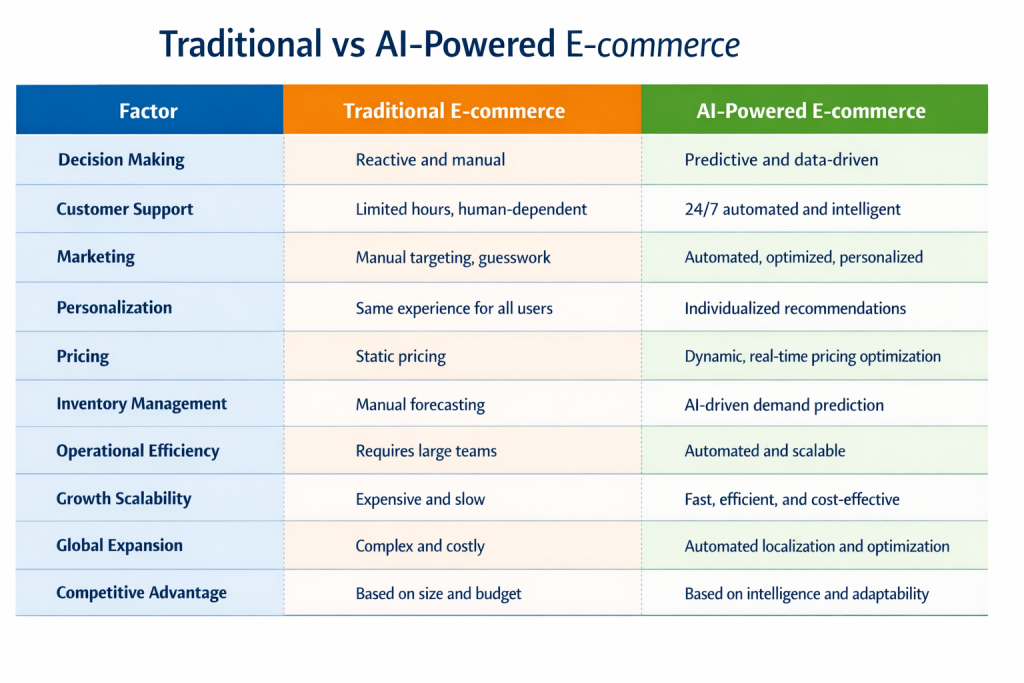
Traditional e-commerce relies heavily on human intervention for decision-making, customer support, marketing optimization, pricing, and operations. This approach is slow, costly, and difficult to scale, especially as customer expectations grow more complex. AI replaces guesswork with real-time intelligence by continuously analyzing customer behavior, market trends, and operational data. It enables businesses to anticipate demand, personalize experiences, automate workflows, and optimize performance without proportional increases in cost or manpower. By embedding intelligence into every layer of the commerce stack marketing, customer experience, logistics, pricing, and fraud prevention, AI allows businesses to move faster, operate leaner, and respond instantly to change.
Instead of reacting to problems after they occur, AI-powered e-commerce systems predict outcomes and act proactively. This transformation turns traditional e-commerce from a static digital storefront into a dynamic, self-optimizing growth engine one that benefits businesses of all sizes, not just the largest players.
How is AI democratizing e-commerce for small businesses?
1. Lowering Financial and Technical Barriers to Entry
Artificial Intelligence has dramatically reduced the cost and complexity of launching and scaling an e-commerce business. In the past, leveraging data-driven decision-making required expensive infrastructure, enterprise software licenses, and in-house data science teams. Small businesses often had to rely on intuition rather than insights because advanced analytics systems were financially out of reach.

Today, open-source and cloud-based AI frameworks such as TensorFlow and scikit-learn provide small businesses with access to advanced analytics, automation, and machine learning at minimal cost. Cloud computing has further eliminated the need for physical servers and IT maintenance, allowing businesses to access powerful computing resources on demand. These tools often operate on subscription or usage-based pricing models, which align naturally with startup budgets and growth stages.
In addition, AI capabilities are now embedded directly into popular e-commerce platforms, payment gateways, and marketing tools, removing the need for complex integrations. Entrepreneurs can access recommendation engines, automated email flows, predictive insights, and fraud detection features without building systems from scratch. Instead of investing heavily upfront, businesses can adopt AI incrementally testing features, measuring ROI, and expanding usage as revenue grows.
2. Empowering Non-Technical Founders Through No-Code Innovation
AI is no longer reserved for developers and engineers. The rise of no-code and low-code platforms has fundamentally changed who can build and deploy intelligent systems. Non-technical founders can now create chatbots, recommendation engines, basic predictive models, and workflow automations using intuitive drag-and-drop interfaces without writing complex code or understanding machine learning algorithms.

This shift dramatically shortens the innovation cycle. Instead of waiting weeks or months for development resources, entrepreneurs can prototype, test, and iterate on ideas in real time. Features can be launched quickly, refined based on user feedback, and scaled only when they prove value. This agility gives small businesses a decisive advantage in fast-moving markets where speed often matters more than perfection.
Equally important, no-code AI tools reduce dependency on expensive technical teams and external agencies. Founders retain direct control over their product logic, customer flows, and automation rules, ensuring that business vision translates accurately into execution. Learning and adoption are further accelerated through professional knowledge ecosystems such as LinkedIn, where entrepreneurs can access tutorials, case studies, peer discussions, and expert insights.
3. Automating Operations for Lean and Efficient Growth
Operational efficiency has traditionally been a major advantage reserved for large enterprises with dedicated teams and complex systems. AI eliminates this imbalance by automating repetitive, time-consuming, and error-prone tasks that once required significant human effort. Core processes such as bookkeeping, invoice generation, order reconciliation, customer onboarding, inventory updates, and reporting can now operate autonomously through AI-powered systems.
By removing manual intervention from routine workflows, AI significantly reduces operational friction. Errors caused by repetitive human input are minimized, data remains consistent across systems, and processes run continuously without delays. This level of reliability allows small businesses to maintain high operational standards even as transaction volumes increase.
For founders and small teams, automation directly translates into leaner operations and lower overhead costs. Instead of hiring additional staff to manage growth, businesses can scale by extending their AI-driven workflows. Time saved on administrative tasks can be redirected toward strategic initiatives such as product development, customer engagement, and market expansion.
In essence, AI enables small companies to scale intelligently rather than linearly. Growth no longer demands a proportional increase in headcount or operational complexity. With automation handling the operational backbone, small businesses can achieve the structural efficiency, consistency, and resilience of much larger organizations while remaining agile and cost-effective.
According to IBM, AI-powered automation can reduce operational costs by up to 30%, while improving process efficiency and accuracy. This allows small businesses to scale without proportionally increasing operational expenses.
4. Delivering Enterprise-Grade Customer Experience
Customer experience has become one of the most decisive factors in e-commerce success, and AI enables small businesses to meet and often exceed modern consumer expectations. In an always-on digital economy, customers expect instant responses, seamless support, and consistent communication. AI makes this level of service possible regardless of business size.

AI-powered customer support platforms such as Zendesk and Intercom provide 24/7 automated assistance, handling common queries related to order status, payments, returns, and product information. These systems respond instantly, reducing wait times and preventing customer frustration—two critical factors in conversion and retention.
By automating routine inquiries, AI frees founders and small teams to focus on high-value, human-centric interactions such as resolving complex issues, engaging loyal customers, and nurturing long-term relationships. Over time, AI systems also learn from interactions, improving response accuracy and personalization with minimal ongoing effort.
What was once a luxury reserved for enterprises with large support teams is now an affordable baseline capability. AI allows small businesses to deliver consistent, professional, and scalable customer experiences building trust, increasing satisfaction, and strengthening brand loyalty without increasing operational costs.
According to McKinsey & Company, personalization powered by AI can increase conversion rates by 10–15%, improve customer satisfaction by 20%, and increase revenue by up to 30%. This demonstrates how AI allows small businesses to achieve measurable growth by delivering relevant and timely customer experiences.
5. Leveling the Marketing and Personalization Playing Field
Marketing has historically favored businesses with large advertising budgets, advanced analytics teams, and deep expertise in campaign optimization. AI fundamentally disrupts this imbalance by automating complex marketing decisions that once required specialized skill sets. Today, small businesses can run highly efficient, data-driven campaigns without needing a dedicated marketing department.

AI-powered marketing tools integrated with ecosystems such as Google and Meta use machine learning algorithms to identify high-intent audiences, optimize ad bids in real time, and continuously improve performance based on live campaign data. Instead of manually testing creatives, audiences, and budgets, AI dynamically adjusts campaigns to maximize return on ad spend ensuring that even modest budgets are used effectively.
Beyond paid advertising, AI enables hyper-personalization across the entire customer journey. By analyzing browsing behavior, purchase history, search patterns, and engagement signals, AI delivers tailored product recommendations, personalized emails, and dynamic offers at the individual level. This level of personalization increases relevance, boosts conversion rates, and significantly improves average order value and customer retention.
For small businesses, this means competing on precision rather than spend. AI allows brands to communicate the right message to the right customer at the right time—without manual effort or large teams. As a result, marketing effectiveness becomes driven by intelligence and adaptability, not budget size, truly leveling the playing field in modern e-commerce.
Research from Salesforce shows that 84% of customers say being treated like a person, not a number, is critical to winning their business, and AI-powered personalization plays a key role in achieving this. Businesses using AI-driven marketing automation also report significant improvements in engagement, conversion rates, and customer retention.
6. Strengthening Operational Intelligence with Predictive and Dynamic Capabilities
AI strengthens operational intelligence by transforming raw historical data into forward-looking, actionable insights. Instead of reacting to trends after they occur, small businesses can now anticipate changes in demand, customer behavior, and market conditions. Predictive analytics models analyze past sales patterns, seasonal fluctuations, customer preferences, and external signals to generate accurate demand forecasts. This enables businesses to prepare for peak seasons, avoid stockouts, and reduce costly overstocking that ties up working capital.

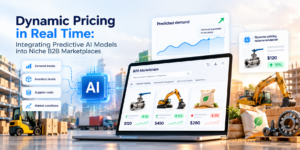
AI-driven dynamic pricing tools further enhance competitiveness by continuously monitoring competitor pricing, customer demand shifts, and purchasing behavior in real time. Smaller retailers can automatically adjust prices based on market conditions without manual tracking, ensuring they remain competitive while protecting profit margins. This level of agility was once exclusive to large algorithm-driven marketplaces but is now accessible to growing brands.
Inventory optimization platforms such as Netstock and Peak use AI to balance supply and demand intelligently, improving turnover rates and cash flow efficiency. At the same time, fraud detection solutions like Sift and Signifyd analyze transaction patterns instantly to flag suspicious activities, reducing financial losses and protecting customer trust.
Together, these predictive and dynamic capabilities allow small businesses to operate with greater confidence and resilience. By reducing uncertainty, mitigating risk, and improving financial stability, AI equips smaller enterprises with the strategic intelligence needed to navigate market volatility and sustain long-term growth.
7. Expanding Global Reach and Democratizing Opportunity
Perhaps the most transformative impact of AI is its ability to eliminate geographic, financial, and structural barriers that once limited e-commerce growth. Traditionally, expanding into international markets required significant investment in localization, logistics, compliance, and payments infrastructure—resources that were largely inaccessible to small businesses. AI fundamentally changes this equation.

AI-powered translation and localization tools automatically adapt product descriptions, customer communications, and support content for different languages and cultural contexts, making global audiences accessible without dedicated regional teams. Intelligent payment optimization systems streamline cross-border transactions by selecting the most effective payment methods, reducing friction at checkout, and improving conversion rates across regions. Automated tax calculations and compliance tools further simplify international selling by handling complex regulatory requirements in the background.
In parallel, AI-driven fraud screening systems continuously monitor transactions to protect businesses from cross-border fraud, while optimized payment routing ensures faster settlements and reduced transaction failures. Together, these capabilities allow even micro-businesses and early-stage startups to operate globally with the confidence and efficiency once reserved for multinational enterprises.
Beyond operational advantages, AI acts as a powerful catalyst for inclusive entrepreneurship. It empowers solopreneurs, creators, and underrepresented founders by removing traditional gatekeepers such as capital access, technical expertise, and geographic location. In this new paradigm, success in e-commerce increasingly depends on creativity, customer understanding, and the strategic use of intelligence—not organizational size or financial strength. AI does not just expand markets; it democratizes opportunity.
Traditional vs AI Powered E-Commerce
Conclusion: AI Is Redefining What’s Possible in E-commerce
AI is transforming e-commerce by making advanced capabilities accessible to businesses of all sizes. By reducing costs, automating operations, personalizing customer experiences, and enabling global reach, AI shifts competitive advantage from scale to intelligence. Success in modern e-commerce is no longer about budget or size—it’s about how effectively businesses use AI to innovate, adapt, and grow.
FAQ's
1. How does AI reduce the cost of starting an e-commerce business?
AI reduces startup costs by replacing expensive infrastructure and large teams with cloud-based, subscription-driven tools. Small businesses can access automation, analytics, marketing optimization, and customer support solutions without heavy upfront investment, allowing them to scale gradually as revenue grows.
2. Do small businesses need technical expertise to use AI in e-commerce?
No. With the rise of no-code and low-code platforms, non-technical founders can deploy chatbots, recommendation engines, automated workflows, and predictive tools without writing complex code. Many AI features are now embedded directly into modern e-commerce platforms.
3. How does AI improve customer experience for small online stores?
AI enhances customer experience through 24/7 chatbot support, personalized product recommendations, automated order tracking, and faster response times. This allows small businesses to deliver enterprise-level service without increasing staff.
4. Can AI help small businesses compete with larger brands in marketing?
Yes. AI-powered advertising tools optimize campaigns in real time, identify high-intent audiences, and maximize return on ad spend. Personalized marketing automation also improves conversion rates and customer retention, allowing smaller brands to compete effectively.
5. Is AI necessary for e-commerce businesses in 2025 and beyond?
Increasingly, yes. As customer expectations rise and competition intensifies, AI becomes essential for automation, personalization, operational efficiency, and data-driven decision-making. Businesses that adopt AI early gain a significant competitive advantage in speed, scalability, and adaptability.