


The act of shopping has always been driven by effort searching through options, comparing prices, evaluating trust, and finally making a decision. But this effort is rapidly being abstracted away by a new layer of intelligence. Autonomous AI agents are emerging as digital intermediaries that do not just assist in shopping, but actively perform it on behalf of users. These systems understand intent in natural language, navigate complex product ecosystems, evaluate trade-offs across price and quality, and increasingly execute transactions end-to-end with minimal human involvement.
What was once a manual, fragmented, and often overwhelming process is evolving into a continuous, automated decision flow where the user defines the goal, and the AI handles the journey.
What Are Autonomous AI Shopping Agents?
Autonomous AI shopping agents are advanced systems designed to operate with a high degree of independence across the entire purchasing lifecycle. Unlike chatbots that respond reactively, these agents function proactively continuously analyzing data, making decisions, and taking actions aligned with user goals.
They are powered by a combination of:
- Large language models for reasoning and natural language understanding
- Machine learning algorithms for pattern recognition and personalization
- API integrations to interact with platforms, vendors, and payment systems
- Workflow orchestration frameworks to execute multi-step processes
Technologies like ChatGPT and Perplexity AI demonstrate how natural language can be transformed into structured decision-making, while frameworks like LangChain enable these systems to operate as coordinated agents rather than isolated tools.
Core Capabilities of AI Shopping Agents
1. Context-Aware Product Intelligence
One of the most significant advancements in AI shopping agents is their ability to interpret intent, not just keywords. Instead of relying on exact-match searches, these systems break down user requirements into multiple dimensions budget, performance, preferences, and context.
For instance, when a user specifies a need for a “high-performance laptop for creative work under a certain budget,” an AI agent evaluates:
- Hardware specifications (CPU, GPU, RAM)
- Real-world performance benchmarks
- User reviews and sentiment
- Long-term reliability and brand reputation
Tools like ChatGPT (with browsing and reasoning capabilities) and Perplexity AI aggregate and synthesize this information into structured recommendations rather than raw search results.
At the platform level, companies such as Amazon and Flipkart are evolving their search systems to incorporate AI-driven intent recognition, making discovery more conversational and less transactional.
2. Multi-Platform Price Intelligence
Price comparison has traditionally required manual effort across multiple websites. Autonomous AI agents eliminate this friction by continuously scanning and analyzing pricing data in real time.
These agents go beyond simple comparisons by:
- Tracking historical price trends to identify the best purchase timing
- Detecting hidden costs such as shipping, taxes, or platform fees
- Evaluating bundled offers (bank discounts, exchange programs, coupons)
For example, tools like Google Shopping aggregate listings across sellers, while Honey automatically applies coupon codes. Autonomous agents extend this functionality by combining both capabilities and adding decision-making logic.
An AI agent might determine that a product listed at a higher base price on one platform is actually cheaper after applying layered discounts something that often goes unnoticed in manual comparisons.
3. Automated Negotiation and Deal Optimization
Negotiation has historically been limited to offline or high-value transactions, but AI agents are bringing this capability into digital commerce.
Using frameworks like AutoGPT and LangChain, developers can build agents that:
- Send structured queries to multiple vendors
- Evaluate responses based on pricing, delivery timelines, and terms
- Iterate toward the most favorable deal
In flexible marketplaces built on platforms like Sharetribe, where quotation-based or customized pricing models are common, AI agents can simulate human-like negotiation at scale.
This capability is particularly impactful in environments where pricing is not fixed, enabling dynamic deal optimization without manual intervention.
4. Personalized Decision-Making Systems
Personalization in e-commerce has traditionally been based on aggregated user behavior (“people like you also bought”). Autonomous AI agents move toward individualized intelligence, where decisions are tailored to a single user’s unique profile.
These agents analyze:
- Purchase history and frequency
- Spending patterns and budget sensitivity
- Brand loyalty and preferences
- Contextual signals such as urgency or occasion
Platforms like Shopify are embedding AI capabilities that allow merchants to deliver highly personalized experiences, while solutions like Klarna AI Assistant showcase how conversational AI can guide users through tailored decision journeys.
The result is not just better recommendations, but decisions that align with both functional needs and personal values.
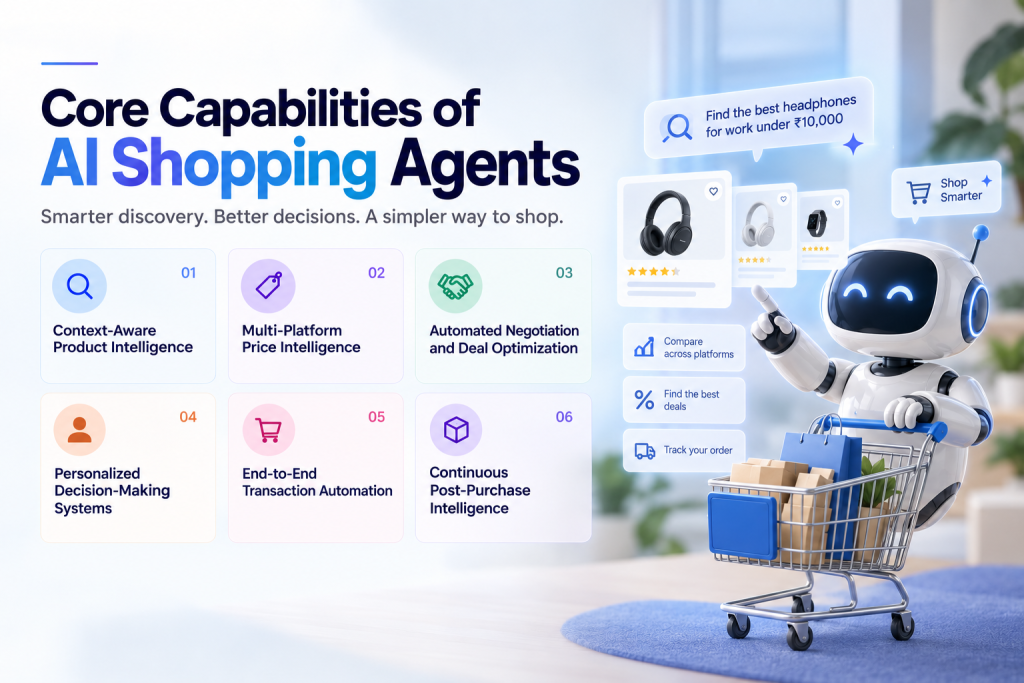
5. End-to-End Transaction Automation
A defining characteristic of autonomous AI agents is their ability to execute transactions without requiring constant user input.
This involves:
- Managing shopping carts across platforms
- Applying optimal discounts and coupons
- Selecting the best payment method
- Completing checkout processes
Payment platforms like Stripe enable programmable transactions, allowing AI agents to trigger payments securely. Similarly, consumer-facing apps like Google Pay and Paytm facilitate seamless payment experiences.
When integrated effectively, these systems reduce the entire purchasing process to a single user instruction.
6. Continuous Post-Purchase Intelligence
The role of AI agents extends beyond the moment of purchase into continuous optimization.
After a transaction is completed, agents can:
- Monitor delivery status and logistics updates
- Detect price drops and initiate refund or replacement requests
- Automate return processes based on predefined conditions
- Manage subscriptions and recurring purchases
This transforms shopping into an ongoing lifecycle rather than a one-time activity, ensuring that users continue to receive value even after the transaction is complete.
Technology Stack Powering Autonomous Agents
| Layer | Role in the System | Key Functionality | Examples |
|---|---|---|---|
| Language Models | Reasoning Core | Understand user intent, interpret natural language, break complex requests into structured requirements | GPT models |
| Agent Frameworks | Orchestration Layer | Break tasks into steps, manage workflows, maintain memory, and execute tool calls | LangChain, AutoGPT |
| Data Aggregation Layers | Information Source | Collect product data, pricing, availability, and reviews from multiple platforms and normalize it | Amazon, Flipkart |
| Payment Infrastructure | Transaction Layer | Enable secure, API-driven payments, refunds, subscriptions, and checkout automation | Stripe, Google Pay, Paytm |
| Cloud Systems | Scalability Layer | Provide compute power, real-time processing, distributed execution, and system reliability | AWS, Google Cloud, Microsoft Azure |
Strategic Implications for Businesses
The rise of autonomous AI agents is not just a technological shift it is a structural change in how customers discover, evaluate, and purchase products. Businesses will increasingly operate in an environment where AI systems, not humans, act as the primary decision-makers.
Shift in Customer Interaction
In traditional e-commerce, brands interact directly with customers through websites, apps, advertisements, and sales funnels. However, with autonomous AI agents, this interface layer begins to disappear. Instead of users browsing products, AI agents will interpret user intent and interact directly with marketplaces on their behalf.
This means the “customer” is no longer just a person it is also the AI system acting as a proxy. For example, instead of a user visiting Amazon to compare products, an AI agent may directly query listings, filter options, and present only the final recommendation. Over time, businesses will need to optimize not only for human users but also for AI-driven discovery systems.
Increased Transparency
Autonomous agents thrive on data visibility and structured comparison. As they aggregate information from multiple platforms, pricing, features, and reviews become fully transparent across the ecosystem. This reduces the effectiveness of traditional marketing tactics such as selective visibility or fragmented pricing strategies.
For example, if a product is priced differently across Flipkart and other marketplaces, an AI agent will instantly detect and highlight the difference. This level of transparency intensifies competition, pushing businesses toward more dynamic pricing strategies and value-based differentiation rather than information control.
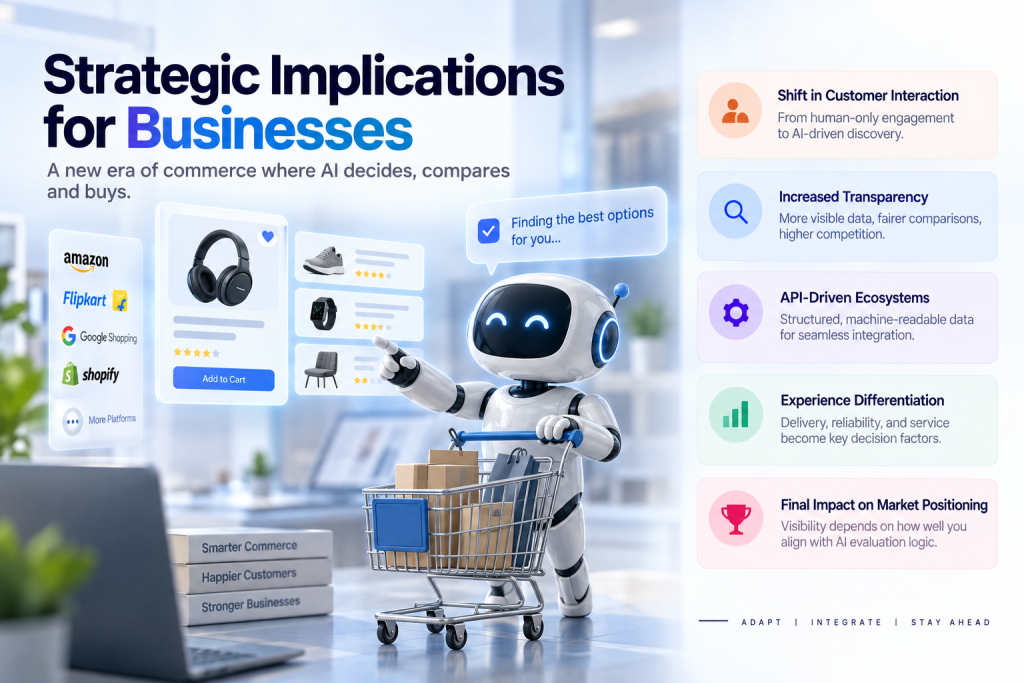
API-Driven Ecosystems
As AI agents become more prevalent, businesses will need to expose structured, machine-readable data through APIs. Without this, agents will struggle to interact efficiently with their systems.
Platforms like Shopify already demonstrate how API-first architecture enables integrations with third-party tools, apps, and services. In the future, product catalogs, pricing engines, inventory systems, and even customer service workflows will need to be accessible programmatically so AI agents can search, compare, and transact seamlessly.
Companies that fail to build API-ready systems risk being excluded from AI-driven purchasing flows entirely.
Experience Differentiation
When product discovery and comparison become automated, businesses can no longer rely solely on visibility or advertising to win customers. Instead, differentiation will depend on operational excellence and experience quality.
Factors such as delivery speed, product reliability, return policies, and after-sales service will become critical ranking signals for AI agents. For instance, even if two products are similar in price and specifications, an AI system may prefer the one with faster delivery or better customer satisfaction history.
This shifts competition from “who is seen the most” to “who delivers the best experience consistently.” Platforms like Stripe already reflect this shift by prioritizing reliability, uptime, and seamless transaction experiences as core value drivers.
Final Impact on Market Positioning
In an AI-mediated commerce environment, visibility is no longer guaranteed by marketing spend or platform presence. Instead, it is determined by how well a business aligns with AI evaluation logic structured data, transparent pricing, reliable operations, and seamless integration.
Businesses that adapt to this shift will become preferred choices for AI agents. Those that do not risk becoming invisible in automated decision-making systems, regardless of how strong their brand presence once was.
Challenges and Limitations
Although autonomous AI agents have the potential to transform shopping and commerce, their real-world adoption is still constrained by several practical, technical, and ethical challenges. These limitations determine how quickly and safely such systems can scale into mainstream usage.
Trust
One of the biggest barriers to autonomous AI shopping is user trust. Shopping decisions often involve money, personal preferences, and confidence in a purchase. Delegating this responsibility to an AI agent requires users to believe that the system will make decisions that are accurate, transparent, and aligned with their expectations.
For example, a user may ask an AI agent to find a laptop under ₹80,000 for professional work. The agent could compare specifications, reviews, pricing, warranty, delivery timelines, and seller ratings before recommending an option. However, the user may still want to know why that particular laptop was selected and whether other options were considered.
Trust becomes even more important when an AI agent moves from recommendations to transactions. A user may be comfortable allowing an agent to compare products, but may still want confirmation before it spends ₹70,000 on a laptop. For smaller recurring purchases, however, the user may be comfortable giving the agent permission to complete the transaction automatically.
This creates the need for different levels of autonomy. An agent could operate independently for low-risk actions while requesting human approval for high-value, unusual, or irreversible transactions.
Another important factor is explainability. Users should be able to understand the key factors behind an agent’s recommendation — such as price, quality, delivery time, reviews, or personal preferences — rather than receiving a decision with no explanation.
Building trust therefore requires more than accurate recommendations. AI shopping agents need clear permissions, transparent decision-making, predictable behaviour, and mechanisms that allow users to intervene when necessary.
That makes Trust much more substantial without repeating Privacy.
Privacy
Privacy becomes significantly more complex when an AI agent moves from recommending products to actually acting on a user’s behalf.
A traditional e-commerce website may collect information such as browsing activity, purchase history, location, preferences and payment information. An autonomous AI shopping agent may need access to several of these data points simultaneously to make decisions on behalf of the user.
For example, consider a user who asks an AI agent to manage recurring household purchases. Over time, the agent could learn:
- What products the user regularly buys
- How frequently those products are purchased
- The user’s preferred brands
- Typical spending limits
- Preferred payment methods
- Delivery address and location
- Shopping patterns and purchase timing
- Products the user searches for but does not purchase
Individually, each piece of information may appear relatively ordinary. Together, they can create a detailed picture of a person’s habits, preferences and financial behaviour.
What Makes Privacy Different in Agentic Commerce?
The privacy challenge becomes more significant because the AI agent may need to interact with multiple systems. A single shopping task could involve a marketplace, product catalog, payment provider, logistics service and customer-support system.
This creates several questions:
What information does the agent actually need?
An agent searching for a pair of shoes does not necessarily need access to a user’s complete purchase history or financial information. Systems should follow the principle of collecting and exposing only the data required for a specific task.
Who can access the data?
If an AI agent connects with multiple merchants and services, organizations need clear boundaries around which information can be shared with each system.
How long is the information retained?
Shopping preferences and transaction information may remain useful for personalization, but retaining sensitive data indefinitely increases the potential impact of a security incident.
Can the user revoke access?
Users should be able to modify permissions, stop an agent from accessing specific information, or disable automated purchasing when they choose.
Privacy Risks in Autonomous Shopping
Several privacy risks become particularly important:
- Excessive data access: Giving an agent more information than it needs increases the potential exposure of sensitive data.
- Data leakage: Information passed between AI systems, merchants and third-party services could be exposed if integrations are not properly secured.
- Credential exposure: Payment credentials and account access require strong protection and should not be unnecessarily exposed to the AI model itself.
- Unintended profiling: Continuous analysis of shopping behaviour could reveal sensitive patterns about a user’s lifestyle, preferences or financial behaviour.
- Third-party data sharing: Agents may interact with multiple external platforms, creating additional points where information could potentially be processed or stored.
- Prompt or instruction manipulation: Malicious content encountered by an agent could attempt to influence its behaviour or cause it to reveal information or perform an unauthorized action.
Building Privacy Into Agentic Commerce
Privacy therefore needs to be treated as an architectural requirement rather than an afterthought.
A secure agentic commerce system should incorporate:
- Explicit permissions defining what the agent can access and what actions it can perform.
- Least-privilege access, ensuring the agent receives only the information required for a specific task.
- Tokenized payment credentials rather than exposing raw payment information to the AI system.
- Encryption for sensitive data both in transit and at rest.
- Clear consent mechanisms so users understand what information is being accessed and why.
- Audit trails recording important agent actions and transactions.
- Data retention controls defining how long information is stored.
- Human approval thresholds for high-value or unusual purchases.
- The ability to revoke permissions when users no longer want an agent to act autonomously.
The goal is not to eliminate data use. Autonomous shopping depends on data to provide useful experiences. The goal is to ensure that data access is purpose-driven, controlled, transparent and proportional to the task being performed.
As AI agents become more deeply integrated into commerce, privacy will increasingly become a core part of the trust relationship between users, AI systems and businesses.
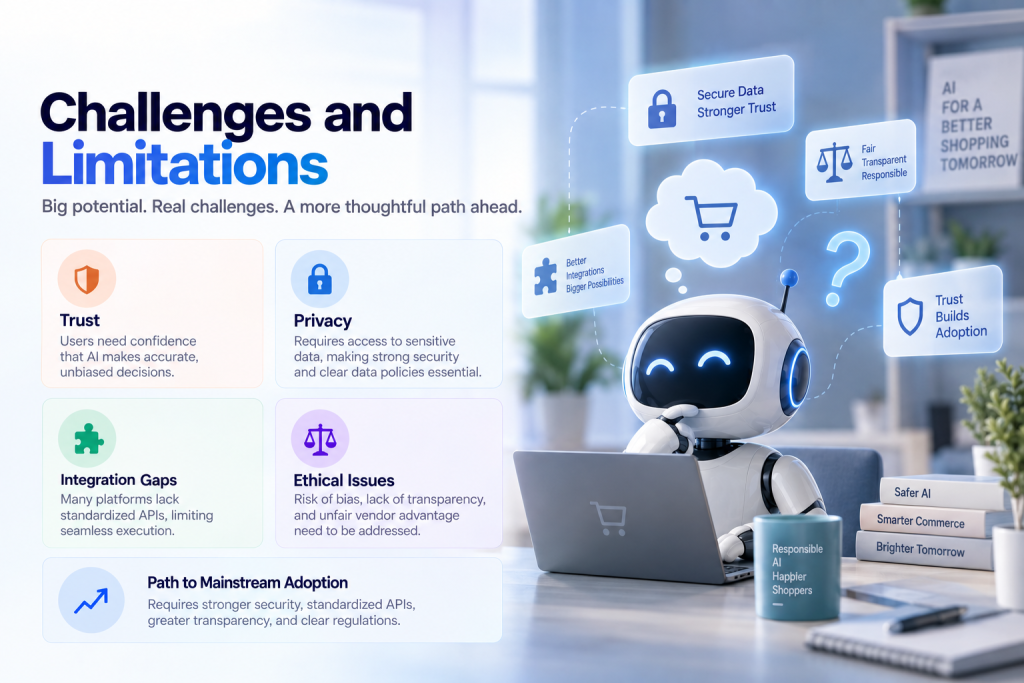
Integration Gaps
A major technical limitation is the lack of standardized integration across platforms. Many e-commerce systems and vendors do not expose APIs or structured data that AI agents can easily interact with.
While platforms like Shopify offer API-first architectures, many smaller marketplaces still rely on static websites or fragmented systems. This forces AI agents to rely on scraping or incomplete data, reducing accuracy and reliability. Without widespread API adoption, autonomous agents cannot achieve full end-to-end execution across the commerce ecosystem.
For example, imagine a customer asking an AI agent to find the best washing machine under ₹40,000 with delivery within three days. The agent may find several products across different marketplaces, but if one retailer does not provide real-time inventory or delivery information through an API, the agent may work with outdated information. A product shown as available could already be out of stock, or the displayed delivery date could change during checkout.
The problem becomes even more complex when the agent has to complete the purchase. One marketplace may provide APIs for product search, inventory and checkout, while another may only expose basic product information. The AI agent can therefore compare the products but may not be able to complete the same level of automation across both platforms.
This creates a significant gap between what an AI agent can understand and what it can actually execute. For autonomous commerce to work reliably, businesses need machine-readable product information, real-time inventory and pricing data, secure APIs, and transaction-ready integrations.
Ethical Issues
As AI agents begin making decisions on behalf of users, ethical concerns become increasingly important. These include transparency in recommendations, fairness in pricing comparisons, potential bias in product selection, and accountability for automated decisions.
Consider a situation where an AI agent is comparing two similar products. One product may receive greater visibility because of the way the marketplace ranks listings, commercial relationships, sponsored placements, or biases within the underlying data. If the agent simply accepts these signals without evaluating them critically, it could repeatedly recommend one seller over another without the user understanding why.
For instance, an AI system might unintentionally prioritize products from certain vendors due to training data bias or commercial incentives. This could distort fair competition across platforms like Flipkart and others.
Another concern is transparency. If an AI agent recommends a product because it considers the seller more reliable, the price more competitive, or the delivery time shorter, users should ideally be able to understand the key factors behind that recommendation. Without this visibility, users may find it difficult to distinguish between a genuinely relevant recommendation and one influenced by commercial or algorithmic factors.
Ensuring accountability — knowing why an agent chose a particular product or vendor — is therefore critical for building responsible AI systems.
Path to Mainstream Adoption
Overcoming these challenges will require more than improving the intelligence of AI models. Autonomous commerce depends on the ability of AI agents to operate securely across products, marketplaces, payment systems, logistics providers, and customer-service platforms.
The first requirement is reliable and structured data. Product information, pricing, inventory, delivery timelines, seller information, and return policies need to be accurate and accessible in machine-readable formats. Without reliable data, even an advanced AI agent can make an incorrect decision.
The second requirement is secure integration infrastructure. Businesses will need APIs and standardized interfaces that allow AI agents to search products, check availability, apply offers, manage orders, and interact with payment systems. These integrations also need appropriate authentication, authorization, monitoring, and audit mechanisms.
The third requirement is clear user control. Not every purchase should necessarily be fully autonomous. Businesses and AI platforms will need mechanisms for defining spending limits, approval requirements, preferred vendors, and other user-specific rules. This allows users to benefit from automation without giving an agent unrestricted control.
Finally, businesses will need to establish trust and governance frameworks around agentic commerce. Users should know what an agent can access, what actions it can perform, how decisions are made, and how those actions can be reviewed or reversed when something goes wrong.
As these capabilities mature, autonomous AI agents can gradually move from assisting with product discovery to handling increasingly complex parts of the purchasing journey. The transition is therefore likely to be incremental, with businesses first adopting AI for search and recommendations before expanding toward automated transactions and post-purchase management.
The path to mainstream adoption ultimately depends on bringing together trust, privacy, reliable data, secure integrations, transparent decision-making, and appropriate human oversight. When these foundations are in place, autonomous AI agents can become a more dependable layer within the commerce ecosystem rather than simply another shopping interface.
The Road Ahead
Autonomous AI agents are gradually reshaping commerce into a system where decision-making is no longer manual, but continuous, data-driven, and increasingly automated. Instead of users actively searching, comparing, and purchasing products, AI agents interpret intent, understand preferences, and monitor real-time market conditions to make optimized decisions on their behalf. Shopping will become increasingly invisible, embedded seamlessly into everyday digital experiences where purchases are triggered by need, context, or predefined goals rather than explicit user action.
As these systems evolve further, AI agents will move beyond platform-specific interactions and begin directly engaging with vendor systems, APIs, and marketplaces to negotiate pricing, check availability, and finalize transactions in real time. This will enable a constantly adaptive commerce environment where decisions are optimized dynamically based on live signals such as pricing fluctuations, inventory changes, user behaviour patterns, and delivery constraints.
Over time, the traditional separation between searching, comparing, and buying will dissolve completely, giving rise to a fully integrated and intelligent ecosystem. This marks the emergence of a new paradigm—autonomous commerce where AI systems act as the primary decision-makers in the purchasing journey.
Conclusion
Autonomous AI shopping agents represent a fundamental shift in how purchasing decisions are made and executed. By combining intelligence, personalization, and automation, they reduce friction and improve outcomes across the entire shopping journey.
As adoption accelerates, these agents will move from being optional tools to essential intermediaries reshaping the relationship between consumers, businesses, and technology in the digital economy.
FAQ's
1. What are autonomous AI shopping agents?
Autonomous AI shopping agents are intelligent systems that can understand a user’s shopping requirements, search for products, compare options, make recommendations and, within defined permissions, complete purchases on the user’s behalf.
Unlike traditional recommendation engines, these agents can perform multiple steps of the shopping journey instead of simply suggesting products.
2. How are AI shopping agents different from regular chatbots or recommendation engines?
Traditional chatbots primarily respond to questions, while recommendation engines typically suggest products based on browsing or purchase behaviour.
Autonomous AI agents are more proactive and goal-driven. They can interpret a broader objective, gather information from multiple sources, evaluate trade-offs and take actions such as adding products to carts, applying discounts or completing transactions when authorized.
3. How does an autonomous AI shopping agent work?
The process generally begins when a user provides a goal, such as finding a laptop within a particular budget.
The agent interprets the requirements, searches available products, evaluates factors such as price, specifications, reviews and delivery, presents or selects suitable options, and then proceeds with the purchase according to the user’s permissions.
After the purchase, it can continue monitoring delivery, returns, refunds or recurring purchases.
4. What is agentic commerce?
Agentic commerce refers to a commerce model where AI agents act on behalf of consumers to perform parts or all of the purchasing journey.
Instead of manually searching, comparing and checking out, users provide goals, preferences and constraints while the AI agent performs the associated tasks.
5. Are AI shopping agents already being used in real life?
Yes, several AI-powered shopping experiences already provide parts of this functionality, although fully autonomous end-to-end purchasing is still evolving.
Tools and platforms such as Perplexity and Klarna have introduced AI-assisted product discovery and shopping experiences, while payment and commerce providers are developing infrastructure to support more automated transactions.
6. What are agentic payments?
Agentic payments are transactions initiated by an AI agent on behalf of a user within predefined permissions or spending rules.
For example, a user could authorize an agent to purchase household supplies below a specific spending limit. The agent could then complete an eligible purchase without requiring manual approval for every transaction.
7. Can an AI shopping agent make a purchase without asking me?
It can, but only when the system has been designed and authorized to operate within predefined rules.
For example, a user might allow an agent to automatically reorder a frequently purchased product below ₹2,000. A higher-value or unusual purchase could instead require explicit confirmation.
The key is to define clear authorization boundaries so the agent knows when it can act independently and when human approval is required.
8. What are the main privacy risks of autonomous AI shopping agents?
Privacy risks can arise because AI agents may need access to information such as purchase history, preferences, delivery details and payment-related information.
Additional risks can occur when an agent interacts with multiple third-party services. Strong permissions, least-privilege access, encryption, tokenized credentials, data-retention controls and clear user consent can help reduce these risks.
9. How can businesses prepare their platforms for AI shopping agents?
Businesses need to make their commerce systems accessible to machines as well as humans.
This includes maintaining accurate and structured product data, exposing reliable APIs for product search and inventory, providing clear pricing and availability information, and establishing secure mechanisms for checkout and transactions.
A business should also define governance rules covering agent identity, permissions, monitoring and transaction limits.
10. What happens if an AI agent makes the wrong purchase?
The system should provide mechanisms for human intervention, transaction monitoring and post-purchase resolution.
For example, an agent could be configured to request approval when a purchase exceeds a predefined amount or when the selected product does not fully match the user’s requirements.
Clear return, refund and cancellation workflows are also important because autonomous commerce does not eliminate the possibility of errors.
11. What technologies power autonomous AI shopping agents?
Autonomous AI shopping agents typically combine large language models, machine learning, APIs, data aggregation, agent orchestration frameworks, payment infrastructure and cloud systems.
Together, these technologies allow an agent to understand user intent, retrieve information, reason about available options and execute multi-step workflows.
12. What are the biggest challenges of agentic commerce?
The major challenges include user trust, privacy, data quality, integration complexity, security, payment authorization, bias and the need for clear human oversight.
Businesses also need to ensure that their product catalogs, pricing, inventory and transaction systems can be accessed reliably by AI agents.