
Introduction
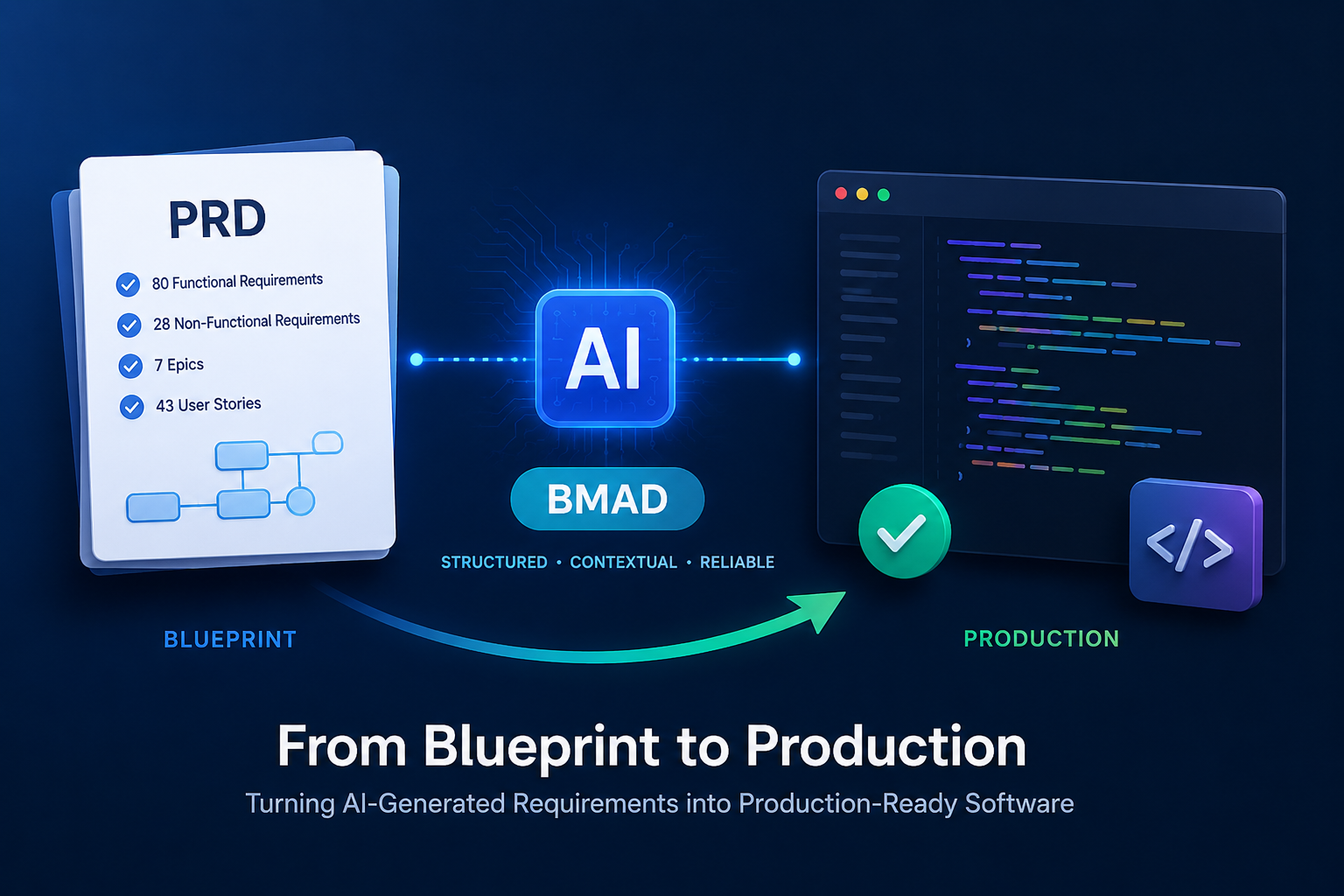
A Product Requirements Document (PRD) is often seen as the finish line of planning. In reality, it’s where the real work begins. A well-crafted PRD can capture every business goal, user journey, and functional requirement, but it doesn’t write a single line of code. It doesn’t make architectural decisions, ensure consistency across dozens of features, or prevent development from drifting away from the original vision. Imagine having a complete blueprint for a platform—80 functional requirements, 28 non-functional requirements, 7 epics, and 43 detailed user stories. On paper, everything is ready.
Yet one critical question remains: How do you transform that blueprint into production-ready software without AI forgetting what it built yesterday, reinventing existing functionality, or slowly introducing inconsistencies into the codebase? This is where many AI-assisted development projects begin to struggle. The challenge isn’t creating specifications; it’s implementing them accurately, consistently, and at scale.
In this article, we’ll explore how BMAD (Breakthrough Method for Agile AI-Driven Development) bridges the gap between planning and implementation by combining structured workflows, disciplined context management, and an AI orchestration layer designed specifically for software engineering. The result isn’t just code that works—it’s software that stays aligned with the original vision from the first user story to the final deployment.
What is BMAD?
Before diving into the implementation process, it’s important to understand what BMAD (Breakthrough Method for Agile AI-Driven Development) actually is.
BMAD is an AI-driven software development methodology that combines structured software engineering practices with specialized AI agents. Instead of relying on a single AI model to perform every task, BMAD assigns different AI agents to different stages of the Software Development Life Cycle (SDLC). Each agent has a clearly defined responsibility, allowing work to move through a structured pipeline while preserving business context, technical decisions, and implementation knowledge.
At the heart of BMAD is an AI orchestration layer that coordinates the entire workflow. It ensures that specialized AI agents work in the correct sequence, shares the right context between stages, and preserves implementation knowledge throughout the software development lifecycle. This coordinated approach enables AI agents to collaborate effectively while delivering consistent, traceable, and production-ready software.
The Challenge
Artificial Intelligence has become incredibly capable of writing code. Ask an AI model to create a login page, build a dashboard, generate database models, or develop REST APIs, and you’ll likely receive a working implementation within minutes.
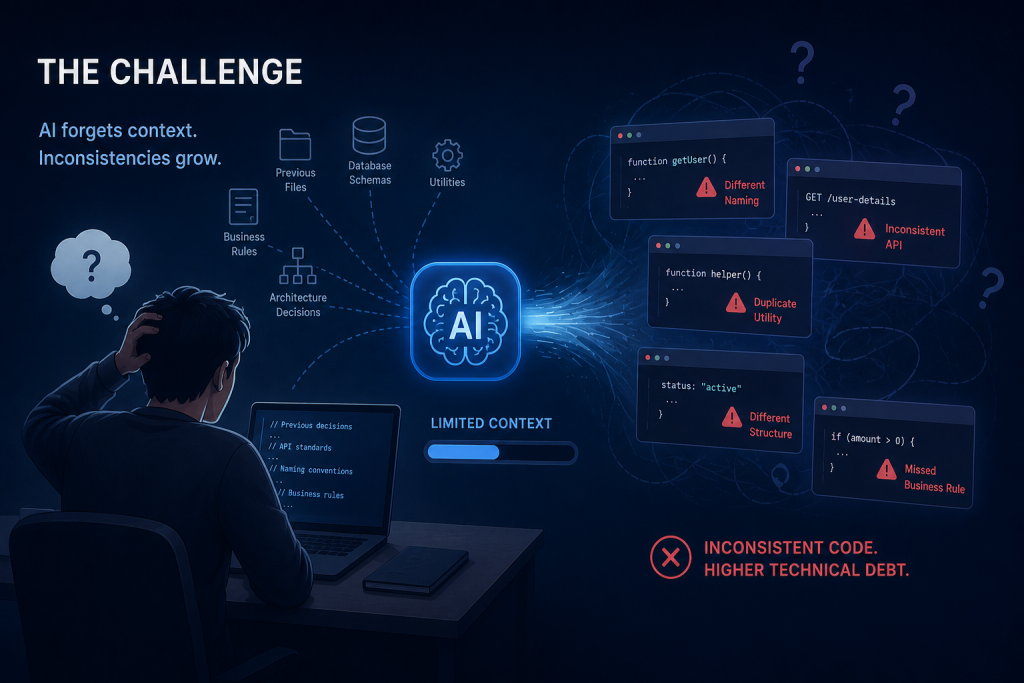
As software projects grow, AI faces several challenges that can impact the quality and maintainability of the codebase.
1. AI Doesn’t Remember Previous Development Sessions
Unlike a human developer who gradually builds knowledge about a project, AI only knows the information provided in the current prompt. It doesn’t automatically remember architectural decisions, coding standards, or implementation details from previous conversations.
As a result, every new development session starts with limited context unless that information is deliberately supplied again.
2. Context Gets Lost as the Project Grows
Enterprise applications evolve continuously. New APIs are introduced, database schemas change, shared utilities are created, and business rules become more complex.
Without access to this evolving project knowledge, AI cannot make decisions based on the complete picture, increasing the risk of inconsistencies.
3. Small Inconsistencies Slowly Become Technical Debt
When AI lacks context, it often makes reasonable—but incorrect—assumptions. Over time, these assumptions accumulate and reduce the overall quality of the application.
Some common examples include:
- Recreating utility functions that already exist.
- Using different naming conventions across modules.
- Generating API endpoints that don’t exist.
- Ignoring architectural patterns established earlier.
- Missing important business rules because they weren’t included in the prompt.
Individually, these mistakes may seem insignificant. Collectively, they make the application increasingly difficult to maintain and extend.
4. Bigger AI Models Don’t Solve the Problem
A common misconception is that newer or larger AI models will automatically eliminate these issues.
While modern models are becoming better at reasoning and coding, they still rely entirely on the information available during a conversation. Even the most advanced AI cannot follow architectural decisions or business logic that it has never been given.
The limitation isn’t intelligence—it’s access to the right context.
5. Enterprise Software Demands Consistency
Building production software isn’t just about generating code that works.
Every feature must:
- Follow the established architecture.
- Reuse existing components wherever possible.
- Maintain consistent coding standards.
- Respect business rules and validation logic.
- Integrate seamlessly with previously implemented features.
Achieving this level of consistency across dozens of user stories requires much more than good code generation, it requires a structured development process.
6. Context Is the Real Challenge
The biggest obstacle in AI-assisted software development isn’t the AI model itself.
It’s ensuring that the model receives the right information at the right time.
Instead of expecting AI to remember an entire codebase, the development process must deliver the precise context needed for each implementation. This is the core philosophy behind BMAD providing AI with structured, story-specific context so it can consistently produce high-quality, production-ready software.
The Solution
If the problem is missing context, the solution isn’t asking AI to remember more; it’s making sure AI never has to guess.
That’s exactly what BMAD (Breakthrough Method for Agile AI-Driven Development) does.
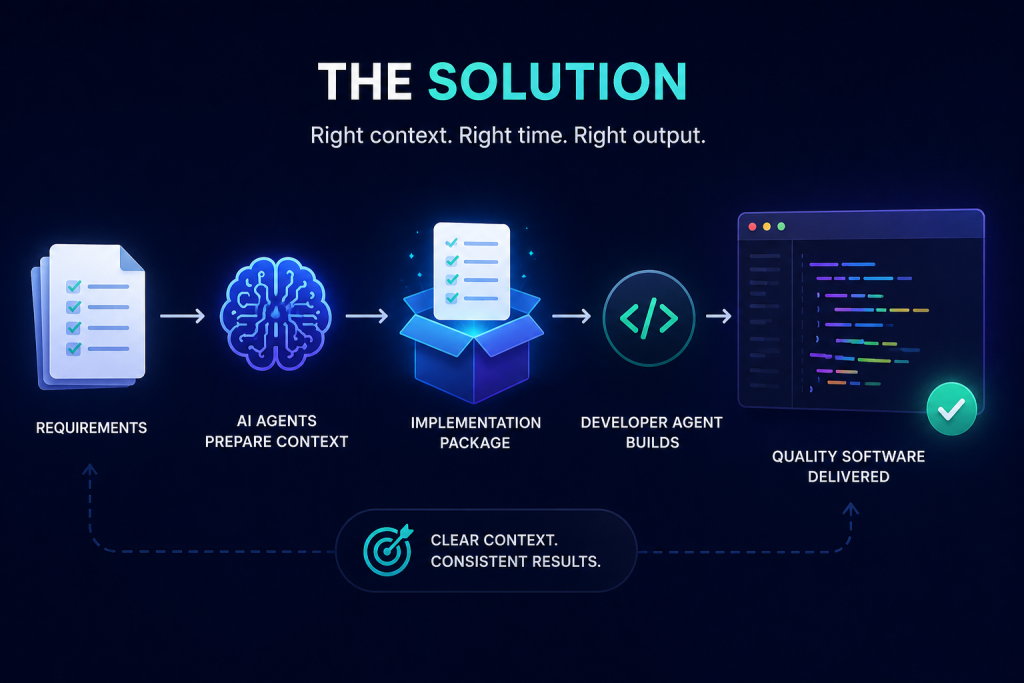
Instead of expecting a Developer Agent to search through hundreds of documents, previous conversations, and architecture diagrams, BMAD prepares everything before development begins. Each AI agent has a clearly defined role, ensuring the right information reaches the right agent at the right time.
Think of it like constructing a building. A builder doesn’t decide where the walls should go after arriving on-site. The architect creates the blueprint, engineers define the specifications, and the project manager organizes the work. Only then does construction begin.
BMAD follows the same principle. The Developer Agent isn’t responsible for interpreting requirements or understanding the entire system. Its job is simple:
Build what has already been planned.
Every User Story Becomes an Implementation Package
Rather than being a simple task, every user story becomes a complete implementation package containing everything the Developer Agent needs to build the feature correctly.
Each story includes:
- Business context
- Functional requirements
- Architecture references
- Technical constraints
- Acceptance criteria
- Dependencies on previous stories
- Implementation notes and decisions
With all this information readily available, the Developer Agent doesn’t need to search for answers or make assumptions. It can focus entirely on writing high-quality code.
Better Context, Better Software
By the time development begins, the requirements have been defined, the architecture has been reviewed, dependencies have been identified, and previous implementation decisions have already been documented.
This structured approach results in:
- Consistent implementation
- Fewer AI hallucinations
- Less rework
- Faster development
- Better alignment with the original product vision
Instead of spending time searching for context, the AI spends its time building software, exactly what it’s meant to do. That’s the core idea behind BMAD: provide the right context before development begins, so implementation becomes faster, more accurate, and consistently reliable.
How the Implementation Works?
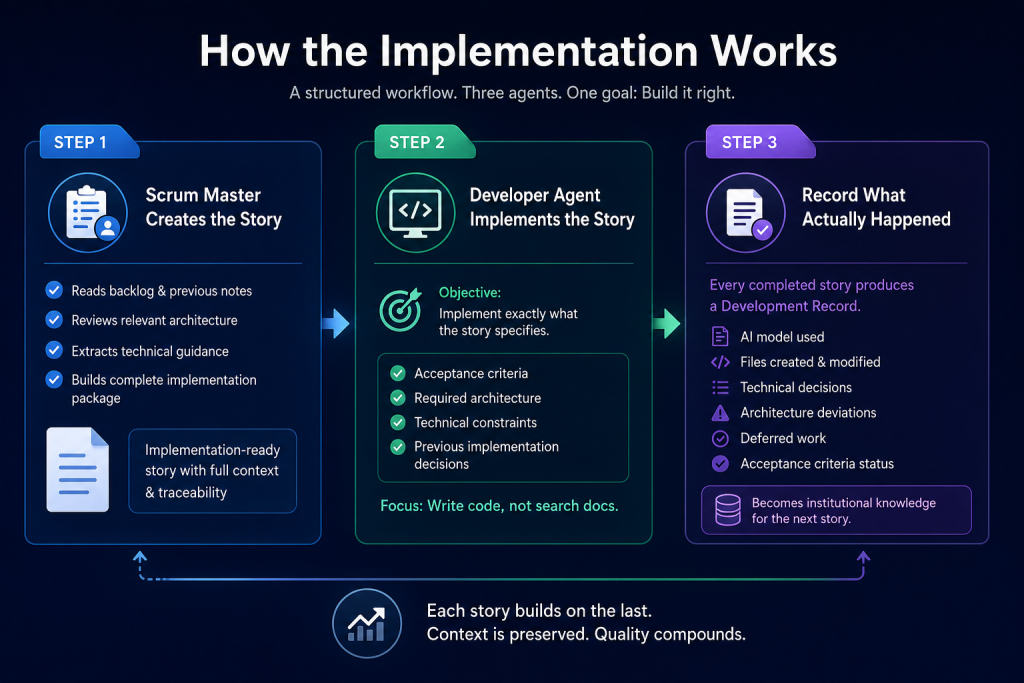
One of the biggest strengths of BMAD is that every AI agent has one clearly defined responsibility. Instead of asking a single AI to plan, design, and develop everything, the work is divided into a structured workflow. This keeps every story consistent and ensures the Developer Agent always has the right context before writing code.
The implementation follows three simple steps.
Step 1: The Scrum Master Prepares the Story
Before development begins, the Scrum Master Agent prepares a complete implementation-ready story. Its responsibility is to gather all the information the Developer Agent will need, eliminating the need for additional research.
To create the story, the Scrum Master:
- Reviews the product backlog
- Identifies the next story in sequence
- Reads implementation notes from previous stories
- Extracts only the relevant architecture documents
- Collects technical guidance and dependencies
- Creates a complete implementation package
Every technical detail is referenced back to the architecture documentation, making each story fully traceable and preventing assumptions during development.
Step 2: The Developer Agent Builds the Feature
Once the story is ready, it is handed over to the Developer Agent.
Its objective is intentionally simple:
Implement exactly what the story specifies.
Since the story already contains everything required, the Developer Agent doesn’t waste time searching for documentation or interpreting requirements.
Each story already includes:
- Acceptance criteria
- Architecture references
- Technical constraints
- Previous implementation decisions
- Business rules and dependencies
This allows the Developer Agent to focus entirely on building high-quality, production-ready code.
Step 3: Capture What Was Actually Built
Writing the code isn’t the end of the process.
Every completed story generates a Development Record that documents exactly what happened during implementation. This creates a valuable knowledge base for future development.
Each record includes:
- AI model used
- Files created and modified
- Technical decisions made
- Architecture deviations (if any)
- Deferred work
- Acceptance criteria status
For example, instead of simply marking a story as “Complete,” the record might say:
- 9 of 10 acceptance criteria completed
- Unit tests deferred for a later phase
- Performance optimization applied
- Architecture deviation documented with justification
This documentation becomes the starting point for the next story. Instead of beginning with an empty context, every implementation builds on the knowledge captured from the previous one, creating a continuous and reliable development workflow.
BMAD vs Traditional AI-Assisted Development
For organizations building enterprise applications, the difference goes beyond productivity. BMAD provides a repeatable and scalable development methodology that improves consistency, reduces rework, and ensures every implementation remains aligned with business and technical objectives.
Business Value
The value of BMAD extends far beyond helping AI write better code. It creates a structured development process where every decision is documented, every feature is traceable, and every implementation builds on verified knowledge. The result is software that is not only faster to develop but also easier to understand, maintain, and evolve as business requirements change.
Complete Traceability
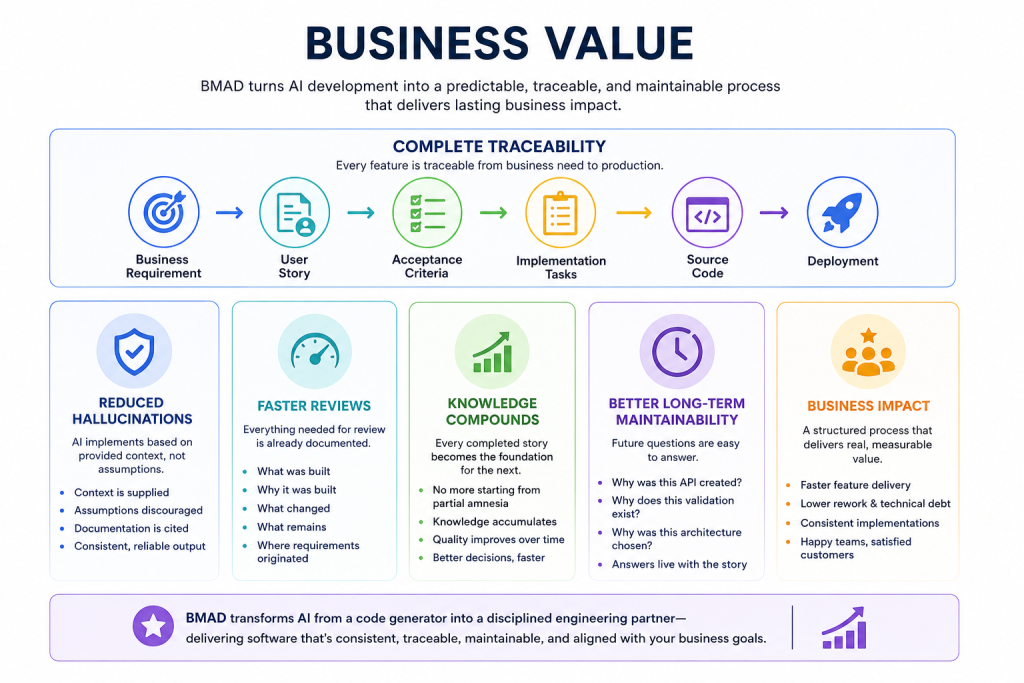
One of the biggest advantages of BMAD is complete traceability throughout the software development lifecycle. Every feature can be tracked back to the original business requirement, making it easy to understand why a piece of functionality exists and how it was implemented.
The traceability chain looks like this:
Business Requirement → User Story → Acceptance Criteria → Implementation Tasks → Source Code → Deployment
This clear chain of evidence helps developers, architects, QA teams, and business stakeholders quickly understand the purpose of any feature. Instead of searching through emails, documents, or commit histories, the entire journey from requirement to production is already documented.
Reduced AI Hallucinations
One of the biggest risks in AI-assisted development is hallucination, when AI confidently invents technical details that don’t exist.
BMAD significantly reduces this risk by providing structured context before development begins. Instead of relying on assumptions, every story includes architecture references, technical constraints, previous implementation decisions, and documented business rules.
This means the AI doesn’t need to guess:
- It knows which architecture to follow.
- It understands the existing project structure.
- It reuses established patterns instead of creating new ones.
- Every technical decision is backed by documented references.
The result is more reliable, consistent, and production-ready code.
Faster Reviews and Better Collaboration
Reviewing AI-generated code can be difficult when reviewers have to figure out the intent behind every change.
BMAD removes that uncertainty.
Each completed story clearly documents:
- What was implemented
- Why it was required
- Which requirements were satisfied
- Technical decisions that were made
- Any deviations from the architecture
- Work intentionally deferred to future stories
Instead of reverse-engineering the developer’s thinking, reviewers receive the complete context alongside the implementation.
This makes code reviews faster, simplifies collaboration across teams, and reduces misunderstandings during development.
Knowledge Compounds Over Time
Traditional AI development often starts every conversation with partial amnesia. Even if a feature was implemented perfectly yesterday, the next development session may not know anything about it unless that context is provided again.
BMAD changes this completely.
Every completed story produces a Development Record containing implementation decisions, lessons learned, deviations, and completed work. The next story begins by reading this information before development starts.
As a result:
- Knowledge is preserved instead of forgotten.
- Every story benefits from previous implementation experience.
- Architectural decisions remain consistent across the project.
- The quality of development improves over time.
Rather than resetting with every prompt, the project continuously builds on its existing knowledge.
Better Long-Term Maintainability
Software isn’t finished when it’s deployed.
Applications continue to evolve through new features, bug fixes, performance improvements, and changing business requirements. Months—or even years—later, development teams often need to understand why a particular implementation exists.
With traditional projects, that usually means reading hundreds of commits, searching through documentation, or asking developers who may no longer be part of the team.
BMAD preserves that knowledge automatically.
Developers can easily answer questions such as:
- Why was this API introduced?
- Why does this validation rule exist?
- Why was this architectural decision made?
- Which business requirement does this feature support?
- What changed during implementation?
The answers are already captured within the story and Development Record, making future enhancements significantly easier and reducing the cost of maintaining the software over time.
A More Predictable Development Process
Beyond individual benefits, BMAD creates a development process that is structured, repeatable, and scalable.
By ensuring every AI agent works with the right context and every implementation is fully documented, teams gain:
- Consistent implementation across all user stories
- Reduced rework and technical debt
- Faster feature delivery
- Greater confidence in AI-generated code
- Improved collaboration between business, product, and engineering teams
- A complete audit trail from requirements to deployment
Ultimately, BMAD transforms AI from a code-generation tool into a disciplined engineering partner—one that delivers software that is consistent, traceable, maintainable, and aligned with the original product vision throughout the entire development lifecycle.
Conclusion
AI doesn’t fail because it can’t write code, it fails when it loses context. BMAD solves this challenge by combining structured planning, clear agent responsibilities, and continuous knowledge sharing throughout the development process. Every user story becomes an implementation-ready package, enabling AI to deliver consistent, traceable, and production-ready software.
As AI continues to reshape software development, success won’t depend solely on better models, it will depend on better processes. With the right context and workflow, AI can become a reliable engineering partner, turning well-defined requirements into high-quality software with confidence and consistency.
FAQ's
1. How does BMAD reduce AI hallucinations during software development?
BMAD minimizes AI hallucinations by providing every Developer Agent with a complete implementation package before coding begins. Instead of relying on assumptions, the AI works with documented requirements, architecture references, acceptance criteria, and previous implementation decisions. This ensures the generated code stays consistent with the overall system design.
2. How does BMAD maintain security and architectural consistency?
Security and architectural standards are built into every user story through documented technical constraints and architecture references. Developer Agents don’t invent security practices or architectural patterns—they follow predefined guidelines such as authentication flows, API standards, validation rules, and coding conventions. This helps ensure secure and consistent implementations across the entire application.
3. Can BMAD be used for large enterprise applications?
Yes. BMAD is designed to scale with enterprise projects that contain multiple teams, hundreds of requirements, and complex architectures. By breaking work into structured, context-rich user stories, it ensures every implementation remains aligned with the overall product vision, regardless of project size.
4. How does BMAD improve collaboration between business and engineering teams?
BMAD creates complete traceability from business requirements to deployed code. Every feature can be linked back to its user story, acceptance criteria, implementation tasks, and source code. This shared visibility helps product managers, architects, developers, and QA teams collaborate more effectively while reducing misunderstandings and rework.
5. Does BMAD replace human developers?
No. BMAD is designed to augment development teams, not replace them. AI handles structured implementation tasks, while human experts continue to make architectural decisions, review code, validate business requirements, and ensure quality. This human-AI collaboration leads to faster delivery while maintaining engineering standards and governance.