
Introduction
In a world where speed defines success, businesses can no longer afford slow, fragmented software development processes. Yet, rushing development often leads to compromised quality, weak architecture, and systems that fail to scale. The real challenge lies in achieving both speed and engineering excellence without trade-offs.
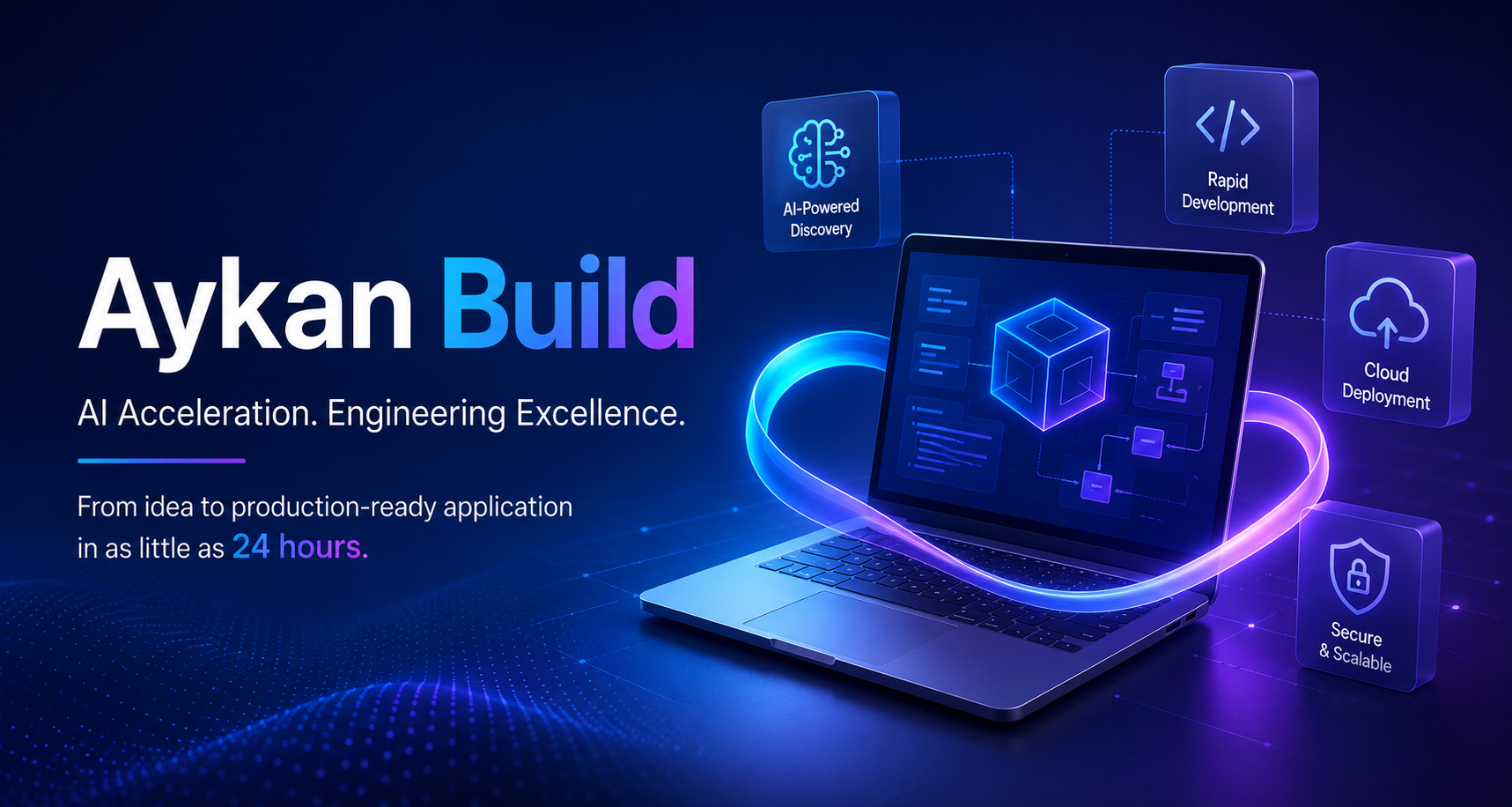
Aykan Build emerges as a powerful answer to this challenge. By combining AI-driven acceleration with enterprise-grade engineering discipline, it transforms how applications are designed, built, and deployed. Instead of choosing between rapid delivery and robust architecture, organizations can now achieve both delivering production-ready applications in record time while ensuring scalability, security, and long-term maintainability.
What is Aykan Build?
Aykan Build is an intelligent application development framework that transforms how software is conceptualized, built, and deployed. It acts as an end-to-end solution that combines AI automation with structured engineering practices.
It is designed to help organizations:
- Translate ideas into structured requirements through an AI-powered Requirement Discovery Agent
- Automatically generate system architecture and technical design
- Create well-defined user stories and workflows
- Build applications using accelerated AI-assisted development
- Deploy applications with DevOps-ready infrastructure
- Host solutions on a secure and scalable cloud environment
- Deliver production-ready applications within hours or days
Unlike standalone AI coding tools, Aykan Build focuses on delivering complete software systems, not just code snippets.
The Challenge
Despite rapid advancements in technology and the rise of AI-assisted tools, development teams still face several critical bottlenecks that slow down delivery and impact product quality.
1. Lengthy Development Cycles
Traditional software development follows a linear and multi-phase approach—starting from requirement gathering, followed by design, development, testing, and finally deployment. Each phase often depends on the completion of the previous one, requiring coordination across multiple teams such as business analysts, designers, developers, QA engineers, and DevOps.
This dependency chain introduces delays, especially when feedback loops are slow or when rework is required. Even small changes can cascade across stages, significantly increasing timelines. As a result, businesses struggle to respond quickly to market demands, often missing opportunities or falling behind competitors.
2. Incomplete Requirement Understanding
One of the most common reasons for project delays or failures is unclear or evolving requirements. Traditional requirement gathering relies heavily on manual documentation, stakeholder meetings, and static documents, which can lead to gaps in understanding.
Requirements may be interpreted differently by different teams, leading to misalignment between what is expected and what is delivered. Additionally, as business needs evolve, updating and maintaining documentation becomes time-consuming. This often results in rework, increased costs, and delays in delivery.
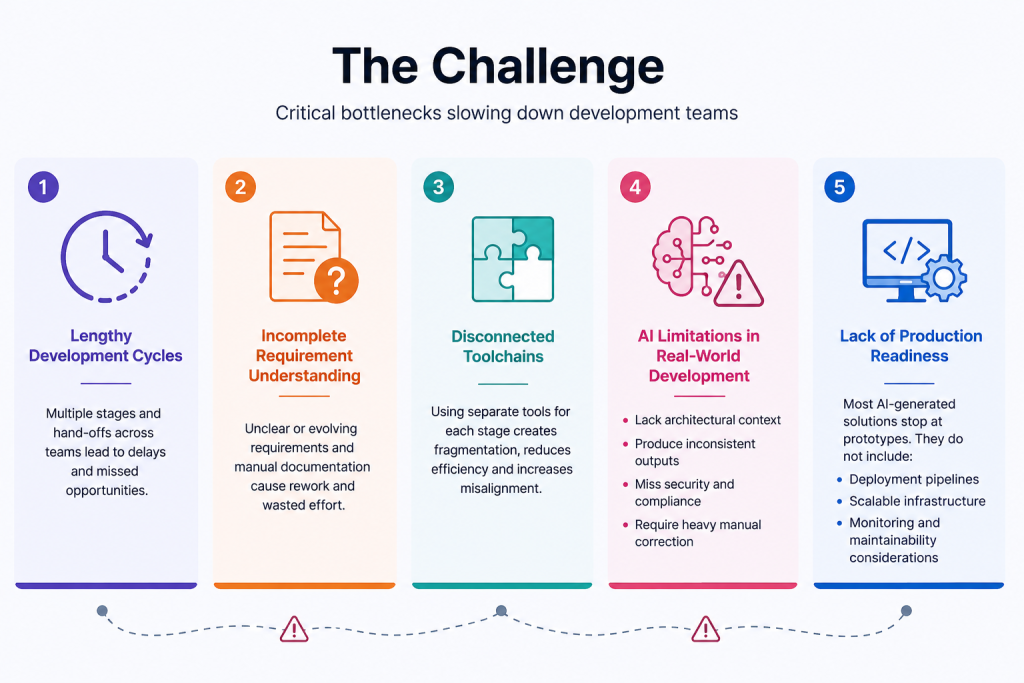
3. Disconnected Toolchains
Modern development teams typically use multiple tools for different stages of the software lifecycle—project management tools for requirements, design tools for UI/UX, coding platforms for development, and separate systems for testing and deployment.
While each tool serves a purpose, the lack of integration between them creates fragmentation. Information gets siloed, communication gaps arise, and teams spend additional time syncing data across systems. This not only reduces efficiency but also increases the risk of inconsistencies, errors, and misalignment across the development process.
4. AI Limitations in Real-World Development
AI-powered tools have significantly improved developer productivity by enabling faster code generation. However, they come with notable limitations when applied to real-world, production-grade systems.
- Lack Architectural Context: AI tools often generate code in isolation without considering the broader system architecture, leading to poorly structured applications.
- Inconsistent Outputs: Generated code may vary in quality and style, making it difficult to maintain consistency across the codebase.
- Missing Security and Compliance Considerations: AI-generated solutions may overlook critical aspects such as data protection, authentication, and regulatory compliance.
- Heavy Manual Correction: Developers often need to spend significant time reviewing, debugging, and refining AI-generated code before it can be used in production.
As a result, while AI speeds up coding, it does not fully eliminate the need for strong engineering practices.
5. Lack of Production Readiness
Most AI-generated solutions are designed to demonstrate functionality rather than support real-world usage. They often stop at the prototype stage and lack the essential components required for deployment and scaling.
- Deployment Pipelines: There is usually no automated CI/CD setup, requiring manual intervention for testing and releasing code.
- Scalable Infrastructure: Prototypes are not designed to handle real user traffic, lacking features like auto-scaling, load balancing, and performance optimization.
- Monitoring and Maintainability: Logging, monitoring, and observability tools are often missing, making it difficult to track performance or debug issues. Additionally, the code may not follow maintainable structures, leading to long-term technical debt.
Without these elements, transitioning from a prototype to a production-ready application becomes a complex and time-consuming process.
The Solution
Aykan Build introduces a structured, intelligent, and scalable approach to modern application development—bridging the gap between speed and engineering excellence. Instead of treating AI as a standalone tool, it integrates AI capabilities within a disciplined engineering framework to deliver reliable, production-ready outcomes.
1. AI-Assisted Rapid Engineering
Aykan Build accelerates the entire development lifecycle by automating time-intensive and repetitive tasks. From understanding requirements to generating architecture and writing code, AI significantly reduces manual effort. This enables teams to move from idea to implementation much faster, while still maintaining structure and clarity. Developers can focus on higher-value problem-solving rather than spending time on routine tasks.
2. DevOps-Ready Setup
Unlike traditional approaches where deployment is considered at the end, Aykan Build embeds DevOps practices from the start. Applications are created with built-in CI/CD pipelines, version control integration, and environment configurations.
This ensures:
- Faster and more reliable deployments
- Consistent release management across environments
- Reduced manual errors during deployment
- Easier rollback and version tracking
By making DevOps an integral part of development, the platform ensures smooth and continuous delivery.
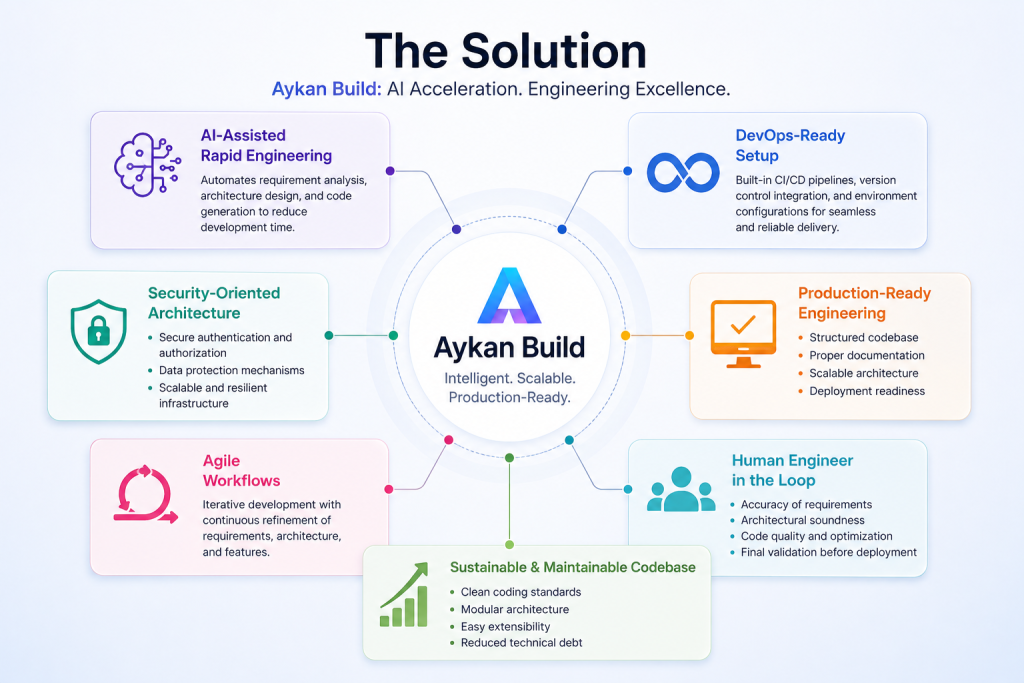
3. Security-Oriented Architecture
Security is deeply integrated into the system design rather than being added later. Aykan Build incorporates best practices to ensure applications are robust and compliant.
Key considerations include:
- Secure authentication and authorization to protect user access
- Data protection mechanisms such as encryption and secure storage
- Resilient infrastructure design to handle failures and threats
This proactive approach minimizes vulnerabilities and ensures that applications are ready for real-world usage.
4. Production-Ready Engineering
Aykan Build goes beyond prototypes by delivering fully functional, production-ready applications. Every output is built with real-world deployment in mind.
This includes:
- A structured and well-organized codebase for clarity and consistency
- Comprehensive documentation to support future development and maintenance
- A scalable architecture that can handle growth in users and data
- Deployment readiness, ensuring applications can be launched without additional rework
The result is a system that is not just functional, but reliable and scalable.
5. Agile Workflows
The platform is designed to support iterative and flexible development. Requirements, features, and workflows can be continuously refined as business needs evolve.
This enables:
- Faster feedback cycles
- Better alignment with stakeholder expectations
- Continuous improvement throughout the development process
By aligning with agile methodologies, Aykan Build ensures adaptability without losing momentum.
6. Human Engineer in the Loop
While AI drives speed, human expertise ensures quality. Aykan Build incorporates engineers at critical stages to validate and refine outputs.
Human involvement ensures:
- Accurate interpretation of requirements
- Strong and scalable architecture decisions
- High-quality, optimized code
- Final validation before deployment
This combination of AI efficiency and human judgment creates a balanced and reliable development process.
7. Sustainable and Maintainable Codebase
Applications built with Aykan Build are designed for long-term success. The focus is not just on delivery, but also on maintainability and scalability.
Key principles include:
- Clean coding standards for readability and consistency
- Modular architecture for easier updates and enhancements
- Extensibility to support future feature additions
- Reduced technical debt, lowering long-term maintenance costs
This ensures that applications remain efficient, adaptable, and easy to manage as they evolve.
Together, these capabilities position Aykan Build as a comprehensive solution that not only accelerates development but also ensures that every application meets enterprise-grade standards.
From Idea to Production: How Aykan Build Works?
Aykan Build follows a structured, intelligent workflow that transforms ideas into fully functional, production-ready applications. Each stage is designed to reduce ambiguity, accelerate execution, and ensure that engineering best practices are consistently applied throughout the lifecycle.
Step 1: Requirement Discovery
The journey begins with an AI-powered Requirement Discovery Agent that interacts with stakeholders in a conversational and guided manner. Instead of relying on static documents or fragmented inputs, the AI asks contextual questions to capture business goals, user expectations, constraints, and edge scenarios. This dynamic approach helps uncover hidden requirements, reduces miscommunication, and ensures that all stakeholders are aligned early in the process. It also significantly shortens the time typically spent on requirement gathering.
Step 2: Intelligent Structuring of Requirements
Once the inputs are gathered, the platform transforms them into a well-structured and standardized format. This includes defining workflows, identifying user roles and permissions, outlining business rules, and breaking down features into logical components. By organizing requirements in a clear and systematic way, Aykan Build eliminates ambiguity and creates a strong foundation for architecture and development. This structured clarity ensures smoother collaboration between teams and reduces the risk of rework later.
Step 3: Automated Architecture Generation
Based on the structured requirements, Aykan Build automatically generates a scalable and secure system architecture. This includes backend services, database schema design, API structures, integration touchpoints, and cloud infrastructure planning. The architecture is not generic—it is tailored to the specific use case, ensuring optimal performance, flexibility, and scalability. Security considerations, such as access control and data handling, are embedded at this stage, ensuring the system is robust from the ground up.
Step 4: User Story and Workflow Creation
The platform then converts requirements into detailed user stories and workflows that define how the system will be used. This includes mapping user journeys, outlining functional requirements, and identifying edge cases, validations, and exceptions. These user stories act as a bridge between business needs and technical implementation, ensuring that development remains user-centric. Clear workflows also help teams visualize the end-to-end experience, reducing gaps between expectation and delivery.
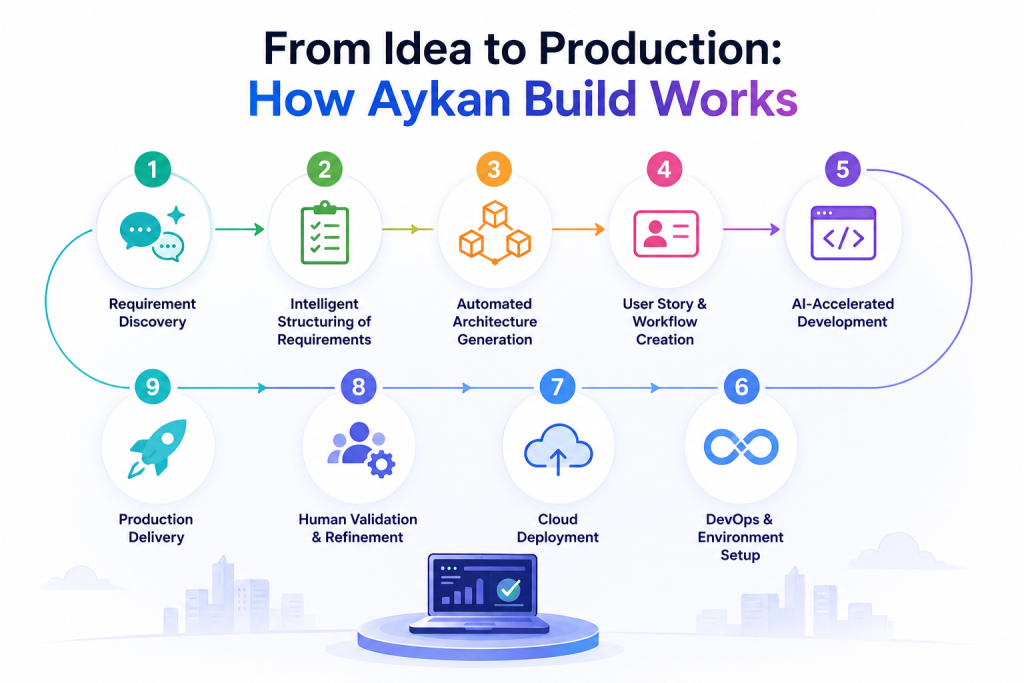
Step 5: AI-Accelerated Development
With architecture and user stories in place, Aykan Build begins the development phase using AI-assisted code generation. The system produces clean, consistent, and modular code aligned with best practices and predefined standards. This reduces manual coding effort while maintaining quality and scalability. Developers can focus on refining logic and adding value rather than writing repetitive code, significantly speeding up the overall development process without compromising reliability.
Step 6: DevOps and Environment Setup
Aykan Build integrates DevOps practices early by automatically setting up CI/CD pipelines, configuring deployment workflows, and managing development, staging, and production environments. This ensures that code can be continuously tested, integrated, and deployed with minimal manual intervention. Version control systems are seamlessly integrated, enabling better collaboration and traceability. This step ensures faster releases, improved stability, and reduced operational risks.
Step 7: Cloud Deployment
The application is deployed on a secure and scalable cloud infrastructure designed to handle real-world usage. This includes configuring hosting environments, enabling auto-scaling capabilities, optimizing resource allocation, and ensuring high availability. Performance optimization techniques are applied to ensure fast response times and smooth user experiences. Cloud deployment also prepares the application for future growth, making it easy to scale as demand increases.
Step 8: Human Validation and Refinement
While AI accelerates the process, human engineers play a crucial role in validating and refining the output. They review the system architecture, optimize performance, verify security measures, and ensure compliance with best practices. Engineers also refine business logic and handle complex scenarios that require human judgment. This step ensures that the final product is not only functional but also reliable, secure, and aligned with enterprise standards.
Step 9: Production Delivery
The final stage involves delivering a fully functional, production-ready application that is ready for real users and real workloads. All components from architecture and code to deployment pipelines and infrastructure are in place. The application is tested, validated, and optimized for performance, scalability, and security. With everything aligned, businesses can confidently launch their solution and continue to iterate as needed.
Aykan Build vs Traditional AI-Assisted Development
| Capability | Aykan Build | Traditional AI Tools |
|---|---|---|
| Requirement Discovery | Interactive AI-driven | Minimal/manual |
| Architecture Design | Automatically generated | Often missing |
| Development Approach | Structured and scalable | Fragmented |
| DevOps Integration | Built-in | Rare |
| Security | Embedded from start | Often overlooked |
| Human Oversight | Yes | Limited |
| Output Quality | Production-ready | Prototype-level |
Business Value
Aykan Build delivers strong and measurable business value by combining speed, efficiency, and enterprise-grade engineering. It enables organizations to accelerate innovation while maintaining high standards of quality, security, and scalability.
1. Accelerated Time-to-Market
Aykan Build dramatically shortens the journey from idea to deployment by automating critical stages such as requirement discovery, architecture design, development, and deployment setup. What traditionally takes weeks or months can now be achieved in days—or even hours for simpler use cases. This speed allows businesses to quickly test ideas, launch products faster, and respond to changing market demands with agility. Faster time-to-market not only improves competitiveness but also enables early user feedback, helping organizations iterate and improve continuously.
2. Cost Efficiency
By automating repetitive and resource-intensive tasks, Aykan Build significantly reduces development costs. Teams spend less time on manual documentation, coding, and configuration, allowing them to focus on higher-value activities. Additionally, the structured workflow minimizes rework caused by unclear requirements or misalignment, which is often a major cost driver in traditional projects. Efficient resource utilization, reduced development cycles, and fewer post-release fixes collectively lead to substantial cost savings over time.
3. Consistent Quality
Aykan Build enforces standardized engineering practices across every stage of development. From architecture design to code generation and deployment, the platform ensures consistency in structure, documentation, and implementation. This reduces variability in outputs and minimizes defects. Built-in validation mechanisms and human oversight further enhance quality, ensuring that applications are reliable, maintainable, and aligned with enterprise standards. Consistency also makes it easier for teams to onboard new developers and maintain projects over time.
4. Reduced Risk
Risk mitigation is a core advantage of Aykan Build. Security is integrated from the early stages of architecture design, ensuring that applications are built with proper authentication, authorization, and data protection mechanisms. Automated testing and validation reduce the chances of defects reaching production, while human review ensures that critical decisions are carefully evaluated. This proactive approach minimizes the likelihood of system failures, performance issues, and security vulnerabilities, ultimately protecting both the business and its users.
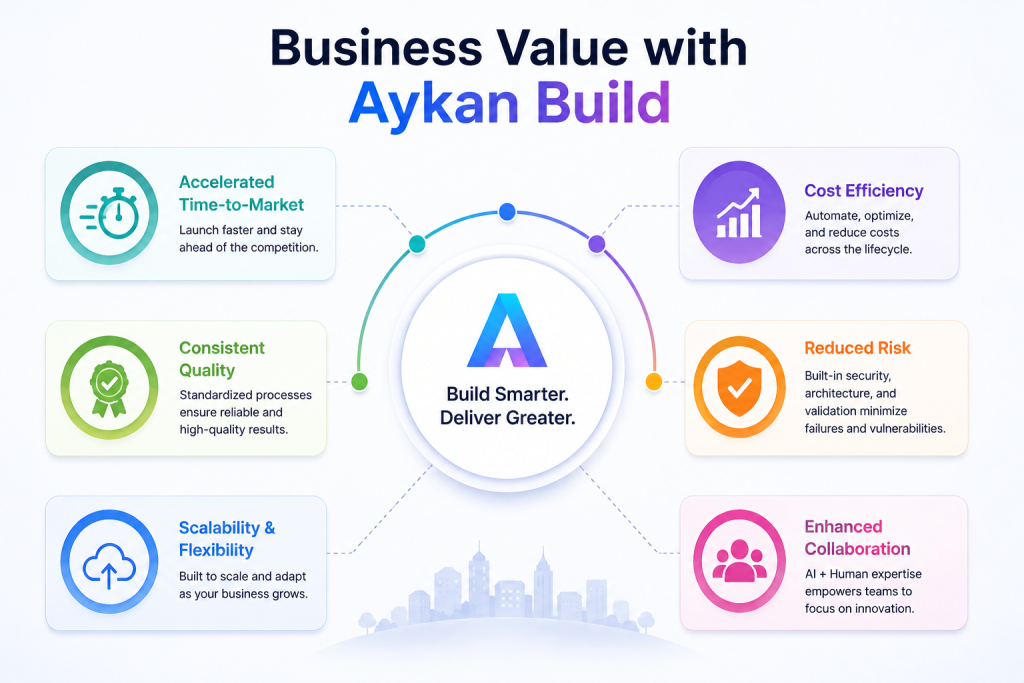
5. Scalability and Flexibility
Applications built using Aykan Build are designed with scalability at their core. The platform incorporates cloud-native architecture, enabling applications to handle increasing user loads and evolving business requirements without significant rework. Modular design and flexible workflows make it easy to introduce new features, integrate third-party services, and adapt to changing market needs. This ensures that the application remains relevant and efficient as the business grows.
6. Enhanced Collaboration
Aykan Build creates a collaborative environment where AI and human expertise work together seamlessly. The AI handles repetitive tasks and accelerates execution, while engineers focus on validation, optimization, and strategic decision-making. This reduces the burden on teams, improves communication across stakeholders, and ensures alignment throughout the development process. By removing inefficiencies and streamlining workflows, teams can dedicate more time to innovation and delivering meaningful business outcomes.
7. Faster Innovation Cycles
With reduced development time and streamlined workflows, organizations can experiment more frequently and bring new ideas to life Aykan Build enables rapid prototyping followed by quick transition to production, allowing businesses to validate concepts, gather user feedback, and refine solutions continuously. This iterative approach fosters a culture of innovation and helps organizations stay ahead in competitive markets.
8. Long-Term Maintainability and Sustainability
Aykan Build emphasizes clean code, modular architecture, and proper documentation, ensuring that applications remain easy to maintain and extend over time. This reduces technical debt and lowers long-term maintenance costs. Teams can confidently scale and enhance their applications without worrying about structural limitations or complexity, making the solution sustainable for long-term growth.
Conclusion
Aykan Build represents a fundamental shift in how applications are developed.
It eliminates the traditional trade-off between speed and quality by integrating AI acceleration with strong engineering discipline. The result is a powerful framework that enables organizations to build scalable, secure, and production-ready applications faster than ever before.
As businesses continue to evolve in a digital-first world, solutions like Aykan Build will play a critical role in driving innovation, efficiency, and sustainable growth.
FAQ's
1. What makes Aykan Build different from other AI development tools?
Aykan Build goes beyond simple code generation by delivering complete, production-ready applications. It combines AI acceleration with structured architecture, DevOps readiness, security, and human validation ensuring enterprise-grade quality.
2. How quickly can an application be built using Aykan Build?
Depending on the complexity, applications can be delivered within 24 hours to a few days. The platform significantly reduces traditional development timelines by automating key stages of the lifecycle.
3. Is human involvement required in the process?
Yes. While AI handles speed and automation, human engineers are involved in validation, refinement, and ensuring quality. This “human-in-the-loop” approach ensures accuracy, scalability, and reliability.
4. Are applications built with Aykan Build scalable and secure?
Absolutely. Applications are designed with scalable cloud architecture and built-in security practices, including authentication, data protection, and compliance considerations from the start.
5. Can Aykan Build support enterprise-level applications?
Yes. The platform is designed to meet enterprise requirements, including robust architecture, DevOps integration, security standards, and maintainability for long-term use.
6. Is the generated code maintainable and customizable?
Yes. Aykan Build produces clean, modular, and well-documented code, making it easy for development teams to maintain, extend, and customize as business needs evolve.