

Introduction
The AI marketplace ecosystem is evolving far beyond traditional subscription-based SaaS models. Earlier software platforms primarily relied on monthly or annual subscriptions because infrastructure costs were relatively stable and predictable. However, AI platforms operate in a completely different economic environment where every interaction generates computational expenses. Each prompt, workflow execution, API call, image generation request, vector database query, or autonomous agent task consumes measurable infrastructure resources such as GPUs, CPUs, memory, bandwidth, storage, and inference processing power.
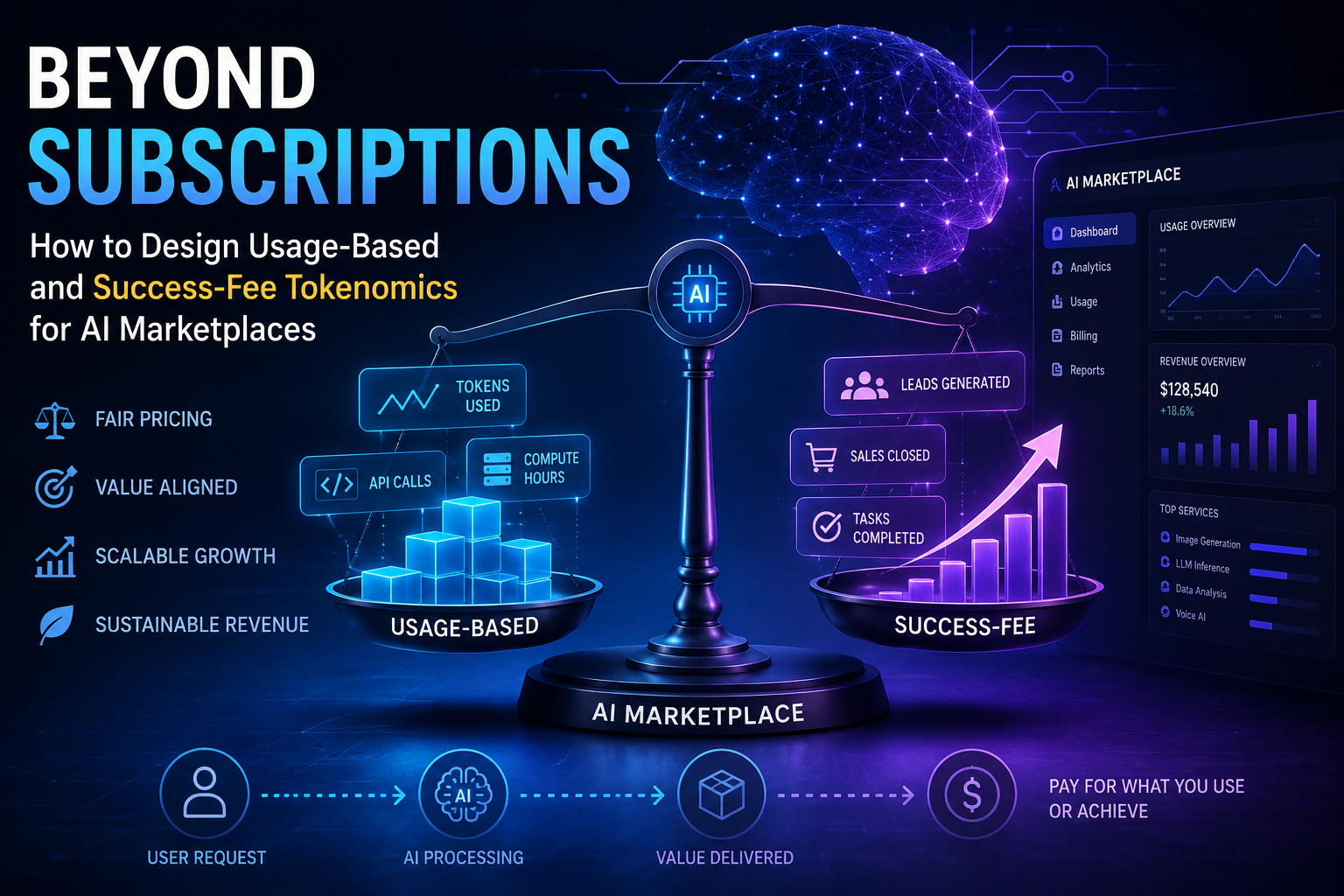
This shift is forcing AI marketplaces to rethink how they monetize products and services. Instead of charging static subscription fees, modern AI businesses are increasingly adopting usage-based pricing, tokenized billing systems, workflow monetization, and success-fee models that align platform revenue with actual customer usage and business outcomes.
Today, companies building AI marketplaces must balance several factors simultaneously, including infrastructure sustainability, user adoption, profitability, scalability, developer incentives, ecosystem participation, and customer trust. The marketplaces that successfully solve these economic challenges will shape the next generation of AI-driven business ecosystems.
Why Traditional Subscription Pricing Is Failing in AI Marketplaces?
AI Infrastructure Costs Are Dynamic and Unpredictable
Traditional SaaS applications usually have predictable hosting and operational costs. In contrast, AI systems consume infrastructure resources differently depending on user behavior, model complexity, context size, and computational intensity.
For example, a simple chatbot query may consume only minimal processing power, while a multi-agent AI workflow performing document analysis, image generation, retrieval-augmented generation, and real-time reasoning may require significant GPU resources and inference time.
This creates major pricing challenges because infrastructure costs can fluctuate dramatically across customers. A fixed subscription fee may work for low-usage users but become financially unsustainable when enterprise customers process millions of AI operations every month. AI companies must therefore design pricing models that can scale alongside infrastructure consumption while protecting profit margins.
Heavy AI Users Create Cost Imbalances
One of the biggest limitations of subscription-only pricing is that it treats all customers equally regardless of actual usage intensity.
For example:
- A small startup may generate a few hundred prompts per month.
- A large enterprise may execute millions of AI tasks daily.
- An AI automation platform may run thousands of workflows every hour.
- A video-generation system may process GPU-heavy rendering continuously.
If all customers pay the same subscription fee, the platform risks severe infrastructure losses from high-consumption users.
This problem becomes even more significant as AI models become more advanced and computationally expensive. Large language models with long-context memory, multimodal capabilities, reasoning engines, and autonomous agents significantly increase compute consumption compared to traditional SaaS products. Because of this, AI marketplaces increasingly require flexible monetization systems that scale with actual platform utilization.

Customers Want Pricing That Reflects Real Business Value
Modern businesses are no longer interested in paying simply for “software access.” Instead, they want pricing models connected directly to measurable outcomes and operational value.
For example:
- Companies want to pay for leads generated rather than chatbot access.
- Recruiters want pricing tied to successful hires.
- Ecommerce platforms prefer transaction-based monetization.
- Enterprises want workflow automation tied to productivity improvements.
This shift is driving the rise of outcome-driven pricing models where AI marketplaces earn revenue when the platform creates measurable business success. The closer pricing aligns with customer ROI, the easier it becomes for AI companies to justify costs and improve adoption rates.
What Is Usage-Based Tokenomics?
Understanding Usage-Based Pricing in AI
Usage-based tokenomics is a monetization framework where customers are charged based on their actual platform consumption rather than paying fixed recurring subscription fees. In AI marketplaces, pricing is directly connected to measurable usage metrics such as tokens processed, API requests, AI agent executions, workflow automations, compute hours, GPU utilization, search operations, data processing volume, storage consumption, and generated outputs. This model creates a strong relationship between customer activity and platform revenue, allowing AI businesses to recover infrastructure costs more efficiently while offering customers greater flexibility.
Unlike traditional SaaS subscription models that charge the same fee regardless of usage intensity, usage-based systems scale naturally as customers increase platform adoption, operational complexity, and AI workload consumption. This makes the model highly suitable for modern AI ecosystems where infrastructure usage can vary significantly between individual users, startups, and enterprise customers.
Why Usage-Based Models Are Growing Rapidly?
Usage-based pricing is growing rapidly in AI marketplaces because it creates better alignment between customer usage and operational costs. Instead of paying fixed subscription fees, customers only pay for the resources they actually consume, such as tokens processed, API calls, workflow executions, or compute usage.
This lowers the entry barrier for startups and small businesses, allowing them to adopt AI solutions without large upfront commitments. At the same time, AI companies can recover infrastructure costs more accurately while generating higher revenue from power users and enterprise customers.
Usage-based models also provide greater flexibility, allowing platforms to introduce dynamic pricing based on workload intensity, premium AI features, or advanced compute requirements. As AI marketplaces continue evolving into complex multi-service ecosystems, this scalable and flexible monetization approach is becoming increasingly important for long-term growth and sustainability.
Understanding Tokenomics in AI Marketplaces
What “Tokenomics” Means in AI Ecosystems?
In AI marketplaces, tokenomics refers to the economic framework used to measure, allocate, distribute, and monetize AI resource consumption. Unlike blockchain tokenomics, which is often focused on speculative digital assets, AI token systems are primarily utility-driven and designed to simplify how customers access and pay for AI services. These token systems create a structured economic layer that allows AI marketplaces to price services dynamically based on infrastructure demand, workload complexity, and platform usage.
In AI ecosystems, tokens or credits may represent:
- Compute credits
- AI usage balances
- Workflow execution units
- Agent task capacity
- GPU allocation rights
- Marketplace incentives
- Revenue-sharing mechanisms
This approach helps AI platforms manage resource allocation more efficiently while providing customers with a simplified and flexible payment structure.

Why Token Systems Simplify AI Monetization?
AI infrastructure pricing is often highly technical and difficult for average users to understand. Most customers are unfamiliar with the operational costs behind AI systems, such as GPU allocation, inference processing, vector database operations, or long-context memory handling. This complexity can create confusion when customers try to estimate usage costs or understand pricing structures.
Some of the technical infrastructure costs customers may struggle to understand include:
- GPU allocation pricing
- Inference runtime costs
- Context-window processing expenses
- Embedding generation costs
- Vector search infrastructure fees
Token systems simplify these technical complexities by converting infrastructure usage into standardized marketplace units such as credits or tokens. Instead of exposing raw backend costs, AI marketplaces provide users with easier-to-understand consumption units that can be used across multiple AI services. This improves the customer experience while giving marketplaces greater flexibility to optimize pricing strategies, manage margins, and scale monetization more efficiently internally.
Core Usage-Based Pricing Models for AI Marketplaces
1. Token-Based Pricing:
How Token-Based Pricing Works?
Token-based pricing is one of the most common monetization models used in AI marketplaces and large language model platforms. In this model, users are charged based on the number of tokens processed during AI interactions. Tokens are small units of text that AI systems use to understand prompts, generate responses, process memory, and perform reasoning tasks. The more tokens processed, the higher the computational workload and infrastructure cost for the platform.
In large language models:
- Input prompts consume tokens
- AI-generated responses consume additional tokens
- Long-context memory increases token processing requirements
- Agent reasoning chains generate higher computational overhead
For example, platforms like OpenAI and Anthropic use token-based pricing for their AI APIs, where customers are billed according to the amount of input and output text processed by their models. Similarly, AI development platforms like Replicate charge users based on model execution and compute usage tied closely to token consumption and inference workloads.
This pricing structure is popular because token usage closely reflects actual infrastructure and inference costs, helping AI companies align pricing more accurately with platform consumption.
Why Token-Based Pricing Works Well for AI APIs?
Token-based pricing works especially well for developer-focused AI ecosystems because it offers flexibility, scalability, and accurate usage-based billing. Instead of forcing users into fixed subscription plans, developers only pay for the resources they actually consume, allowing businesses to scale usage gradually as demand increases.
Some major advantages of token-based pricing include:
- Granular billing accuracy
- Real-time scalability
- Infrastructure transparency
- Flexible API monetization
For example, companies building AI applications on platforms like OpenAI Platform or Cohere can start with smaller workloads during development and later scale to millions of API requests as their products grow. AI-powered SaaS applications, chatbots, content generation tools, and automation platforms benefit greatly from this flexibility, as pricing scales automatically with usage intensity.
This model also enables enterprise AI platforms like Microsoft Azure AI and Google Cloud AI to monetize large-scale AI workloads more effectively while supporting dynamic enterprise demand.
AI Dynamic Pricing and Real-Time Monetization Intelligence
As AI marketplaces grow more complex, token-based pricing is increasingly evolving into dynamic AI-driven monetization systems capable of adjusting pricing strategies in real time. Modern AI pricing engines continuously analyze operational signals such as infrastructure demand, workload intensity, API usage patterns, latency requirements, and compute availability to optimize monetization automatically. Instead of relying on static pricing structures, AI platforms can dynamically adapt usage pricing based on changing system conditions and marketplace activity.
Similar to modern AI pricing software platforms, these systems help AI marketplaces automate pricing decisions, improve revenue optimization, and maintain infrastructure efficiency at scale. Intelligent pricing frameworks can also reduce manual pricing management by continuously monitoring usage trends, operational performance, and customer activity.
Some major capabilities of AI-driven pricing systems include:
- Real-time pricing optimization
- Automated workload-based pricing adjustments
- Dynamic infrastructure cost allocation
- AI-powered pricing recommendations
- Revenue and margin optimization
- Transparent usage analytics
As AI ecosystems continue evolving, dynamic pricing infrastructure and agentic pricing systems are expected to become increasingly important for supporting scalable, usage-driven AI monetization models.
Challenges of Token-Based Monetization
Although token-based pricing offers flexibility and scalability, it can also create uncertainty for customers because costs fluctuate based on usage patterns, prompt size, output length, reasoning depth, and workflow complexity. Unlike fixed subscription plans, businesses may find it difficult to accurately predict monthly AI expenses, especially when using advanced reasoning models, long-context workflows, autonomous AI agents, or large-scale automation systems. As AI adoption grows across organizations, unpredictable consumption patterns can create budgeting challenges and operational concerns for both startups and enterprise customers.
Common customer concerns include:
- Budget forecasting
- Cost estimation
- Long-context pricing
- Variable AI output lengths
- Sudden infrastructure surcharges
For example, businesses using GitHub Copilot or Zapier AI may experience rising costs as AI workflows become more advanced or usage scales unexpectedly across teams and operations. Similarly, organizations running enterprise search systems, AI automation pipelines, or multi-agent workflows may see higher token consumption due to increased reasoning complexity and larger context windows.
Another major challenge is pricing transparency. Many customers struggle to understand how token usage directly translates into infrastructure costs, particularly when pricing structures vary between AI models, latency tiers, or processing priorities. This complexity can create hesitation during enterprise adoption if businesses feel they lack visibility into real-time consumption and future operational costs.
To improve transparency and reduce billing anxiety, platforms like OpenRouter and AWS Bedrock now provide advanced cost-management tools such as usage dashboards, spending alerts, billing analytics, usage forecasting, and budget controls. These systems help customers monitor AI consumption more effectively, optimize workloads, and maintain better financial predictability. As usage-based AI ecosystems continue growing, transparent pricing infrastructure and intelligent billing management are becoming essential for improving customer trust and long-term platform retention.

2. Credit-Based Pricing
How Credit Systems Work?
Credit-based pricing converts complex AI infrastructure usage into simplified marketplace credits that customers can easily understand and manage. Instead of exposing technical metrics like GPU hours, token consumption, or inference runtime, AI marketplaces allow users to purchase credit packages that can be used across multiple AI services and tools. This creates a more user-friendly billing experience while simplifying cost estimation for customers.
For example:
- AI image generation on platforms like Midjourney or Canva AI may consume a small number of credits.
- AI video generation tools such as Runway ML or Pika Labs may require significantly higher credits due to heavy GPU usage.
- Complex AI workflows on automation platforms like Zapier AI may consume variable credits depending on workflow complexity and execution volume.
This simplified structure makes pricing easier to understand for both technical and non-technical users.
Why AI Marketplaces Prefer Credit Systems?
Credit systems provide several strategic advantages for AI marketplaces because they simplify monetization while offering greater pricing flexibility internally. Instead of constantly adjusting customer-facing pricing whenever infrastructure costs change, marketplaces can manage backend resource allocation more efficiently through credits.
Some major advantages include:
- Simplified customer experience
- Flexible internal pricing
- Improved revenue predictability
- Better ecosystem integration
For example, platforms like OpenAI Platform, Leonardo AI, and Freepik AI Suite use credit-style systems to simplify access to multiple AI services, including image generation, editing, design automation, and content creation tools. Prepaid credit systems also improve cash flow and customer retention because users often purchase larger credit bundles in advance. Additionally, credits can be shared across multiple AI services within the same ecosystem, making this model highly effective for multi-service AI marketplaces.
3. Compute-Based Pricing
What Is Compute Monetization?
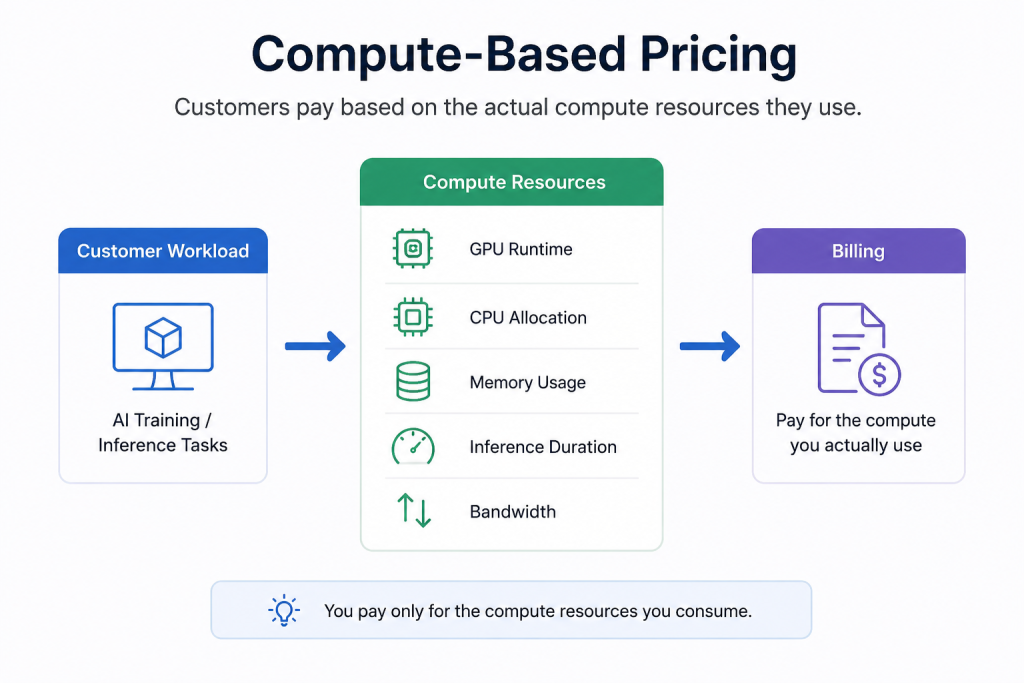
Compute-based monetization charges customers directly for the infrastructure resources consumed while running AI workloads. Instead of billing based on tokens or credits, pricing depends on actual compute usage such as GPU runtime, CPU allocation, inference duration, memory utilization, parallel processing, and data transfer bandwidth. This model is commonly used in AI infrastructure platforms, cloud AI providers, and GPU-sharing marketplaces where computational power itself becomes the core monetizable resource.
Pricing may depend on:
- GPU runtime
- CPU allocation
- Parallel processing
- Inference duration
- Memory utilization
- Data transfer bandwidth
For example, platforms like AWS Bedrock, Google Cloud AI, and CoreWeave charge customers based on compute infrastructure usage for AI training, inference, and large-scale model deployment.
Why Compute Pricing Is Becoming More Important?
Compute pricing is becoming increasingly important because the global AI industry is facing rising GPU shortages and growing infrastructure demand. Advanced AI systems require massive computational resources for training, inference, video generation, and autonomous agent execution, making AI compute one of the most valuable assets in the AI economy.
Several trends driving compute monetization growth include:
- AI video generation
- Large-scale model training
- Real-time AI inference
- Autonomous agent ecosystems
- Enterprise AI deployment
For example, AI video platforms like Runway ML and Synthesia require high GPU processing power for video rendering, while companies using infrastructure providers like NVIDIA DGX Cloud depend heavily on scalable compute resources for enterprise AI operations. As AI adoption grows, compute itself is rapidly becoming a monetizable marketplace commodity.
4. Workflow-Based Pricing
What Is Workflow Monetization?
Workflow-based pricing charges customers based on completed business operations or automated workflows instead of individual prompts or API requests. This pricing model focuses on operational outcomes and business productivity rather than raw AI infrastructure usage, making it highly suitable for enterprise automation platforms and AI workflow ecosystems.
Examples of workflow monetization include:
- Document processing pipelines
- Customer onboarding automation
- Lead qualification systems
- AI-powered support resolution
- Multi-agent task orchestration
For example, platforms like Zapier AI, Make.com, and UiPath AI Center monetize automation workflows based on task execution volume, integrations, and workflow complexity.
Why Workflow Pricing Is Valuable for Enterprises?
Workflow pricing is highly valuable for enterprises because businesses care more about completed operational outcomes than technical infrastructure metrics like tokens or GPU usage. Organizations prefer pricing structures that directly align with business productivity, operational efficiency, and measurable ROI.
Workflow pricing helps enterprises:
- Measure ROI more clearly
- Predict operational costs
- Align spending with productivity gains
- Scale automation initiatives efficiently
Success-Fee Tokenomics: The Future of AI Monetization
What Is Success-Based Pricing?
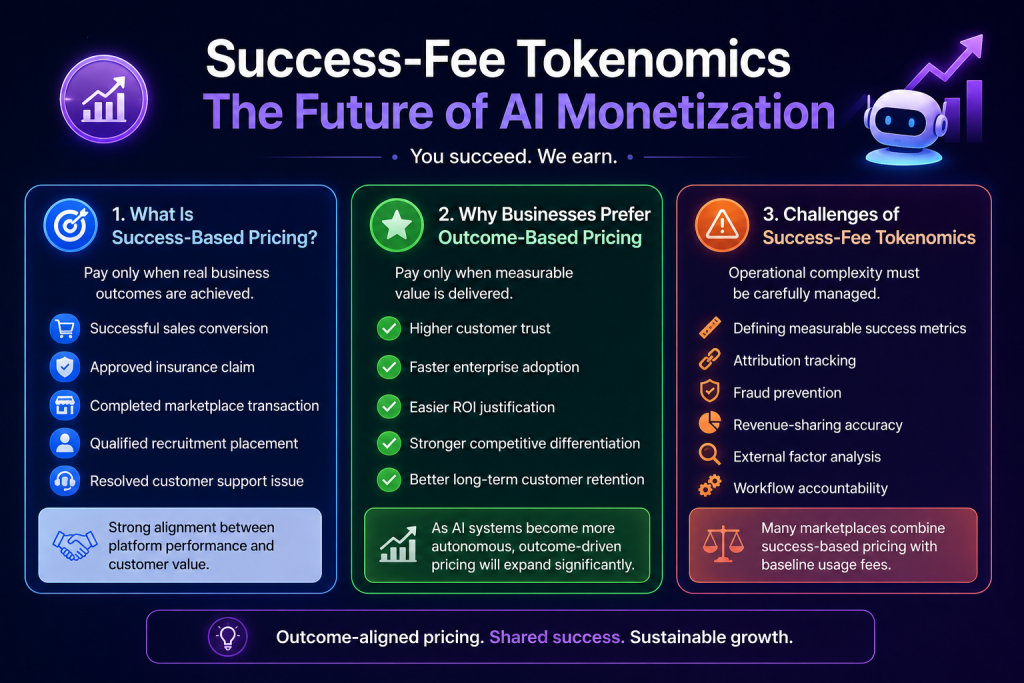
Success-based pricing, also known as success-fee tokenomics, is a monetization model where AI marketplaces generate revenue only when customers achieve predefined business outcomes. Instead of charging purely for API usage, tokens, or compute resources, businesses pay when measurable value is delivered. This creates stronger alignment between platform performance and customer success because revenue depends directly on outcomes achieved through AI systems.
Examples of success-based pricing include:
- Paying per successful sales conversion
- Paying per approved insurance claim
- Paying per completed marketplace transaction
- Paying per qualified recruitment placement
- Paying per resolved customer support issue
For example, recruitment platforms like LinkedIn Talent Solutions often monetize based on successful hiring outcomes, while ecommerce marketplaces such as Upwork or Fiverr generate revenue from completed transactions between buyers and sellers. Similarly, AI-powered customer support platforms like Intercom AI can align pricing with successfully resolved support interactions.
Why Businesses Prefer Outcome-Based Pricing?
Businesses increasingly prefer outcome-based pricing because it reduces financial risk and ensures they only pay when measurable business value is delivered. Unlike traditional subscription models, success-based monetization directly connects platform costs to ROI, making enterprise adoption easier and improving customer trust.
Some major advantages include:
- Higher customer trust
- Faster enterprise adoption
- Easier ROI justification
- Stronger competitive differentiation
- Better long-term customer retention
For example, AI sales automation platforms like HubSpot AI or AI marketing tools such as Salesforce Einstein AI can justify pricing more effectively when customers clearly see measurable improvements in lead conversion, customer engagement, or sales productivity. As AI systems become more autonomous and capable of completing complex business tasks, outcome-driven pricing models are expected to expand significantly across industries.
Challenges of Success-Fee Tokenomics
Although success-based pricing is attractive, it also introduces operational and measurement complexity for AI marketplaces. Unlike simple subscription or token billing models, success-fee tokenomics requires platforms to accurately define, track, and validate business outcomes before revenue can be generated.
AI marketplaces must solve challenges such as:
- Defining measurable success metrics
- Attribution tracking
- Fraud prevention
- Revenue-sharing accuracy
- External factor analysis
- Workflow accountability
For example, AI advertising platforms may struggle to determine whether a sales conversion happened because of AI recommendations or human sales efforts. Similarly, AI recruitment systems may find it difficult to attribute successful hiring outcomes entirely to platform performance. Because business results are often influenced by both AI systems and human actions, attribution becomes complex in many industries.
Due to these challenges, many platforms combine success-based pricing with baseline subscription or usage-based fees. For instance, enterprise automation platforms like UiPath AI Center or customer engagement platforms like Zendesk AI may use hybrid monetization models that include both workflow usage charges and outcome-based incentives.
Key Principles for Designing Sustainable AI Tokenomics
1. Align Pricing With Customer Value
Successful AI monetization models work best when pricing is directly connected to the value customers receive from the platform. Different customer segments prioritize different outcomes, so pricing structures should align with how users measure business impact and operational benefits. When customers clearly understand the relationship between pricing and delivered value, adoption becomes easier and long-term retention improves significantly. Designing pricing around customer expectations and usage behavior is therefore one of the most important factors in building sustainable AI marketplace economics.
2. Reduce Billing Anxiety
One of the biggest challenges in usage-based AI systems is customer concern over unpredictable costs. Since AI usage can fluctuate based on workload intensity, workflow complexity, and infrastructure consumption, businesses often worry about unexpected billing spikes. To build customer trust, AI marketplaces should provide transparent billing systems with features such as real-time spending visibility, usage forecasting, budget notifications, transparent invoices, billing simulations, and spending limits. These tools help customers monitor consumption more effectively, improve financial predictability, and reduce churn caused by billing uncertainty.
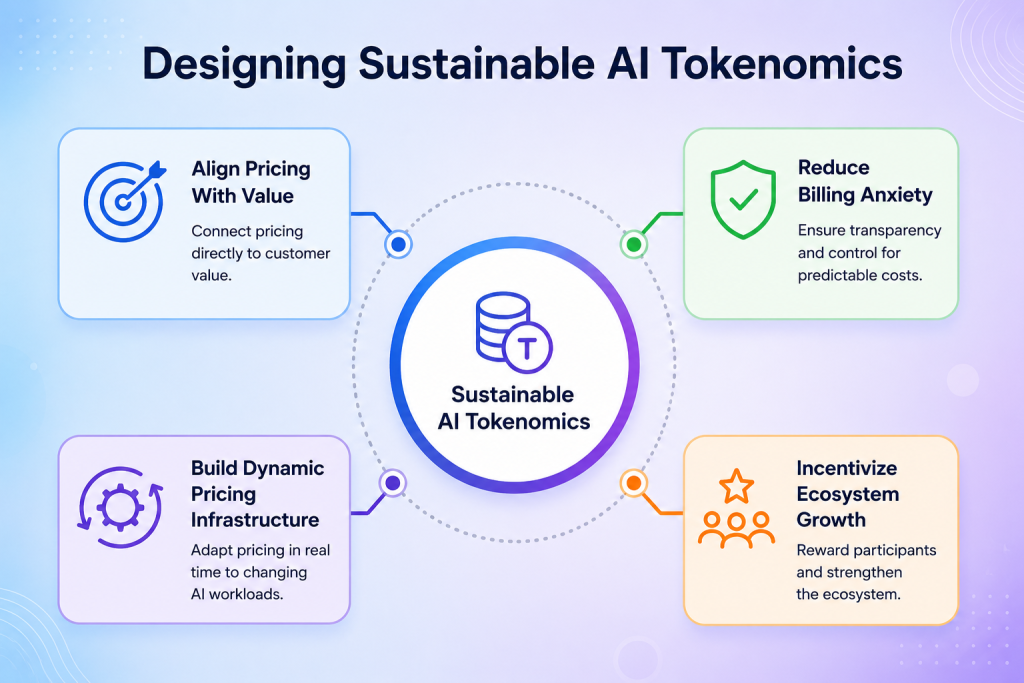
3. Build Dynamic Pricing Infrastructure
AI workloads are highly dynamic and constantly change depending on factors such as model complexity, latency requirements, context size, GPU demand, agent orchestration, and API integrations. Because of this, static pricing systems are often unable to support evolving AI infrastructure requirements efficiently. AI marketplaces need flexible and dynamic pricing infrastructure capable of adapting monetization rules in real time based on changing workloads, compute consumption, and customer usage patterns. This allows platforms to optimize operational efficiency while maintaining scalable and sustainable pricing models.
4. Incentivize Ecosystem Growth
Strong AI marketplaces are built around active ecosystems that include developers, AI model creators, workflow builders, integration partners, and other contributors. To encourage innovation and long-term platform growth, marketplaces should implement incentive systems that reward ecosystem participation and value creation. These incentives may include revenue sharing, referral commissions, usage rewards, contributor bonuses, and token-based rewards. Well-designed ecosystem economics help attract more contributors, improve platform engagement, accelerate innovation, and strengthen the overall marketplace network effect.
Conclusion
The future of AI marketplaces extends far beyond traditional subscription pricing models. As AI systems become more compute-intensive, autonomous, workflow-driven, and outcome-oriented, marketplaces must adopt monetization systems capable of aligning infrastructure costs with measurable customer value.
Usage-based pricing, tokenized billing systems, workflow monetization, compute-based pricing, and success-fee tokenomics are rapidly becoming the foundation of next-generation AI business ecosystems.
The AI marketplaces that succeed in the coming years will be those that build scalable, transparent, flexible, and customer-aligned economic systems capable of supporting the rapidly evolving world of intelligent AI services and autonomous digital labor.
FAQ's
1. What is usage-based pricing in AI marketplaces?
Usage-based pricing is a monetization model where customers pay based on actual AI resource consumption instead of fixed monthly subscriptions. Pricing may depend on factors such as tokens processed, API calls, workflow executions, GPU usage, storage consumption, or AI agent activity. This model helps AI marketplaces align revenue with infrastructure usage and customer demand more accurately.
2. Why are AI companies moving beyond subscription pricing?
Traditional subscription models often fail to cover the highly variable infrastructure costs of AI systems. AI workloads can differ significantly between customers depending on model complexity, workflow intensity, and compute requirements. Usage-based and success-driven pricing models provide better scalability, cost recovery, and revenue alignment for modern AI platforms.
3. What is the difference between token-based pricing and credit-based pricing?
Token-based pricing charges customers directly based on AI token consumption during interactions, while credit-based pricing converts technical infrastructure usage into simplified marketplace credits. Credit systems are generally easier for non-technical users to understand because they abstract complex compute costs into standardized usage units.
4. What are the advantages of success-fee tokenomics?
Success-fee tokenomics allows businesses to pay only when measurable outcomes are achieved, such as successful sales conversions, completed transactions, or resolved customer support cases. This model improves customer trust, reduces financial risk, simplifies ROI justification, and creates stronger alignment between platform performance and business value.
5. What challenges do AI marketplaces face with usage-based pricing?
One of the biggest challenges is billing unpredictability. Customers may struggle with budget forecasting, cost estimation, and fluctuating AI usage costs. AI marketplaces also face technical challenges related to infrastructure scaling, workload monitoring, attribution tracking, and real-time pricing optimization.
6. What is the future of AI marketplace monetization?
The future of AI monetization is expected to move toward hybrid pricing models that combine subscriptions, usage-based billing, compute pricing, workflow monetization, and success-based fees. As AI agents become more autonomous, marketplaces may eventually monetize AI labor, autonomous task execution, and AI-to-AI transactions within larger digital ecosystems.